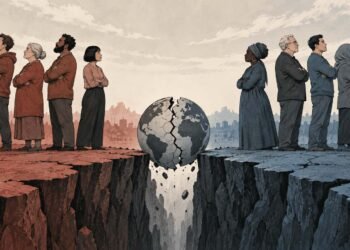

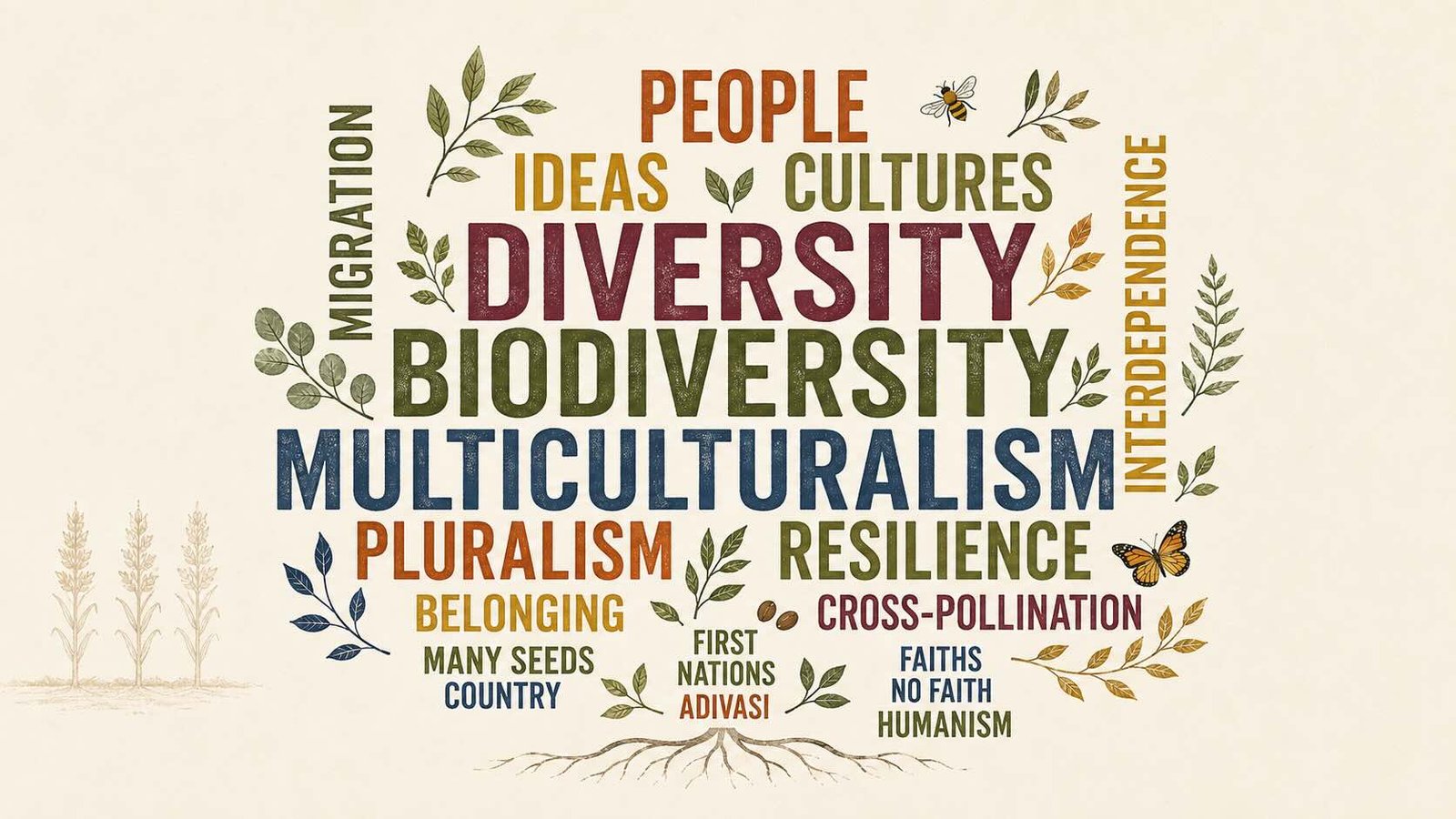
Our recent reflections on the First Nations and Adivasi (Indian’s first peoples) connection to country and land through Reconciliation Week points with clarity at the interconnectedness of human life with all of nature – nature that intrinsically embraces multiplicity and diversity. This is generational wisdom fast receding from the hyper capitalist way of living that tells us – there is only one, narrow extractive way to live. However, our shared wisdom tells us there is another way, a symbiotic way that respects biodiversity, the natural, inevitable migration of life, from microscopic bacteria to seeds, from animal life to human beings.
Poets from the Global South articulate this idea in different ways, some that completely reject static borders. Barbadian poet Kamau Brathwaite introduces the concept of “tidalectics”, which models human identity after the fluid, cyclical motion of ocean water rather than the unyielding, linear borders drawn by modern nation-states. Tidalectics views human migration and cultural blending not as an invasive uprooting, but as a continuous, dynamic tide where diverse cultures splash against new shores, constantly altering and enriching the landscape. Brathwaite’s oceanic framework argues that containing a national identity in a single, unmoving state is an unnatural act that ultimately guarantees its decay.
The Ecological Illiteracy of Monoculture
When Senator Pauline Hanson stands before the National Press Club and declares that Australia “must be mono-cultural,” she advances a proposition that is both ecologically unsound and socially dangerous. Not just poetry (though a legitimate system of knowledge in my books), the scientific consensus is unequivocal: monoculture, whether in agriculture, forestry, or human society is the antithesis of resilience.
This political monoculturalism views diversity as a contaminant, or an invasion that demands static, unyielding borders to protect an artificial cultural purity. Yet, this worldview hinges on a profound ignorance of biological and social realities. Data compiled by the Food and Agriculture Organization of the United Nations (FAO) warns that monocultural ecosystems offer an ideal, vulnerable habitat for pests and pathogens. Because uniform species lack the narrow genetic variations needed to resist systemic shocks, a single disease can decimate them entirely, a lesson historically realized in the catastrophic failures of the Irish Potato Famine and Panama banana disease.
This vulnerability is also what occurs when human systems reject pluralism. Scientific research published in Nature confirms that the stability of any community is positively related to its diversity. Just as a reduced, monocultural gut microbiome leads to internal inflammation and susceptibility to disease, a rigid, monocultural society strips away the intellectual and spiritual variety needed to adapt to a changing world. Monoculture is fundamentally an ideology of control rather than freedom; it is a blueprint for fragility.
This principle extends beyond the farm to the human microbiome. Within each of us resides a vast community of bacteria, fungi, and viruses that outnumber our own cells. A diverse microbiome is a hallmark of health; a reduced one, a monoculture of the gut, is associated with inflammation, autoimmune conditions, and susceptibility to disease. The human body, like human society, thrives on diversity.
The rainforest offers the most powerful analogy. The Amazon is not a single organism but a tapestry of millions of species, each playing a role in a complex web of interdependence. This diversity is what makes the rainforest resilient, capable of withstanding droughts, pests, and other stresses. The loss of a single species can have cascading effects, as the intricate relationships that sustain the ecosystem unravel. A culture that is “one thing” is a culture that cannot adapt. It is a culture that lacks the genetic, intellectual, and spiritual diversity needed to respond to new challenges.
Native and Introduced: A Nuanced Understanding
Critics of diversity and multiculturalism often invoke the language of “native” and “invasive” species to argue for cultural purity. Movements of the far right often garner popular support by evoking the ‘us vs them’ argument. ‘This is our land, our culture. We are being overrun and taken over’. This framework, however, is a poor analogy for human migration and reveals a static, ahistorical understanding of ecological and cultural evolution.
The distinction between “native” and “introduced” is often less about biology and more about the timeline of human observation. Anglo-Australians with their European roots may find it surprising to know that many of the plants we now consider integral to European identity were, in fact, introduced from elsewhere. The tomato originated in the Andes; the potato in the Peruvian highlands; tea in China and Assam. None of these are native to Europe, yet they have become staples of European cuisine, culture, and economic life. They were transplanted, adapted, and, over time, gained wide cultural acceptance. They are now central to the identity of countless societies.
For a country that is built on stolen land, the call for a monoculture shows a profound ignorance of the deep knowledge held by Indigenous peoples in Australia and around the world. For millennia, First Nations Australians and Adivasi communities in India have lived in harmony with their environments, developing sophisticated systems of land management that are fundamentally diverse and resilient.
This process of adaptation is not a threat; it is the essence of cultural and ecological evolution. In the words of poet, Olive Senior, identities appear to grow “as plants… even though they are damaged, the roots remain and can be grafted, replanted, and fertilized into a transcultural being.” This is the reality of diaspora: cultures are not lost but transformed, not erased but enriched. The garden of human culture, like the botanical garden, is a space of grafting, cross-pollination, and renewal, and we are better for it.
The Political Danger of Monoculture Thinking
It is undeniable that the call for a monoculture is historically linked to the most destructive political ideologies of the modern world. Neo-fascist movements, under the banner of the “Third Position,” explicitly advocate for the creation of “monocultural nation states built around the idea of supremacist racial nationalism and/or supremacist religious nationalism.”
We see the danger of this thinking in present day India where some seek to create a monoculture around one narrow definition of the Hindu identity. These ideologies stand at odds with liberal democracy and communism alike in their ethnically homogeneous societies. They view diversity as a threat to their ideal of a “pure” nation, fanning populist fears of a takeover, or cultural dilution and ‘impurity.’ Of course in the Indian context, the idea is furthered by the dynamics of caste oppression that play to a hierarchy of ‘purity’, marked by food, clothing, and degrees of religiosity. The notion of being sullied in some way by the mere presence of the other, who is considered a cultural inferior, is the dangerous path to dehumanisation. It removes even the fig leaf of a perceived threat. The mere existence of the other is the threat.
This thinking is the root of genocide, ethnic cleansing, and cultural erasure as was inflicted upon Australia’s First Nations peoples and its stolen generations. It is the logic of the concentration camp, the forced assimilation, and the border wall. When a political leader claims that Australians must live “under the one cultural umbrella,” they are echoing the language of these movements. They are proposing a society where difference is not tolerated, is seen as dangerous and where the only acceptable identity is a narrowly defined one.
While much has been said about what social cohesion means, this certainly is not a vision for a prosperous, peaceful Australia; it is a blueprint for a police state. The historical record is unambiguous: monoculture thinking, in the political realm, leads to authoritarianism. It is an ideology of control, not of freedom. It is the logic of the garden that has been stripped of its diversity, leaving only the single, vulnerable crop.
Philosophical Foundations: Hindu and Indian Humanist Traditions
In our work, we often return to the philosophical traditions of India, traditions that have long understood the value of unity within diversity. It is what we work hard to incorporate in our interfaith celebrations such as Holi and Diwali. It is what drives us to co-host climate conscious Iftars with our Muslim friends, stand with peacemakers from Palestine and Israel, listen to people from Lebanon and Iran, engage with atheists and humanists, be led by Ambedkarite leaders in our anti-caste work, invite Chirstian, Jewish, Sikh leaders to address our gatherings, and extend our solidarity to refugees and migrants, no matter where they come from.
The concept of Vasudhaiva Kutumbakam, “the world is one family” is central to the Indian civilisational worldview . This is not a call for uniformity but for recognition of the underlying unity that connects all beings. Our vision is lokasangraha (universal common good), a world where there is peace among all people, and our planet is honoured and protected . This commitment to lokasangraha is not abstract; it is manifest in the organisation’s advocacy for pluralism, its opposition to caste discrimination, and its work building interfaith solidarity .
Community Resilience Through Interculturalism
At a time when Indians have become Australia’s largest overseas-born migrant group, reaching an estimated 971,020 residents and overtaking the English-born for the first time, the call for a monoculture is not merely divisive; it is a refusal to recognise the rich gifts that new communities bring. This demographic shift reflects a long-term transformation in migration patterns. Migration from India has grown strongly over the past decade, adding hundreds of thousands of residents through skilled and student pathways, while migration from Europe has steadily declined.
This is not a threat; it is an opportunity that will benefit all of Australia. It is a chance to enrich Australian society with new perspectives, new skills, and new energies. It is a chance to demonstrate that a diverse society is a strong society, one that is better equipped to face the challenges of the twenty-first century.
Apart from political turmoil and wars, we live at a time when climate threats exacerbated by human greed may well turn many of us into climate refugees or forced migrants. The organic reality of human solidarity simply cannot be permanently contained by state lines, a truth immortalized by Palestinian poet Mahmoud Darwish in his poem ‘The Passport.’ Facing the brutal realities of exile, checkpoints, and artificial borders, Darwish turns to the resilient botany of the earth, writing:
“Don’t ask the trees for their names.
Don’t ask the valleys who their mother is…
All the hearts of the people are my identity.”
As Australian society reflects on the idea of what is Australian and who belongs, let us remember that unity is not sameness, that diversity is not dangerous or divisive, and that the recognition of our shared humanity is the foundation for a just and peaceful society.
At Hindus for Human Rights, we reject the politics of fear and division. We reject the false promise of a monoculture. We choose instead the garden of many seeds, where each plant, each culture, each person contributes to the beauty and resilience of the whole. We call on all Australians to embrace this vision, to recognise the deep wisdom of Indigenous peoples, and to build a future where diversity is celebrated, not feared.
It is time to tend the garden, with all our hearts and hands, for us, for the custodians of this land who came before us, and for generations still to be born.