India in the World
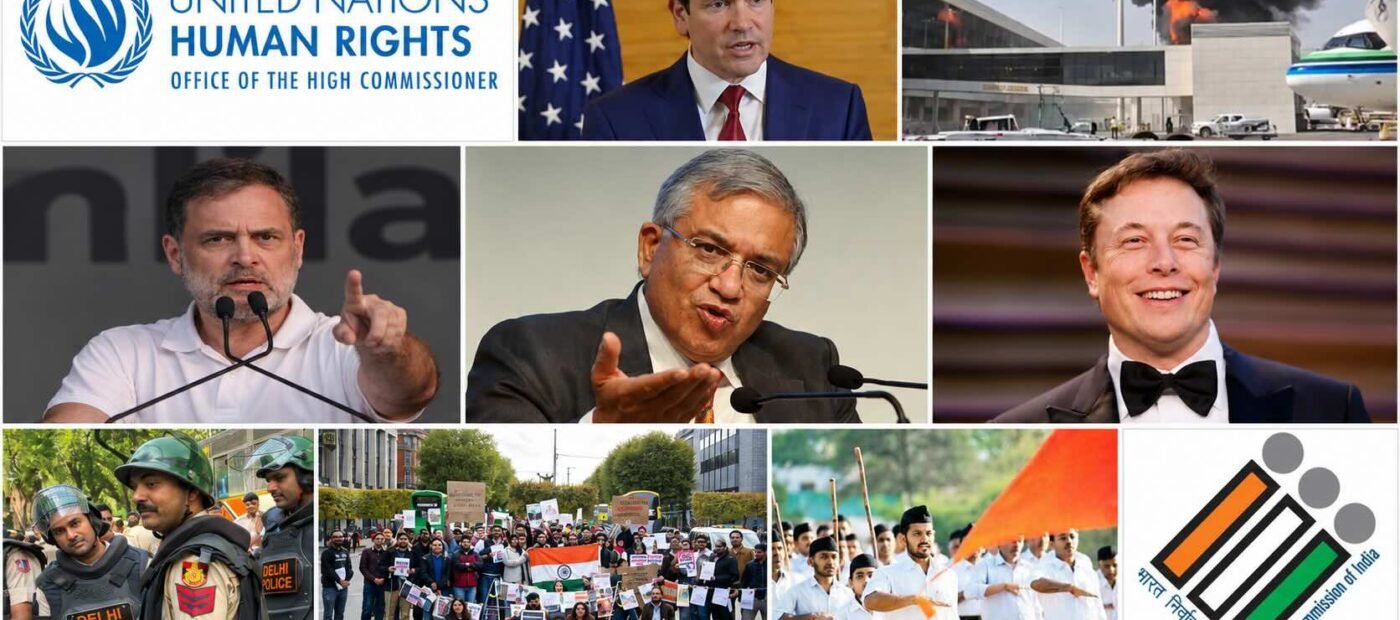
- On the 10th of October, the UN Office of the High Commissioner for Human Rights expressed their concern on “reports of mass detentions in India of demonstrators, protest leaders, members of civil society organizations, lawyers and journalists” in the demonstrations in Delhi. At the time of publishing, 7000 were detained and many beaten and injured as part of the authorities’ actions. UN spokesperson called on Indian authorities to respect the right to peaceful assembly and act considering necessity and proportionality.
- On the 11th of October, India condemned the attack on Riyadh airport, expresses their solidarity with Saudi Arabia and urged its nationals in Saudi Arabia to remain alert and vigilant, while adding that targeting of civilian infrastructure is “completely unacceptable”. IndiGo and Akasa Air both extended the suspension of flights to and from Saudi Arabia until 17th of October, citing the evolving security situation.
- On the 17th of October 2026, solidarity protests were organised in cities in Europe and around the world as part of “Jantar Mantar is everywhere”. Protesters opposed India’s Special Intensive Revision (SIR) of electoral rolls, a process introduced by the Election Commission to verify voter eligibility and remove duplicate or ineligible registrations. Demonstrators called for the resignation of Chief Election Commissioner Gyanesh Kumar, the reversal of the SIR process, and the restoration of wrongfully deleted voter registrations.
- On the 21st of October, US Secretary of State Marco Rubio visited India to discuss a bilateral trade agreement and meet with the chairman of the Adani Group and chief executive officer of the Tata Group.
Civil society, human rights defenders, and journalists
- On the 2nd of October, India’s youth-led Cockroach movement (Cockroach Janta Party (CJP) started a nationwide protest, alleging that millions of citizens were being unfairly stripped from their vote, demanding the resignation of Chief Election Commissioner, Gyanesh Kumar, and seeking electoral reforms over the allegations of manipulating voter rolls.
- On the 9th of October, the Cockroach Janta Party (CJP) accused the government of a mass detention of its members ahead of the protests, as thousands were predicted to demonstrate against changes in voter lists. CJP spokesperson said that “at least 10,000” people from its demonstrations, student organizations, affiliated grassroots groups and political parties were detained across the country. On the 10th, CJP and other student organizations vowed to continue until their demands are met, including the resignation of Chief Election Commissioner (CEC) Gyanesh Kumar. They alleged the manipulation of the voter lists, which the Election Commission denied. Students allege crackdowns on trains, assault and detention from the police as they were traveling, while others allege being taken to unknown locations. Detainees spoke of phones snatched and further violence, being taken to a community center, including minors. Dozens of journalists were detained and harassed as well as they were covering the anti-SIR protests. Opposition parties have demanded the SIR suspended and approach the Supreme Court, asking for the Election Commission of India (ECI) to make their records public.
- On the 9th of October, 19 days into the hunger strike, Aligarh Muslim University (AMU) announced that the Students’ Union elections will be held on the 5th of November. The elections will be held following the student protests demanding the restoration of AMUSU, as the leader, Y. Fahad’s hunger strike for the restoration of campus democracy entered its 19th day.
- On the 24th of October, Jamia Millia students vowed to continue their hunger strike until their union is restored. On the 13th day of their sit-in and hunger strike, they vowed to continue their protest demanding the restoration of the Jamia Milia Islamia Student’s Union (JMISU) until the administration announces a time-bound union election, revokes all disciplinary action, and removes the Chief Proctor and Security Advisor.
- On the 25th of October, eighty-four organizations have demanded the resignation of IIT Bombay Director Shireesh Kedare, accusing the institute of smearing Sahil Wakode as a cheater hours after his death, while shielding a Dean accused of casteism, leaking selective CCTV footage as well as unleashing the police on the students and Sahil’s grieving parents. His parents allegedly filed a complaint against the Dean, Suryanarayana Doolla, and the signatories also held the Director responsible for the recent police action against students.
Hate Crimes and Hate Speech against Minorities
- On the 1st of October, a Muslim man from Bengal was pushed into Bangladesh, despite him having a voter ID and passport, according to his family. He was picked up by Raiganj Police for being allegedly an undocumented Bangladeshi immigrant and was pushed into Bangladesh. He was detained previously in June, and his family says the police ignored that his name was on the electoral rolls after the Special Intensive Revision exercises.
- On the 4th of October, two Muslim men were killed and three others injured in a mob lynching in West Bengal after being accused of cattle theft. One victim died at the scene, while the second died en route to hospital. The attackers also reportedly set the victims’ pickup van on fire. Separately, on 3 October, the South Asia Justice Campaign’s Election Watch: Uttar Pradesh bulletin reported a rise in alleged anti-Muslim violence between August and September, documenting four suspected religiously motivated killings, 70 Muslims injured in police “half-encounters”, 152 reportedly arbitrary arrests or detentions, and 21 incidents of hate speech, including ten allegedly involving Chief Minister Yogi Adityanath.
- On the 11th of October, at least nine people were killed in a fresh outbreak of violence in Manipur. The attacks were on civilians and village guards, gunfights and arson raising tensions between Kuki and Naga communities. Kuki groups accused Nga armed groups of involvement in the attacks on Kuki civilians, as the reports from the are attributed attacks on Naga settlements to suspected Kuki militants.
- On the 11th of October, a Hindutva mob claiming to be journalists have allegedly surrounded and harassed Maktoob journalists Fida Fathima and Nada Saeeda, as well as independent journalist Akhtarisa Ansari, and hurled Islamophobic slurs at them during the protests against the Special Intensive Revision (SIR) of electoral rolls and Chief Election Commissioner Gyanesh Kumar in Delhi.
- On the 14th of October 2026, students at Jawaharlal Nehru University (JNU) in New Delhi organized a march marking ten years since the disappearance of Najeeb Ahmad, a Muslim student who went missing on the 15th of October 2016, following an alleged assault by members of the right-wing student organization ABVP. The demonstration demanded accountability from investigating agencies and university authorities. Student groups alleged that institutional failures, anti-Muslim discrimination and misleading narratives surrounding the incident had obstructed justice.
Religious Freedom and Minority Rights
- On the 5th of October, tribal students in Maharashtra had marched to Mumbai to protest delays in scholarship payments and demand better living conditions in government-run hostels and residential schools. According to the opposition Congress party, police detained several students at around 3 a.m. after they had spent more than ten days protesting. The party accused authorities of intimidating the students rather than addressing their demands for financial support and basic facilities.
- On the 7th of October, police in Hyderabad registered a case against a local representative of India’s ruling Bharatiya Janata Party (BJP) for allegedly attempting to remove 30 Muslim voters from electoral rolls. The representative reportedly submitted pre-filled forms requesting their removal, despite election officials confirming that the individuals were legitimate residents. BJP representatives denied the allegations. The incident raised concerns about the potential misuse of voter registration procedures and the protection of minority voting rights.
- On the 9th of October, Delhi Police officers were accused of visiting mosques and Muslim-majority neighborhoods to discourage participation in planned demonstrations against India’s electoral roll revision process. The allegations raised concerns about religious discrimination and restrictions on freedom of peaceful assembly.
- On the 9th of October, four Bengali Muslim migrant workers were reported released after spending more than a month in detention in Chhattisgarh over suspicions that they were undocumented Bangladeshi migrants. The Calcutta High Court had questioned the authorities’ decision to pursue citizenship proceedings while the men’s appeals against their removal from electoral rolls remained unresolved. Their release raised wider questions about due process, arbitrary detention and the treatment of Muslim migrant workers.
- On the 20th of October, three Christian families in Paschim Medinipur, West Bengal, reported being assaulted, threatened and forced to participate in Hindu religious conversion rituals by alleged members of Bajrang Dal, a Hindu nationalist organization. Women and a minor girl were subjected to alleged sexual harassment and physical violence, while families accused local police of failing to provide adequate protection.
Internet and Technology
- On the 3rd of October, BitChat was removed from India’s App Store following a reported government blocking order. Digital rights groups SFLC.in and IFF criticised the lack of transparency, noting that neither the order nor its legal basis had been disclosed and that developers were not given a chance to respond before the app was blocked.
- On the 8th of October, BOOM reported that Meta restricted Facebook content from several Bengali news outlets and journalists covering alleged vote-rigging during West Bengal by-elections. Some posts and videos were blocked under India’s IT rules, including a seven-day ban on NBTV Bangla’s page. Meta had not commented.
- On the 10th of October, Elon Musk shared media reports on X concerning the political activities and donations of Reliance-linked companies, amid his dispute with Mukesh Ambani over Starlink’s delayed entry into India. Musk’s posts followed his earlier allegations that powerful business interests were obstructing Starlink’s launch in India.
Political Parties
- On the 5th of October, a BJP leader in Karnataka had requested the removal of 81 people from a draft electoral roll, claiming they no longer lived in the area. According to the Solidarity Youth Movement, all but three individuals on the list were Muslim, and residents said they continued to live locally or in nearby villages. The incident comes amid wider allegations of bulk voter-deletion applications during the Special Intensive Revision (SIR) of electoral rolls. The organisation called for a special task force to investigate possible targeting of Muslim voters.
- On the 12th of October, opposition leaders from the INDIA bloc marched towards the Supreme Court in New Delhi to challenge alleged irregularities in the Special Intensive Revision of electoral rolls. Led by Rahul Gandhi and Congress president Mallikarjun Kharge, the alliance submitted a joint petition calling for the exercise to be suspended and independently audited.
Police and Authorities
- On the 4th of October, three journalist alleged sexual harassment by Delhi Police while covering the Jantar Mantar protest. The Delhi Police said they have transferred the complaints of the journalists to the Crime Branch for an “impartial” enquiry. The accusations by the women journalists include inappropriate touching by the police men, and Aahna Singh, student and activist claimed that the police were resorting to “brutality” at the protests.
- On the 8th of October, several senior Telangana Congress leaders were detained by the police, as they were attempting to march towards Lok Bhavan in Hyderabad, demanding the resignation of Chief Election Commissioner Gyanesh Kumar.
- On the 11th of October, protesters detained during anti-SIR demonstrations in New Delhi alleged physical assaults by police while being transported in police vehicles. Several women reported being struck on their breasts and genital areas, while others said their phones were confiscated. Detainees were reportedly transported to Pandwalan Khurd, approximately 40 kilometres from central Delhi.
- On the same day, police in Panaji, Goa, denied permission for a Cockroach Janta Party (CJP) and expressions of support for imprisoned activist Umar Khalid. Seven protesters were detained before the Bombay High Court at Goa ordered their release, questioning the legal basis for their detention.
- On the 16th of October, Rahul Gandi and other Congress leaders were released after being detained by the police. The Delhi Police detained around 260 people previous on the 6th of October, including 10 Members of Parliament during a protest march by the INDIA bloc. Targeting the Prime Minister, Union Home Minister and the RSS chief, Gandhi alleged that the country had been “hijacked” with the “vote chori”.
- On the 23rd of October, Rashtriya Swayamsevak Sangh (RSS) -affiliated trade union Bharatiya Mazdoor Sangh (BMS) opened its maiden public office in South Kasmir, in Pulwama district. The new BMS office was inaugurated at a time when BJP and RSS-affiliated organizations are trying to expand their organizational presence in Kashmir. The ruling National Conference’s spokesperson said that the RSS is a fascist organization built on the premise of minority hatred.
- On the 24th of October, security forces fired tear gas on a peaceful bandh by Adi Indigenous protesters in Arunachal’s Siang region, against the Siang Upper multipurpose Project, as well as the detention of 10 anti-dam activists, injuring many, before the protest turned violent. Four of the anti-dam activists have been slapped with the Arunachal Pradesh Unlawful Activities (Prevention) Act, 2024 (APUAPA).
Judiciary
- On the 5th of October, the Supreme Court emphasised that the name of a voter once entered in the electoral rolls cannot be deleted without notice and an opportunity of hearing, unless the voter is deceased. Justice Bhuyan highlighted that Section 22 of the Representation of the People Act, 1950 allows for the deletion of an entry in the voters’ list only after the voter was given a reasonable opportunity of being heard.
- On the 10th of October, a Delhi court has rejected the Cockroach Janat Party (CJP) legal affairs head Ratna SIngh’s appeal for registration for a First Information Report (FIR) against the police. The appeal to the Saket District Court was the first attempt by the CJP to involve the courts in its detentions or protests.
- On the 12th of October, the Delhi High Court questioned the police over Association for Protection of Civil Rights (APCR) secretary and prominent rights activist Nadeem Khan’s alleged eight-hour confinement to prevent him from attending a peaceful protest. Khan said the incident reflected a disturbing disregard for constitutional safeguards and questioned the independence of the police’s actions.
- On the 13th of October, the Supreme Court temporarily stayed the trial proceedings in the case on criminal defamations against Congress leader Rahul Gandhi for having called describing Prime Minister Narendra Modi “Commander-in-Thief”. The complaint was issued by a worker of the Bharatiya Janata Party (BJP) contending that it lowers the reputation of the ruling party and its members, portraying all BJP members as “thieves”, giving the workers right to initiate defamation proceedings.
Business & Economy
- On the 24th of October, the Indian government announced it had issued digital IDs to 110 million farmers under the Digital Agriculture Mission, achieving its target five months ahead of schedule. The system aims to streamline access to government schemes and services, but has raised concerns about the inclusion of tenant farmers and sharecroppers, data protection, and the accuracy of linked land records.
- On the 27th of October, Calcutta High Court restricted the circulation of a documentary alleging links between Prime Minister Narendra Modi and billionaire Gautam Adani until 31 January 2027. The order followed a ₹50 crore defamation suit filed by Adani Enterprises, which argued that the film presented unsubstantiated allegations as facts.
Compiled by Diaspora in Action for Human Rights and Democracy.