When we were young, a perennial party favourite among uncles and older cousins was to challenge a gaggle of children with a logistical puzzle.
Many will remember it: a tiger, a goat and a bundle of hay. There is a river and a boatman who can carry only one item at a time. How does he get everyone safely to the other side? Leave the tiger with the goat, and the tiger will eat the goat. Leave the goat with the hay, and the goat will eat the hay.
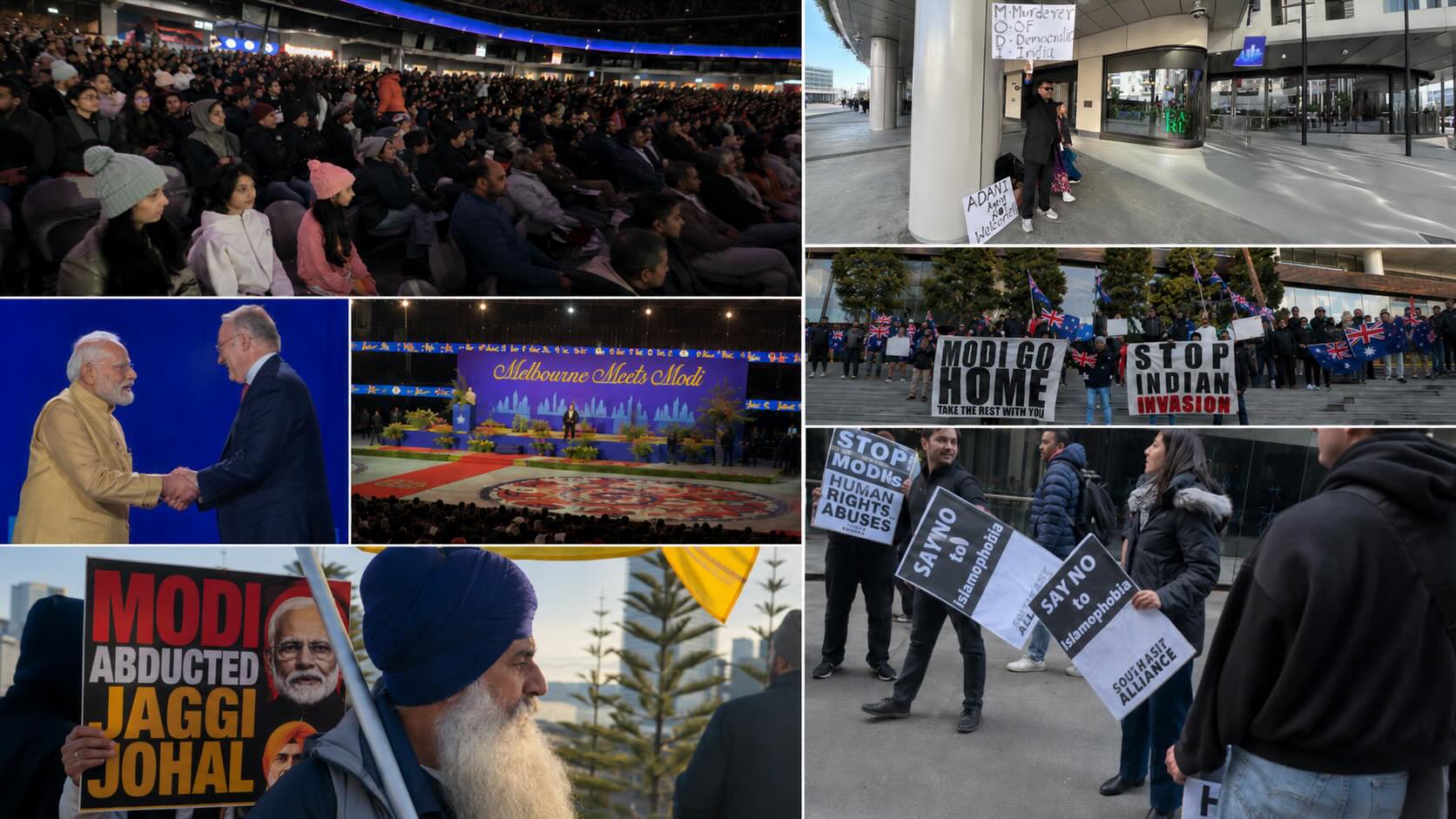
To my mind, it is a fitting analogy for the round-robin mental maps we had to draw as Prime Minister Narendra Modi came to our shores.
Pauline Hanson has a problem with migrants. Migrants are taking over the Australia she knows and loves. Now, she has no problem with big business. Big business is also something she knows and loves. Sometimes migrants bring in big business. Education, Sports. Uranium.
Conundrum.
Neo-Nazis have a problem with migrants. They want a White Australia. They have an even bigger problem with Muslims. Yet some migrants are frontrunners in the “let’s hate Muslims” race. This band of migrants is all for ethno-supremacy and shutting the doors behind them. They are flag-bearers for a minimally melanated Australia.
But they are inconveniently brown.
Conundrum.
Khalistan supporters have a problem with India and its governments, present and past. They believe Modi should be challenged. Progressives also believe Modi should be challenged. They, too, are willing to engage critically with power.
But Khalistan? For many, that is a bridge too far.
Conundrum.
Progressive Anglo-Australians, including parliamentarians who consider themselves progressive, want to champion multiculturalism. Indian Australians are their friends. How dare anyone suggest there might be a vote bank?
But not all Indian Australians support the Indian government. Some do not want to play nice over samosas. They want Australian parliamentarians to ask their Indian counterparts hard questions that extend beyond trade: questions about human rights, press freedom and democratic institutions.
But Diwali is coming up. And elections are approaching in some places.
Conundrum.
The intersections between sections of the wealthy Indian-Australian establishment and the transferable right-wing politics of India are impossible to ignore. But it is com-pli-ca-ted.
Doing the right thing by multiculturalism would mean being willing to hold influential Indian Australians, and the Indian leadership to account. But someone did promise a business jaunt to India, with a significant other, including an Ayurvedic wellness experience over seven days in lush Kerala.
You know, for trade.
Conundrum.
And then there are progressive and liberal spaces themselves. Ideologically, they run from conscious capitalism and the flavour of the season, social democracy, through to purebred socialists, Marxists and anarchists with five-step skincare routines, because even though they are young and have perfect skin, there is also TikTok-induced brain rot.
What do these spaces do with the India question? The Kashmir question? The caste question? The right to sovereignty? A country’s right to pursue an independent foreign policy – but also, can we please agree about China and Russia?
How progressive is progressive enough? Where is the starting line? What are the non-negotiables?
Conundrumz: the pluralism of problems.
Through all of this, the drums beating steadily for peace, truth and justice, but mostly for people not to be terrible to one another carry another rhythm of rebellion.
What if the most radical thing we can do is simply and obstinately refuse to hate, while steadily working to create a world in which everyone belongs?
And so we cross the waters, even though they churn, the stones beneath us have sharp edges and we cannot be entirely sure of the way.
Even so, we grasp the tiger in one hand, the goat in the other, balance the bale of hay on our heads, hold the phone between our teeth, and cross.
It is not always simple to get everyone across choppy waters together. Some have more power, some less. Some are hungrier than others. The path can be difficult, frustrating and uncertain.
But it is still simpler than having many people to hate all at once, and then having to sift through them to find our friends.
It is simply simpler to care. To show up for one another. To understand that movements for justice are interconnected, and to keep the main event the main event.
We work for a world in which people can live with dignity, not according to some strange arithmetic in which one plus one equals eleven, but according to what is.
And what is was not always so. Nor need it remain so forever.

Nandini Sen Mehra
Nandini Sen Mehra is Culture Editor at NRI Affairs. She is an Australia-based poet and writer with an abiding curiosity about the human condition, the natural world, and the underlying interconnectedness of all things. Nandini is also with Hindus for Human Rights Australia and works across interfaith solidarity, human rights and social justice. She can be followed at nandinisenmehra.substack.com
More stories by Nandini Sen Mehra