


Census night falls tonight, 11 August 2026, and a petition asking the Australian Bureau of Statistics to “include Hindi as an option” in the form has passed a thousand signatures. The petition is aimed at the wrong target, and it is right about the wrong thing.
It is aimed at the wrong target because Hindi is not excluded from the Census. The 2026 form offers a short pick list of tick boxes, Mandarin, Arabic, Vietnamese, Cantonese, Punjabi and Greek, and then a free text field for everything else. That list is not a judgement about which languages matter. It is a mechanical reproduction of the six most commonly reported languages other than English from the 2021 Census. Anyone can write Hindi into the box, and 197,132 people did so in 2021.
It is right about the wrong thing because there is a genuine defect in the question, and it has nothing to do with which languages appear as tick boxes. The defect is that the question permits only one answer.
What the ABS instrument actually does
The ABS is entirely open about this. Its own Census Dictionary describes the variable, Language used at home, as one that “records the main non-English language which is used”. Under the heading Data use considerations, it states plainly that “this question only allows for one answer”.
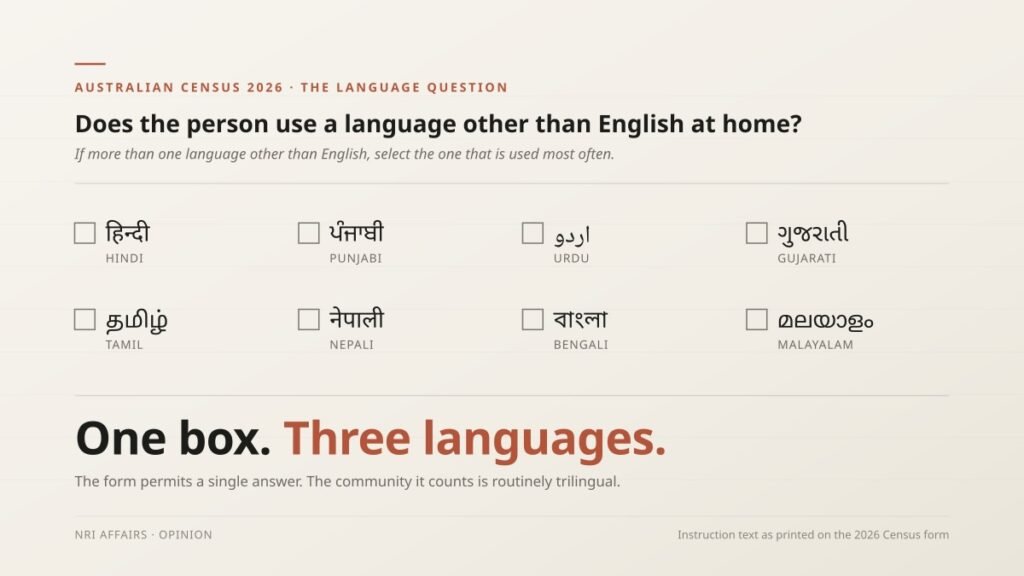
The processing rule is more revealing still. The ABS explains that “when a person marks more than one language or marks a language and gives a text response, responses are accepted in the order they appeared on the form and the extra response is rejected”. A household that ticks Punjabi and then writes Hindi into the free text field will have the Hindi discarded, because Punjabi appears first on the page. The instruction to respondents removes any ambiguity: if more than one language other than English is used, select the one used most often. And if a person uses only English at home, select “No, English only”, even if they can speak another language.
So the Census does not ask what languages you speak. It asks which single non-English language dominates your kitchen table. For a household where a grandmother speaks Marathi with her brothers and sisters, the parents – raised in Delhi and Bengal respectively – switch between Hindi and English, and the children answer in English with Hindi verbs attached, there is no honest answer. There is only a forced choice.
This is not new, and it is not the product of neglect. It is a design decision with a real purpose. The Census pairs this question with a proficiency in spoken English question, and together they identify households likely to need interpreting support at the front door of a hospital or a Centrelink office. As a screening tool, main language at home does a reasonable job. The problem is that governments and councils then use the same variable as though it were a map of who speaks what, which it was never built to be.
The evidence that the design misfits this population
The country people migrate from counts trilingualism. The country they migrate to does not.
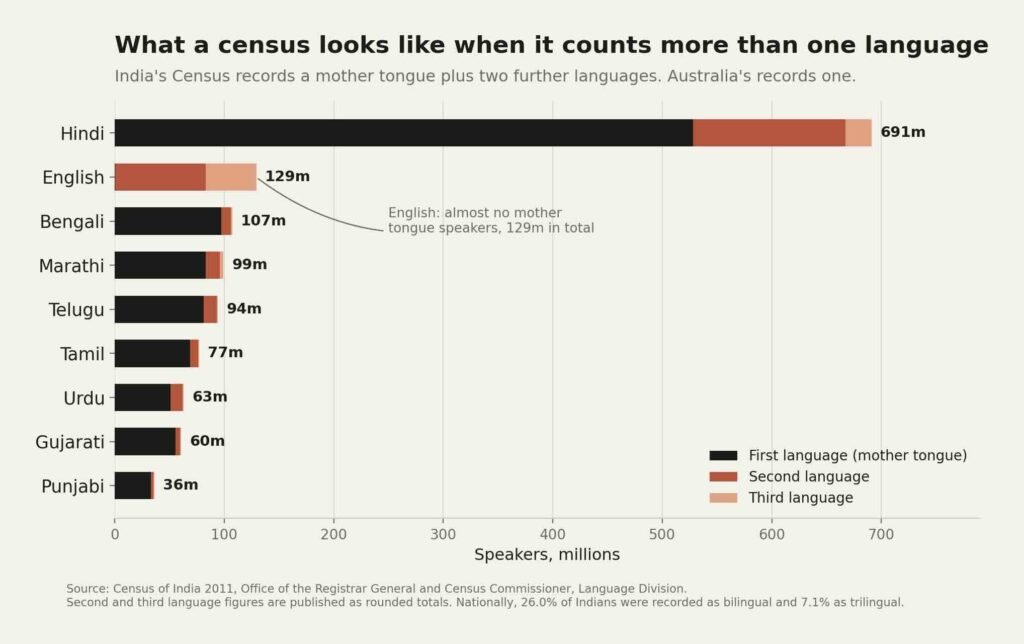
Start with the source countries. India’s 2011 Census recorded 528,347,193 people with Hindi as their mother tongue, 43.63 per cent of the population. It also recorded roughly 139 million second language speakers and 24 million third language speakers, taking the total to about 692 million, or 57.1 per cent. Those second and third language figures exist because the Indian Census asks for a mother tongue and two subsidiary languages, and publishes bilingualism and trilingualism tables from the answers.
That is the sharpest point in this entire debate. The country people migrate from counts trilingualism. The country they migrate to does not.
Honesty requires an important qualification here, because the claim doing the rounds on community pages, that every Indian speaks three languages, is not what the Indian data shows. Nationally, only 26.02 per cent of Indians were recorded as bilingual and 7.1 per cent as trilingual in 2011. In the Hindi belt states, bilingualism runs as low as 10.9 per cent in Rajasthan and 11.45 per cent in Uttar Pradesh.
But Australia does not draw a random sample of India. It draws overwhelmingly from urban, tertiary educated, English proficient populations, which is precisely the segment where trilingualism concentrates. Punjabi with Hindi and English was the second most common trilingual combination recorded in India’s 2011 Census, with about 7.8 million speakers, behind Marathi with Hindi and English. Gujarati with Hindi and English was third. These are not marginal patterns. They describe exactly the communities that dominate recent migration to Australia.
Pakistan tells a parallel story. Its 2023 census put Punjabi at 36.98 per cent of mother tongue speakers and Urdu at 9.25 per cent, yet Urdu functions as the national lingua franca and is understood far beyond that 9 per cent. Pakistan’s census, it should be said, asks for mother tongue alone, so it is no model either.
The natural experiment across the Tasman
New Zealand asks a different question. Its census asks in which languages a person could hold a conversation about a lot of everyday things, and it codes up to six answers per person.
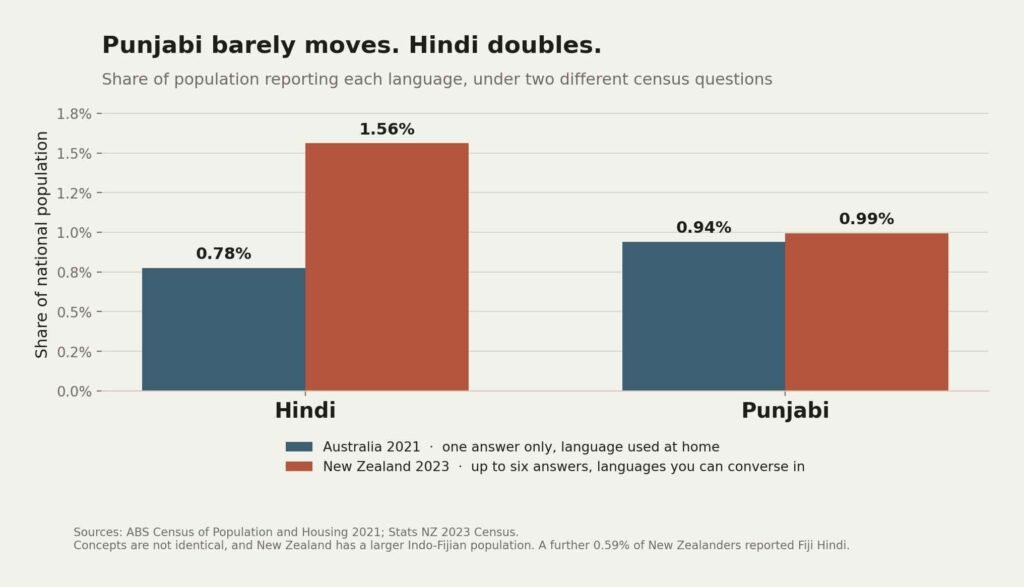
The 2023 results are instructive. Hindi came in at 77,985 speakers, or 1.56 per cent of the population. Panjabi came in at 49,656, or 0.99 per cent. Add Fiji Hindi at 29,406 and the gap widens further. Gujarati recorded 24,195 and Urdu 9,549.
In Australia’s 2021 Census, using a single response home language question, the order is reversed: Punjabi 239,033, Hindi 197,132, Nepali 133,068, Tamil 95,404.
The comparison is not a clean control, and it should not be presented as one. New Zealand’s Indian community has a much larger Indo-Fijian component, its migration mix differs, and conversational ability is a genuinely different concept from language used at home. But that last difference is the entire point. Change the question from which one do you use most at home to which ones can you hold a conversation in, and a language that functions as a bridge moves from fourth to first.
Canada goes further again, asking mother tongue, language spoken most often at home, other languages spoken regularly at home, knowledge of official languages, and, on the long form, knowledge of non-official languages. Four in ten Canadians reported being able to hold a conversation in more than one language.
Australia used to do this
Here is the part that should embarrass the ABS a little. Its own history note on the language variable records that in 1976, Australians were asked for all the languages they spoke. The question narrowed in 1981 to a single home language, and it has stayed there for forty five years while the population it measures has become dramatically more multilingual.
The ABS is plainly capable of allowing multiple answers when it decides a concept warrants them. The 2026 Census expands ancestry from two responses to four, on the reasoning that the existing structure could not capture how people actually identify. Language was explicitly on the list of topics the ABS sought feedback on during phase two of the 2026 topic consultation in 2023, which drew 213 submissions. The outcome for language was a reshuffled pick list and minor instructional wording changes. Ancestry got four boxes. Language kept one.
Why this damages the Census, not just community pride
An agency planning a bushfire warning or a vaccination campaign, reading that 197,132 people use Hindi at home, has no way of knowing that a broadcast in spoken Hindustani would be understood by a substantial share of the 239,033 Punjabi speakers, much of the Urdu speaking Pakistani community, Fiji Hindi speakers, and some Afghan and Bangladeshi audiences as well. The Census gives that agency a fragmented picture and no bridge.
The ABS states that the main language data informs access and equity policy, multilingual resources in health and education, and, in its words, ensuring emergency communications reach non-English speakers.
Consider what a single response variable does to that task. It systematically understates the reach of any bridging language while systematically overstating the isolation of smaller ones. An agency planning a bushfire warning or a vaccination campaign, reading that 197,132 people use Hindi at home, has no way of knowing that a broadcast in spoken Hindustani would be understood by a substantial share of the 239,033 Punjabi speakers, much of the Urdu speaking Pakistani community, Fiji Hindi speakers, and some Afghan and Bangladeshi audiences as well. The Census gives that agency a fragmented picture and no bridge.
The reverse risk is just as real, and advocates for Hindi recognition should say so out loud. If a bridging language were counted properly, a cost conscious department could use it to justify cutting Punjabi, Gujarati, Tamil or Malayalam materials on the grounds that everyone can read the Hindi version. That would be a serious harm. Multiple response is the answer to both problems at once. A Gujarati speaker who currently reports Hindi because it is used most often would be able to report Gujarati and Hindi. Nobody is erased to make room for anyone else.
There is also a script problem the Census cannot see at all. Hindi and Urdu are, in speech, close to a single language written in two scripts, mutually intelligible to the point where many of us code switch without noticing which one we are in. Pakistani community pages are currently arguing over whether to write Punjabi or Urdu, with Sikh and Muslim respondents writing the same spoken language in different scripts. A question about conversational ability, paired with any indication of written literacy, would let agencies distinguish between what can be broadcast and what must be translated twice.
What should actually be asked for
Languages enrich themselves when they keep their doors and windows open. The Census currently asks us to shut all but one, and then reports what it sees through the last remaining window as though it were the whole house.
The 2026 form is locked. Nothing written tonight changes it, and nobody should game their answer in protest. Deliberately misreporting a home language corrupts the very dataset the community says it wants improved.
The realistic asks are these. First, use the feedback field on the back page of the paper form, which invites comment on questions that caused problems. Second, and far more importantly, treat the 2031 topic review as the actual battleground, and prepare an evidence based submission rather than a petition. The ABS assesses submissions against published criteria and asks for evidence of unmet data need, not expressions of sentiment. Councils, health services, ethnic community councils and language schools that cannot currently plan services from Census data are the strongest possible co-signatories.
The substantive proposal is modest: allow multiple responses to the language question, or add a companion question on other languages used regularly, along the lines Canada already runs and New Zealand has run for decades. Retain main language at home as a separate variable so the time series back to 1981 survives intact.
This was raised with the ABS after 2021. It went nowhere. Raising it again as a contest between Hindi and Punjabi will guarantee it goes nowhere again, because a statistical agency has no reason to adjudicate between communities and every reason to avoid it. Raised as what it actually is, a measurement problem in which the instrument presumes bilingualism of a population that is routinely trilingual, it becomes something the ABS can act on without taking anyone’s side.
Languages enrich themselves when they keep their doors and windows open. The Census currently asks us to shut all but one, and then reports what it sees through the last remaining window as though it were the whole house.
Sources
- Australian Bureau of Statistics, Census of Population and Housing: Census dictionary, 2021, Language used at home (LANP): https://www.abs.gov.au/census/guide-census-data/census-dictionary/2021/variables-topic/cultural-diversity/language-used-home-lanp
- Australian Bureau of Statistics, 2026 Census topics and data release plan, 25 November 2025: https://www.abs.gov.au/statistics/research/2026-census-topics-and-data-release-plan
- Australian Bureau of Statistics, 2026 Census topic consultation, phase two (outcomes, 12 December 2023): https://consult.abs.gov.au/census/2026-census-topic-consultation-phase-two
- Australian Bureau of Statistics, Cultural diversity: Census, 2021: https://www.abs.gov.au/statistics/people/people-and-communities/cultural-diversity-census/latest-release
- Australian Bureau of Statistics, Australia’s population by country of birth, June 2025: https://www.abs.gov.au/statistics/people/population/australias-population-country-birth/latest-release
- Office of the Registrar General and Census Commissioner, India, Language Division, Census 2011 tables C-16 to C-19: https://language.census.gov.in/
- Pakistan Bureau of Statistics, Population and Housing Census 2023, mother tongue tables, as reported by Gallup Pakistan: https://gallup.com.pk/post/37156
- Stats NZ, Languages spoken, 2023 Census: information by concept: https://datainfoplus.stats.govt.nz/item/nz.govt.stats/dcbae0ce-f19e-464c-905f-b7236e10437c
- Stats NZ 2023 Census language counts, via Figure.NZ: https://figure.nz/chart/SmQOXQSp0Pv4H0pC
- Statistics Canada, Dictionary, Census of Population, 2021, language variables: https://www12.statcan.gc.ca/census-recensement/2021/ref/dict/az/definition-eng.cfm?ID=pop034
- Indira Laisram, “Does the Census miss Australia’s Hindi speakers?”, The Indian Sun, 10 August 2026: https://www.theindiansun.com.au/2026/08/10/does-the-census-miss-australias-hindi-speakers/









This writeup provided a refreshing way to understand the issue while browsing online and I look forward to reading more from you