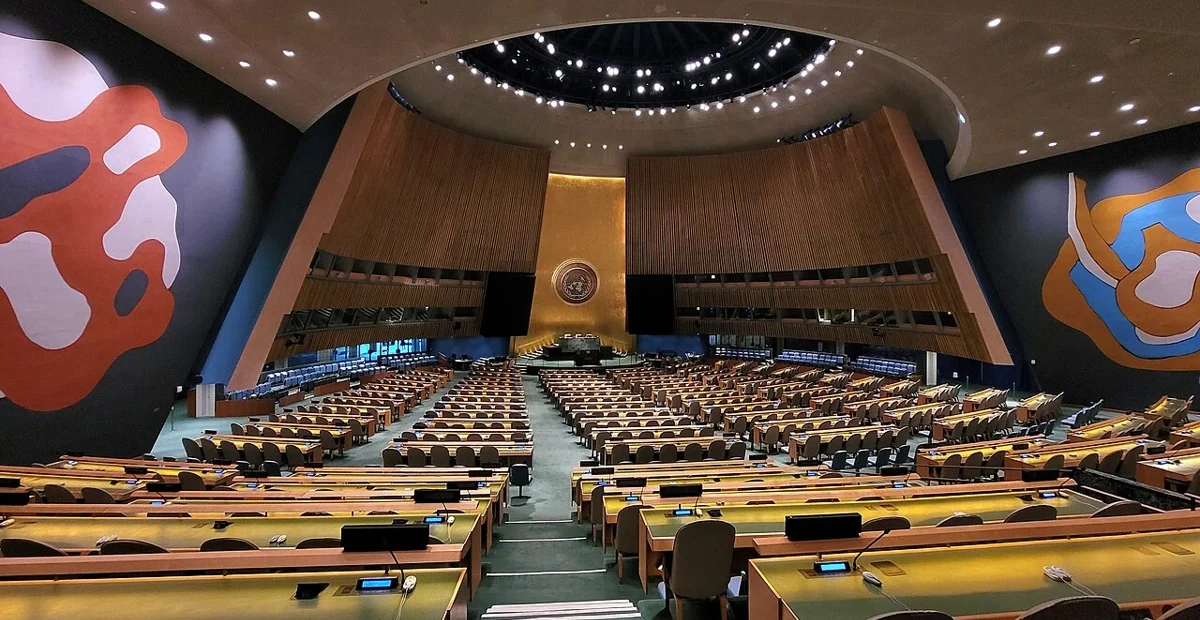
India has asked the president of the UN General Assembly to investigate why its delegation and other countries were excluded from consultations on a resolution concerning cooperation with the Organisation of Islamic Cooperation. The UN-OIC resolution dispute combines an objection to the negotiating process with disagreement over references to documents that India says contain inaccurate statements about its internal affairs. Deputy Permanent Representative Yojna Patel set out India’s position in an explanation of vote dated 16 November 2026.
Her statement published by India’s permanent mission says India voted against draft A/81/L.13. It challenges the way successive versions were circulated and asks for action to prevent a recurrence.
The European Union has separately complained that it and several member states were left out of relevant communications. Its objections also concern language about Cyprus, illustrating that the dispute involves different national concerns rather than a single disagreement shared by every delegation.
What is India’s objection to the UN-OIC resolution process?
India says delegations with differing positions were deliberately excluded from consultations and from the circulation of successive drafts.
Patel argued that disagreement cannot justify leaving member states outside negotiations on a General Assembly matter. She said some countries raised objections but were still not included in later rounds, and challenged the suggestion that the changes amounted only to a technical update.
India’s statement directs criticism at the facilitator’s working methods and the OIC observer mission’s circulation of drafts. It asks the Assembly’s president to investigate the process.
That is India’s account of what happened. The published statement establishes the objection and the request for an investigation; it does not itself establish that the Assembly has completed an inquiry or reached a finding against the facilitator.
Why does the content of the resolution concern India?
India objects to references that it says import politically motivated claims about its internal affairs into a text on institutional cooperation.
Patel specifically challenged references to the ninth OIC Ministerial Conference on Women, held in Islamabad in July 2026. India rejected the declaration and omnibus resolution from that meeting, saying the OIC platform had been used for accusations against India.
The OIC’s official conference page confirms that the meeting was held on 12–13 July 2026 and lists its declaration and report. The conference’s stated remit concerned women’s empowerment across member countries.
India’s objection concerns the political content it says was incorporated into those outcomes, rather than the existence of international cooperation on women’s rights. Its statement also disputes an expanded OIC role in resolving other conflicts.
Patel argued that the interests of citizens should be protected by their sovereign states regardless of faith. That is a diplomatic position advanced by India, not a finding by the United Nations about every OIC activity.
What is an explanation of vote?
It is a delegation’s account of why it supported, opposed or abstained on a text. It records that government’s reasoning. It is separate from the adopted resolution, a formal investigation and a judicial decision.
What has the European Union said?
The EU says the negotiations lacked transparency and excluded it and several member states from communications despite requests to participate.
In an official explanation and right of reply delivered by Ireland, dated 16 November, the EU said it had submitted comments on an initial draft on 14 September but its concerns had not been meaningfully resolved.
The same statement supports constructive UN-OIC cooperation on peace, security and human rights. It identifies cooperation concerning the Rohingya and other minorities in Myanmar as one area of common work.
The EU therefore distinguishes its support for cooperation between the institutions from its criticism of this particular process and text. That distinction helps explain why a delegation can object to a resolution’s drafting without rejecting all engagement with the organisation concerned.
How does Cyprus enter the dispute?
The EU objects to language linked to the OIC Programme of Action that it considers inconsistent with UN resolutions on Cyprus.
Its statement cites Security Council resolutions 541 of 1983 and 550 of 1984 and reaffirms recognition of the Republic of Cyprus. In a separate right of reply to Türkiye, the EU rejected attempts to legitimise the self-declared administration in the north of the island.
That exchange concerns the long-running Cyprus dispute. It is not the same substantive objection raised by India over references concerning its internal affairs, even though both appear alongside complaints about the negotiating process.
The distinction is necessary when describing an apparent grouping of countries opposed to a text. Delegations can reach the same voting position for different reasons, and their explanations should be represented separately.
What is the OIC’s stated role in this discussion?
The Organisation of Islamic Cooperation is the international body with which the resolution seeks to frame UN cooperation.
Its July conference materials present women’s social, economic and political empowerment as the meeting’s purpose. The EU’s statement acknowledges areas of constructive cooperation with the organisation, while India contests references and activities it considers outside an appropriate mandate.
Those institutional aims do not answer India’s allegation about exclusion from consultations. The negotiating-process complaint requires its own response from those involved and, if pursued, consideration by the Assembly’s leadership.
The materials verified for this account do not provide a direct answer from the facilitator to Patel’s specific allegation. No response is being inferred from the absence of one in those materials.
How did Pakistan describe the conference outcomes India disputes?
Pakistan’s government presented the July conference as a programme for women’s empowerment and digital inclusion, while endorsing political language on Kashmir that India rejects.
A Ministry of Information and Broadcasting account dated 14 July 2026 says the Islamabad Declaration sought wider participation by women in political, economic and public life. It described measures concerning education, employment, finance and women-led businesses.
The same account announced an Islamabad Initiative on Women’s Digital Inclusion, a voluntary platform covering digital literacy, entrepreneurship, science and technology skills, cybersecurity awareness and access to technology. It invited support through training, scholarships and mentorship.
It also said the declaration expressed solidarity with women and girls in Palestine and Jammu and Kashmir, using Pakistan’s description of the latter territory. India rejects that characterisation and the political references incorporated in the conference outcomes.
These are conflicting diplomatic positions, rather than a shared description of Kashmir’s status. The conference’s social-policy programme supplies context for the document; it does not remove the substantive dispute over its political language or answer the allegation about later UN consultations.
Which documents should readers distinguish?
The July conference outcomes, the later UN cooperation text and the delegations’ explanations are separate records in the dispute.
| Record | Relevant date | Role in the dispute |
|---|---|---|
| OIC women’s conference outcomes | Meeting on 12–13 July 2026 | Documents whose political references India rejects |
| India’s explanation of vote | 16 November 2026 | India’s reasons for opposing A/81/L.13 and seeking a process inquiry |
| EU explanation and right of reply | 16 November 2026 | Separate procedural objections and a position on Cyprus |
The distinction prevents the July conference from being presented as a new November event. It also keeps the request for an investigation separate from the underlying political disagreement: a response about consultation methods would not, by itself, resolve the competing positions on Kashmir or Cyprus.
What does this mean for readers following India’s diplomacy?
The dispute concerns India’s participation in international negotiations and the wording endorsed in a multilateral forum.
It does not announce a change to visa eligibility, consular services or residence rights for Indians living abroad. Its significance is diplomatic: India is challenging both how a text was negotiated and what some of its references imply.
Readers comparing accounts should look at the delegation’s actual statement, the resolution text and any response by the Assembly’s leadership. Those documents answer different questions. A political criticism should be attributed to the government making it rather than presented as an established procedural finding.
The issue can be followed alongside international news and reporting on Indian diaspora affairs, with care to distinguish international diplomacy from individual rights and services.
What happens next?
India has asked for an investigation into the consultation process and measures to prevent future exclusions.
A response by the General Assembly president, an account from the facilitator or a change to future negotiating arrangements would be the next substantive development on that complaint. Any such response would need to be assessed separately from the competing positions on the resolution’s content.