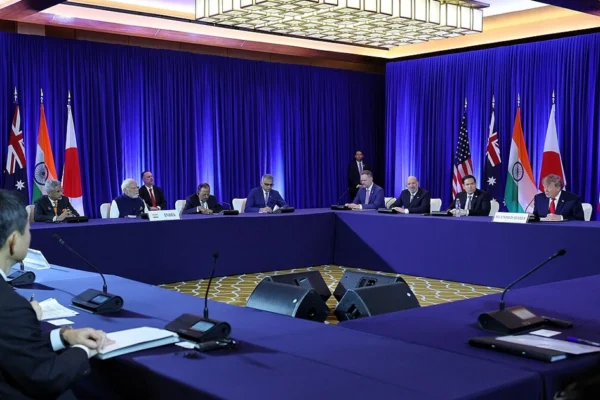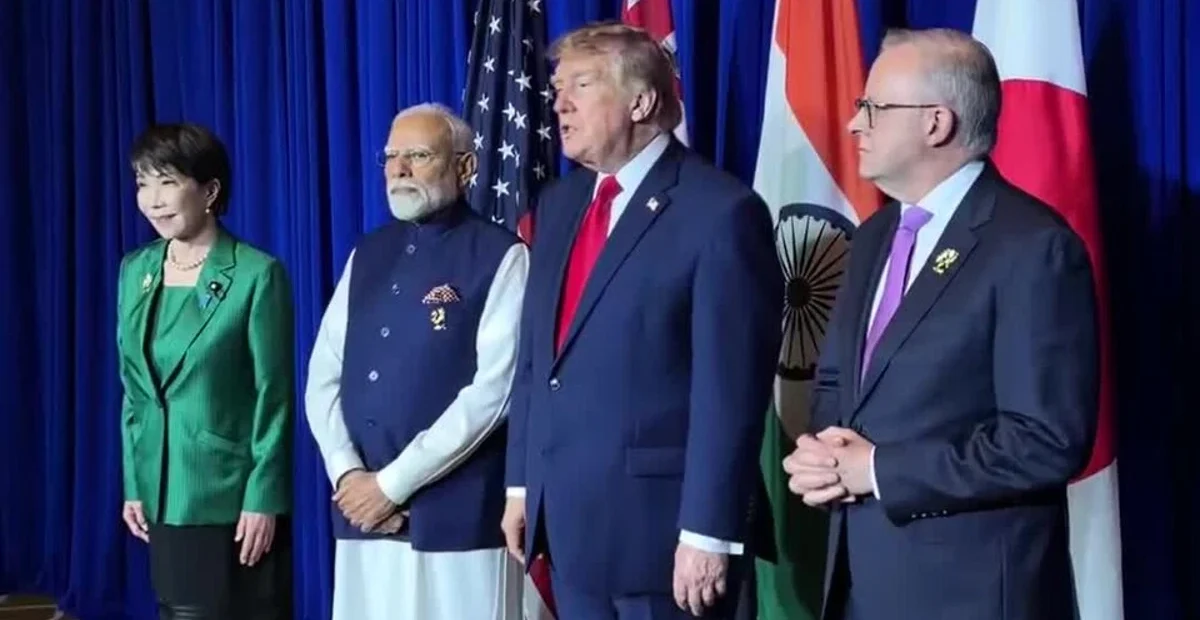
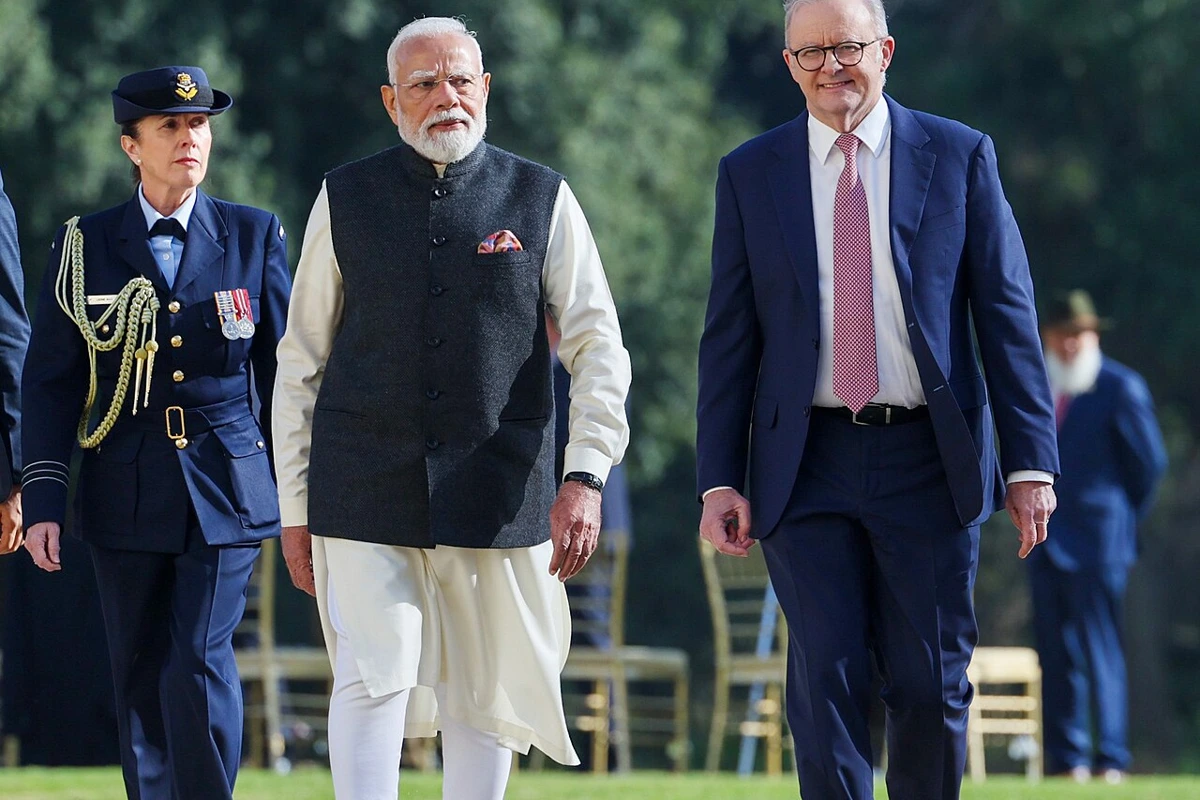
An exchange before the Quad leaders’ meeting in Manila has reopened debate about Narendra Modi’s engagement with unscripted questions, after the Indian prime minister suggested moving on while Donald Trump continued speaking to reporters. The Modi Manila photo-op took place on 17 November 2026 alongside Australian Prime Minister Anthony Albanese and Japanese Prime Minister Sanae Takaichi. A short remark by Modi, asking whether the leaders should move, became the subject of criticism by opposition politicians and competing interpretations online.
The White House’s full recording of the photo opportunity provides the event’s setting. It is separate from the formal four-country meeting and its agreed outcomes.
The exchange establishes what happened publicly. It does not establish a private motive for Modi’s suggestion, and a facial expression cannot prove that he feared a question or wished to avoid a particular subject.
What happened during the Modi Manila photo-op?
Trump took questions from journalists while the other three leaders stood beside him, and Modi suggested proceeding to the meeting.
The moment occurred before the leaders’ substantive discussions. The White House published separate recordings of the photo opportunity and the multilateral meeting, making it possible to distinguish the media encounter from the formal session.
The Indian prime minister’s suggestion did not immediately end the exchange. Trump continued addressing reporters. That sequence is the basis of the subsequent argument over whether the moment was ordinary timetable management or an illustration of Modi’s limited engagement with open questioning.
The competing interpretations should not be confused with the observable event. Descriptions suggesting humiliation, panic or a private rebuke add conclusions that the sequence alone cannot establish.
What criticism has the exchange prompted?
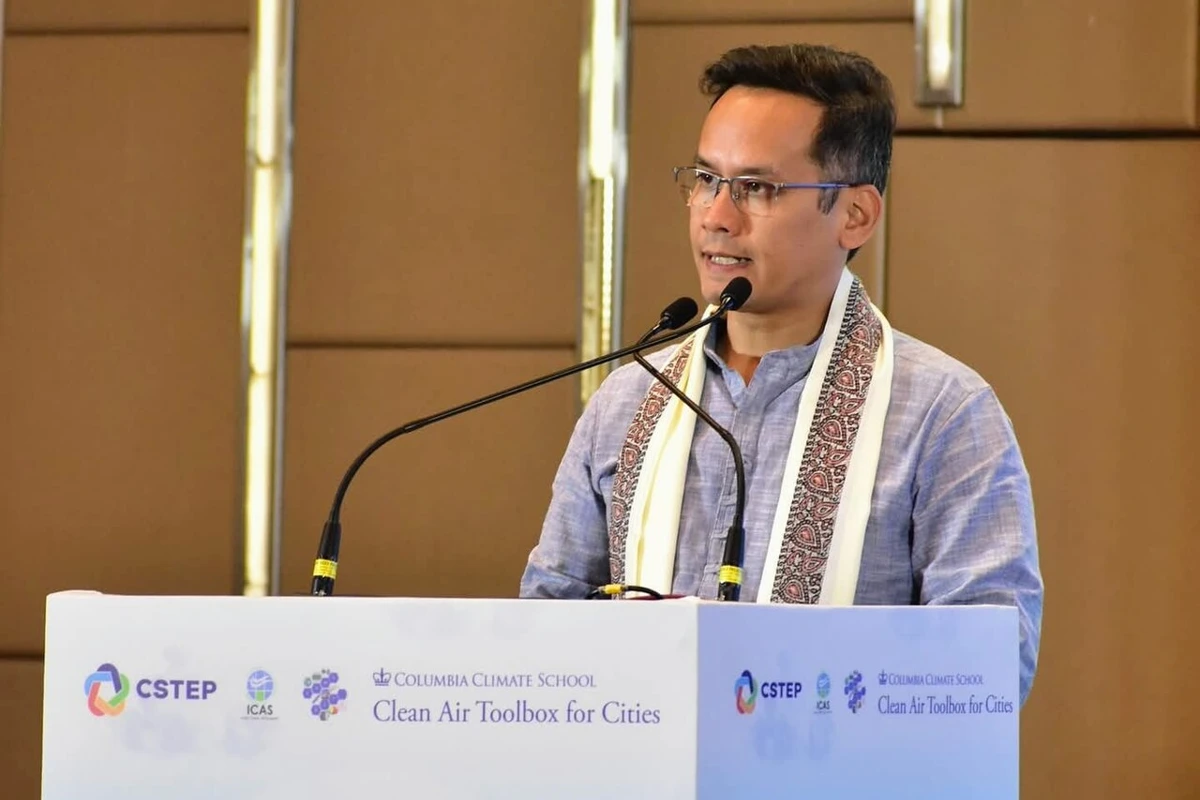
Congress politician Gaurav Gogoi used the moment to criticise Modi’s communication of India’s position on the world stage.
In a public post dated 18 November, Gogoi argued that India needed clearer communication and stronger leadership. His criticism is an opposition political assessment, rather than an official account of the prime minister’s intentions.
Other commentary has treated the suggestion as an attempt to keep the leaders’ programme moving. A schedule explanation and a press-access criticism are different interpretations of the same brief episode. Neither becomes a confirmed motive simply because it is repeated widely.
The government record of the summit concentrates on the meeting and its diplomatic outcomes. No direct explanation from Modi of the brief remark has been verified in the materials used for this account.
Has Modi previously answered questions at a press conference?
Yes. Modi answered questions at a joint White House news conference with then-US president Joe Biden on 22 June 2023.
The official US record of that news conference includes questions on minority rights and freedom of expression. Modi defended India’s democratic record and said the country did not discriminate on grounds including religion and caste.
That dated example matters because an assertion that he has never answered questions at a press conference would be inaccurate. The more specific criticism concerns the frequency and format of unscripted questioning, particularly at home.
The distinction also separates participation in a joint international event from holding a solo press conference. Those are different formats and should not be treated as equivalent evidence about access.
How is a photo opportunity different from a press conference?
A photo opportunity gives journalists access to record leaders together, sometimes with brief remarks or questions. A press conference is organised around an exchange with the press. A photo opportunity can become an impromptu question session, as happened in Manila, without changing the purpose of the meeting that follows.
What did the formal Quad meeting cover?
The formal meeting dealt with maritime security, technology, business cooperation and regional stability.
Japan’s official summit account dates the discussion to 17 November and says it lasted approximately 90 minutes. It identifies the leaders and records discussion of the East and South China seas and the situation around Iran.
The joint programme included plans for a 2027 business forum and a maritime exercise, alongside work on cables and cybersecurity. Those are substantive commitments that should be assessed on their implementation, separately from the controversy over the media encounter.
The episode therefore has two distinct news dimensions. One is how leaders respond to public questioning; the other is what the four governments agreed. A viral extract of the first does not provide a full account of the second.
What can a short clip establish, and what needs more evidence?
A short clip can establish visible actions and audible words, but context is needed to assess timing, sequence and political claims.
The original recording allows viewers to see who was speaking, how long the exchange continued and whether the leaders moved immediately. A caption added by an account sharing the clip is an interpretation, rather than part of the original event.
The same care applies to descriptions of press access. A documented example of answering questions disproves an absolute claim that it never happens. It does not settle a broader criticism about how often it happens or how questions are selected.
What does the more recent White House record show?
Modi also answered reporters at a joint White House news conference with Trump on 13 February 2025, providing another dated example beyond the Biden event.
The official transcript held by the US Government Publishing Office records questions addressed to Modi about subjects including irregular migration and his meeting with Elon Musk. Modi said India would take back Indian nationals living illegally abroad once their nationality was established and called for cooperation against human trafficking.
Those answers belong to the February 2025 event, not the Manila photo opportunity. They show why the historical claim needs precision: the debate is about the availability and form of questioning, rather than the absence of any example of an answer.
The transcript also records reporters attempting to ask questions at the same time. The prepared statements and the question-and-answer portion are distinguishable within the same public record. Both should be examined before describing what access journalists had at that particular event.
That does not settle whether the available opportunities are sufficient. It gives readers a documented starting point for evaluating that argument, with the date, setting and format attached.
Where does the wider press-freedom debate stand?
Reporters Without Borders ranked India 157th out of 180 countries and territories in its 2026 World Press Freedom Index, a separate assessment of the conditions in which journalists work.
The organisation’s India profile and 2026 index place the country below its position of 151st in the 2025 edition. The ranking is an assessment by the organisation, not a judicial ruling on an individual press encounter.
Its relevance is the broader context for criticism of access, safety and institutional conditions. It cannot establish why a leader made a particular remark in Manila, and the Manila exchange cannot, by itself, explain a country-wide annual ranking.
| Record | Date or edition | What it establishes |
|---|---|---|
| Biden-Modi joint news conference | 22 June 2023 | A documented occasion when Modi answered reporters |
| Trump-Modi joint news conference | 13 February 2025 | A later documented question-and-answer event |
| RSF World Press Freedom Index | 2026 edition | India’s position of 157th in an annual comparative assessment |
| Quad photo opportunity | 17 November 2026 | The specific exchange now prompting debate |
These records answer different questions. Keeping them separate avoids using a ranking as proof of an individual’s motive or using one news conference as proof that broader criticism has been resolved.
How has the Indian government described its position?
The government has defended the scale of India’s media and pointed to constitutional and institutional protections for journalists.
In a Lok Sabha reply dated 12 August 2026, Minister of State L. Murugan responded to a question about the 2026 ranking and journalists’ safety. He cited about 81,658 registered printed periodicals and more than 900 permitted satellite television channels, alongside digital publishers.
The reply pointed to Article 19’s protection of speech and expression and the Press Council of India’s role in complaints concerning restrictions, attacks and threats. It also referred to the judiciary’s role in enforcing constitutional provisions.
Those are the government’s stated grounds for its position. The number of publications and channels measures the scale of the sector; it does not directly measure how an individual press interaction is organised. The reply did not provide a specific explanation of the later Manila remark.
The current debate therefore contains distinct positions: critics seek more open scrutiny of the prime minister, while the government points to India’s constitutional framework and extensive media sector. Each claim requires the evidence appropriate to it.
For readers outside India following their prime minister’s overseas engagements, the useful distinction is between a record of the event and a claim about what the event reveals. Political reactions belong in the story, with their authors identified and their conclusions attributed.
What does this mean for readers following the summit?
It means the press-access debate should be read alongside the summit’s official documents, without using either to erase the other.
The Quad’s practical maritime cooperation involving Indian and Australian personnel supplies context for the relationship. Wider international news coverage can track both policy decisions and scrutiny of political leaders.
The Indian connection here is direct: the episode concerns India’s prime minister at an international meeting. No separate claim that diaspora communities have collectively reacted is required, and online commentary should not be presented as evidence that they have.
What happens next?
Any direct explanation from the prime minister’s office would add to the record of the media exchange, while the Quad’s announced programme will be tested through subsequent delivery.
For now, the public video, the dated 2023 press-conference record and the named political reactions provide the basis for a measured account. Claims about private motives require evidence beyond the clip.