Contemporary and progressive political ideologies disdain religion.
People often interpret its nature through ritualistic practices rather than its ethical doctrines and noble ideas.
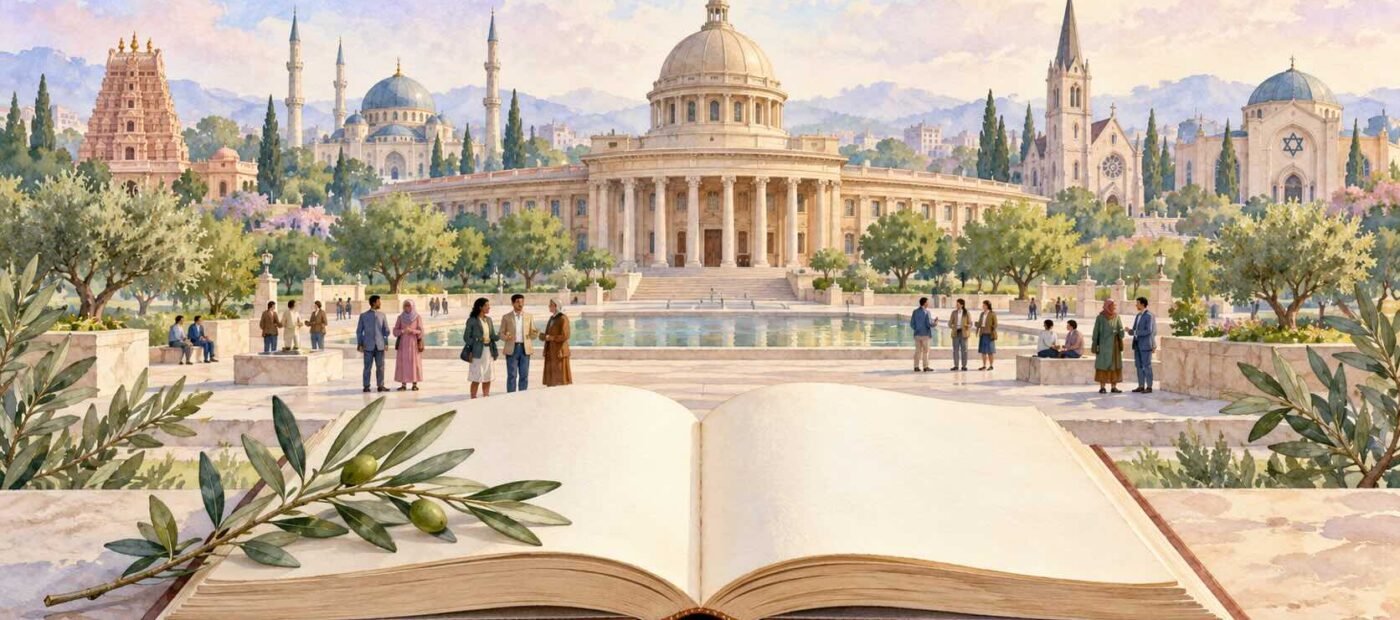
This article examines “politics and religion” and seeks to introduce virtuous, logical, informed, and intelligent religiosity into modern societies’ political constitutions.
The contempt for religion in Communist and democratic-socialist political ideologies is based on a portrayal that usually embodies rituals, customs, and traditions of a religious order.
Religion has become an official or legal taboo in the political and bureaucratic functioning of secular democracies and socialist regimes.
Separation of church, temple, mosque, or synagogue from the state is the byword of the current political thinking.
Although religion has contributed significantly to political science through its philosophies, universal truths, and theories, the two are treated as separate disciplines that influence civil society’s affairs and social character.
Modern political pundits and their students or observers have not gone beyond religious customs and beliefs to explore the intelligence and enlightenment generated over the centuries in discernible interpretations that touch every aspect of human endeavours, including politics.
Philosopher T. S. Eliot “believed that democratic societies rejected the influence of an established church at their peril, for in doing so, they cut themselves off from the kind of ethical wisdom that can come only from participation in a tradition. Thus, he argued, such a society would degenerate into tyranny and/or social and cultural fragmentation”. (Source: Internet Encyclopedia of Philosophy, Chapter: Religion and Politics).
Outright purging of religion without recognizing its universal messages of ethical and secular nature has been a significant part of the liberal political appeal.
But this appeal also holds the hyped social impression that “politics is a dirty game.”
The “game” is soiled by evil and corrupt intentions.
That’s why politics becomes “dirty,” since ethics are either optional or non-binding.
“Politics and religion must be kept separate” is an acknowledged doctrine in secular and democratic-socialist systems. But most religions contain elements that are liberal, secular, and democratic.
For these reasons, politics can incorporate religion. The latter can keep its sanctity if the “dirty politics” stay out of it.
The fact is, the laws of the land, with their universal application, have been shaped by religious teachings to institute political ideologies.
Obama states, “The Majority of great reformers in American history were not only motivated by faith but repeatedly used religious language to argue for their cause.”
Nevertheless, religion does not fit well with progressive political behaviour. Instead, it is seen as meddling in the affairs of a political system.
In secular societies, demarcations have been made to separate the functioning and observance of religious customs and traditions from political entities.
However, religion still enjoys certain privileges and rights besides its deep roots in people’s psyches, influencing public opinion.
But as long as religion exists with its antiquated, irrational, and irresponsible rituals, customs, traditions, and beliefs, an intelligent society will not accept them as part of its political culture.
Moreover, as societies become increasingly culturally pluralistic, religious representations in rituals are not acceptable in non-cohesive populations.
In this scenario, senseless convictions and ceremonial rituals, customs, and traditions must be disqualified from a political discipline. Instead, let religious doctrines based on ethics and moral values support and enrich political ideologies.
Politics generally is not, and should not be, confined to skills and strategies to seek or manage power.
Beyond governance, it should also aim to guide people, drawing on the conscientious and sociological logic religion has offered over the centuries.
In fact, religion began as a socio-political movement from its very origin.
Essentially, religion is a code of conduct for a civil society. It all started from here.
As society progressed, the code of conduct evolved, expanding and formalizing.
As civilization started taking root, the management of society began.
The origin of religion can be traced to human evolution.
Ancient religious orders basically were a set of laws and principles for acceptable behaviour in an emerging civil society.
Later, all aspects of human culture, including presumptions, myths, and nature’s overwhelming elements, were covered in one order. In all these developments, social unity and coherence were advancing society’s natural needs and dependencies.
With an organized collection of beliefs and behaviours, a set of ideas started pouring into this social construction. And with the introduction of the Supreme Being, man’s most intuitive conception or imagery, the assemblage got sanctified.
During this stage of evolution, when spirituality and supernatural elements began dominating religion, its philosophical and learned aspects branched into various faculties.
As such, political science emerged as a separate discipline to guide the management of civil society.
Ethics plays a significant role in developing and disciplining a civic society in this management.
Ethics holds society together.
Ethics delivered through religion has greater acceptance in society than constitutional laws and statutes enforced by political regimes.
Accepting ethics as a theological appeal finds a conscientious stay in people’s minds.
Many statesmen and leaders have effectively advocated religious ethics as part of their political wisdom and temperament to better understand and accept their messages and to underline the importance of faith in civil society’s affairs.
From Mohammad to Abraham Lincoln, and Martin Luther King Jr. to Nelson Mandela and Dr. Ambedkar, all had religious commitments grounded in humanism, love, compassion, and kindness to wage their political and social campaigns against slavery, apartheid, discrimination, inequality, and untouchability based on colour, class, and caste.
Gandhi’s crusade against social evils and his political discourse drew on the Hindu scriptures of the Upanishads, advocating non-violence, truthfulness, self-discipline, compassion, and virtuousness.
Obama, who believes in the power of faith, has sought a “serious debate about how to reconcile faith with our modern, pluralistic democracy.”
He argues, “more fundamentally, the discomfort of some progressives with any hint of religion has often prevented us from effectively addressing issues in moral terms.”
In a public address, he said: “secularists are wrong when they ask believers to leave their religion at the door before entering into the public square.” (“Obama’s 2006 Speech on Faith and Politics”, The New York Times, June 28, 2006, edition).
“Before entering the public square,” Obama demands the infusion of true religion, without its symbolism, into the political environment to establish moral guidelines for its ideologies.
In a world that is politically divided into castes of Leftists and Rightists with sub-castes of Extreme Left and Extreme Right, ideological fanaticism runs high along with elements of power, ego, and greed, which are opportunistically embraced by all political establishments. In this “dirty game”, socialist idealism becomes just sloganeering.
The idiosyncrasy of the present socio-political left and the proper mental constitution is that the leftists have a revulsion for religion. And the rightists are religious fanatics. The former ridicules and rejects religion, and the latter is narcissistically illiterate about it.
This is where the science of politics must step in to explore the true spirit of religion, based on its universal teachings, and find permanent residency in political leadership.
Paved with these divine and acknowledged values, religion offers an ever-guiding relationship with politics in serving humanity and its environment.

Promod Puri
Promod Puri resides in Vancouver, Canada. He is the former editor, publisher and founder of The South Asian Canadian newspaper The Link, published from Surrey, Canada. Puri is the author of ‘Hinduism beyond rituals, customs and traditions’. Websites: promodpuri.com, progressivehindudialogue.com
More stories by Promod Puri