If you are in India and want to apply for an OCI card, the process just became significantly simpler.
The Bureau of Immigration announced on 17 July 2026 that applicants filing for an Overseas Citizen of India card from within India no longer need to submit a Registration Certificate or Residency Permit. These documents, which previously created significant friction for foreign nationals and long-term visa holders trying to apply in-country, have been removed from the mandatory document list entirely.
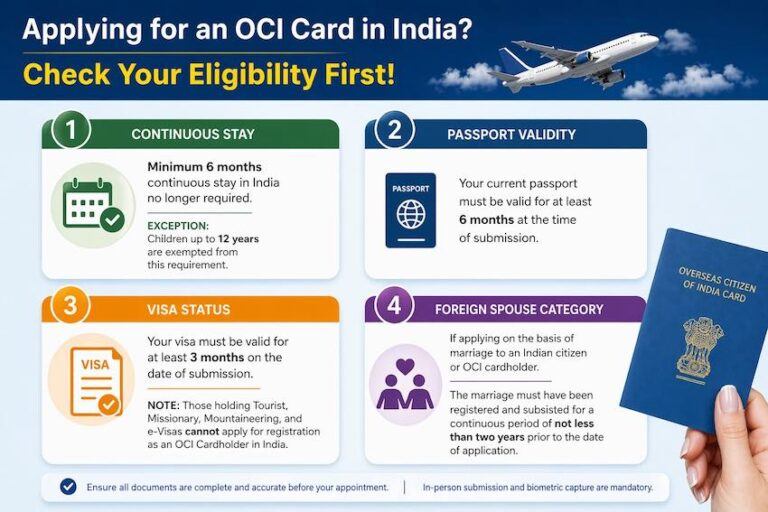
In their place, a single eligibility condition applies: you must hold a valid long-duration visa with at least three months of validity remaining on the date of physical submission of your application at the Foreigners Regional Registration Office.
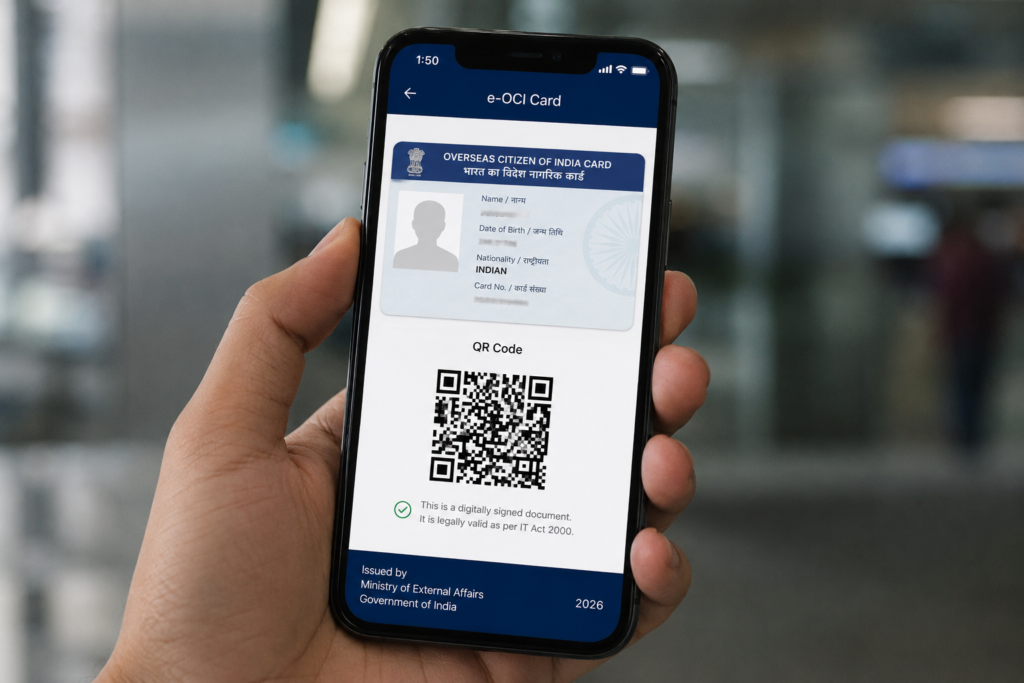
The Bureau of Immigration also confirmed that no physical OCI booklet will be issued under the revised process. All approved applicants receive a digital e-OCI card only, consistent with the digital rollout confirmed at the 30 June 2026 launch of the e-OCI system.
What changed and what stayed the same
The 17 July update is the latest in a series of OCI rule changes the Ministry of Home Affairs introduced in 2026. Understanding what is new in this specific announcement versus what changed earlier in the year matters before you apply.
| Requirement | Old rule | New rule (from 17 July 2026) |
|---|---|---|
| Registration Certificate / Residency Permit | Mandatory for in-country applications | No longer required |
| Visa type required | Specific visa categories; RC/RP as alternative | Any long-duration visa except E-3 |
| Minimum visa validity at application | Not standardised | At least 3 months from date of physical submission |
| Physical OCI booklet | Issued on approval | No longer issued under any circumstances |
| Six-month stay in India before filing | Previously required | Removed in April 2026 MHA overhaul |
| Application date | Varied by interpretation | Confirmed as the date of physical submission at FRRO |
The removal of the six-month continuous stay requirement, which had previously prevented foreign nationals from filing shortly after arriving in India, was part of the broader MHA overhaul in April 2026. The 17 July announcement builds on that change by also removing the RC/RP documentation requirement.
What is an OCI card?
What is an OCI card?
An Overseas Citizen of India card is a lifelong, multi-purpose visa for foreign nationals of Indian origin or those connected to India through marriage or ancestry. It is not citizenship. OCI cardholders can live, work, study and own property in India without a separate visa. They cannot vote or hold government posts. The scheme was introduced in 2005 and has been progressively updated since then. Since the e-OCI rollout in June 2026, the card is issued as a digital credential only. No physical booklet is issued for any new application.
Who this update affects most
The removal of RC/RP as a requirement primarily benefits four groups.
Foreign nationals currently in India on long-duration visas who wanted to apply for OCI but did not have RC/RP documentation can now apply immediately, provided their visa has at least three months remaining.
Spouses of Indian nationals who are in India on long-duration visas and were previously blocked from filing in-country applications due to RC/RP requirements can now proceed without that documentation. Note that OCI cards issued to spouses on the basis of marriage from 3 September 2025 onwards are valid for five years initially and can be extended for life after a review.
Children of Indian-origin parents who are in India on long-duration visas and whose RC/RP status was uncertain or unavailable can now apply using the simplified document set.
Long-term visa holders who have been in India for extended periods on employment, student or other long-duration visas and whose RC/RP was not in order or had not been issued are now able to file without resolving the RC/RP status first.
What documents you need to apply in India now
The following documents are required for an OCI card application filed from within India under the updated July 2026 rules. Confirm with your local FRRO before attending, as city-specific requirements may vary.
A valid foreign passport with at least six months of remaining validity. A valid long-duration visa with at least three months of remaining validity from the date of physical submission at the FRRO. E-3 visas are explicitly excluded. Any other long-duration visa category is accepted. Two proofs of Indian origin, which may include a parent’s Indian passport, birth certificate, or other documentation establishing the connection to India. A valid address proof for your current residence in India.
Additional supporting documents may be required depending based on your application. Spouse-basis applicants must provide the marriage certificate and documentation establishing the Indian nationality or origin of the spouse. Children applying based on an Indian-origin parent must provide birth certificate documentation.
How to apply for an OCI card in India: the step-by-step process
Step one: Complete the online registration on the official OCI portal at ociservices.gov.in. Fill in the application form and upload all required documents as specified in the online form. Do not submit incomplete documentation.
Step two: After completing the online registration, book an appointment at your nearest Foreigners Regional Registration Office. FRRO offices are located in major Indian cities including Delhi, Mumbai, Bengaluru, Chennai, Hyderabad, Kolkata and Amritsar.
Step three: Attend your FRRO appointment in person on the scheduled date. Bring all original documents alongside the copies you uploaded online. The date of your physical appearance at the FRRO is your official application date for the purposes of visa validity calculation. Ensure your long-duration visa has at least three months remaining from this date, not from the date of your online registration.
Step four: The FRRO officer will conduct document verification. Spouse-basis applications may require a personal interview at this stage, in line with the rule introduced under the Citizenship Amendment Rules 2026. All other application categories generally do not require a personal interview.
Step five: Pay the applicable fees at the FRRO. Current OCI application fees are set by the Bureau of Immigration. Confirm the exact fee at ociservices.gov.in before your appointment.
Step six: After approval, your e-OCI card will be issued as a digitally signed PDF sent to your registered email address. It is not a physical document. You can add it to your Apple Wallet or Google Wallet for easy access at airports and immigration checkpoints. Do not modify or merge the PDF file after receipt, as this breaks the digital signature verification.
Processing times and what to expect
The Ministry of Home Affairs targeted 15 business days for e-OCI processing under the new digital system. Processing times may vary depending on FRRO workload, the complexity of your application and whether additional verification is required. Applications requiring background verification may take longer.
If you are applying with a visa that has only slightly more than three months remaining, factor processing time into your calculation. A visa that has three months remaining on the date of physical submission but expires before your OCI is processed does not affect the OCI application itself, as the application date is fixed at the time of physical submission.
The other 2026 OCI changes worth knowing
The 17 July Bureau of Immigration update sits within a broader set of OCI rule changes that took effect in 2026. If you have not applied for or updated your OCI card recently, these are the other changes that affect you.
PIO cards were formally decommissioned on 1 January 2026. All former PIO card holders who have not yet converted to OCI must now file a complete OCI application.
OCI holders who receive a new foreign passport must update their passport details online at ociservices.gov.in within 90 days of the new passport being issued. Missing this deadline triggers an automatic USD 25 penalty through the portal.
Physical OCI card re-issuance requirements at age milestones have been simplified. Re-issuance is required once after the first adult passport post age 20. Additional age-based re-issuance is no longer mandatory.
Sri Lankan Tamils of Indian origin are now eligible for OCI up to the fifth and sixth generation, expanded from the previous fourth-generation limit.
What NRIs visiting India need to know
For NRIs in Australia, the UK, the UAE, the US, Canada and New Zealand who are currently visiting India and have been considering an in-country OCI application, the 17 July update removes the most significant document barrier that previously made in-country applications difficult.
The key check before applying is your visa type and remaining validity. If you are in India on a tourist visa, confirm whether it qualifies as a long-duration visa under the Bureau of Immigration’s definitions. E-3 visas are explicitly excluded. If your current visa has less than three months remaining, you will need to extend it or depart and re-enter before filing.
Applications filed at the wrong FRRO, with incomplete documents, or with a visa that does not meet the three-month threshold will be rejected. Check the official OCI portal at ociservices.gov.in and confirm with your local FRRO before attending your appointment.
What applicants need to know before filing
Does the RC/RP removal apply to all OCI application categories?
The Bureau of Immigration’s 17 July announcement confirmed the removal applies to OCI applications submitted from within India. It covers new applications and, by implication, applications in all categories where RC/RP was previously required as an in-country document. Confirm with your local FRRO whether any category-specific exceptions apply to your situation before filing.
Can I apply for OCI on a tourist visa?
The Bureau of Immigration’s announcement specifies a long-duration visa with at least three months’ validity. Whether a standard tourist visa qualifies as a long-duration visa depends on the specific visa type and its duration. Confirm with your local FRRO or check the official Bureau of Immigration clarification at boi.gov.in before filing on a tourist visa.
My spouse is Indian. Can I apply for OCI in India now without RC/RP?
Yes, provided you hold a valid long-duration visa that is not an E-3 visa, with at least three months remaining on the date of physical submission at the FRRO. Spouse-basis OCI applications issued from 3 September 2025 onwards are valid for five years initially and can be extended for life after review.
Will I receive a physical OCI card after my application is approved?
No. The Bureau of Immigration confirmed no physical OCI booklet will be issued under the revised process. Your approved OCI card will be issued as a digitally signed PDF sent to your registered email address. Add it to your Apple Wallet or Google Wallet for easy access.
What is my application date for visa validity purposes?
Your official application date is the date of your physical submission at the FRRO, not the date you completed the online registration. Your long-duration visa must have at least three months of validity remaining from that physical submission date.