
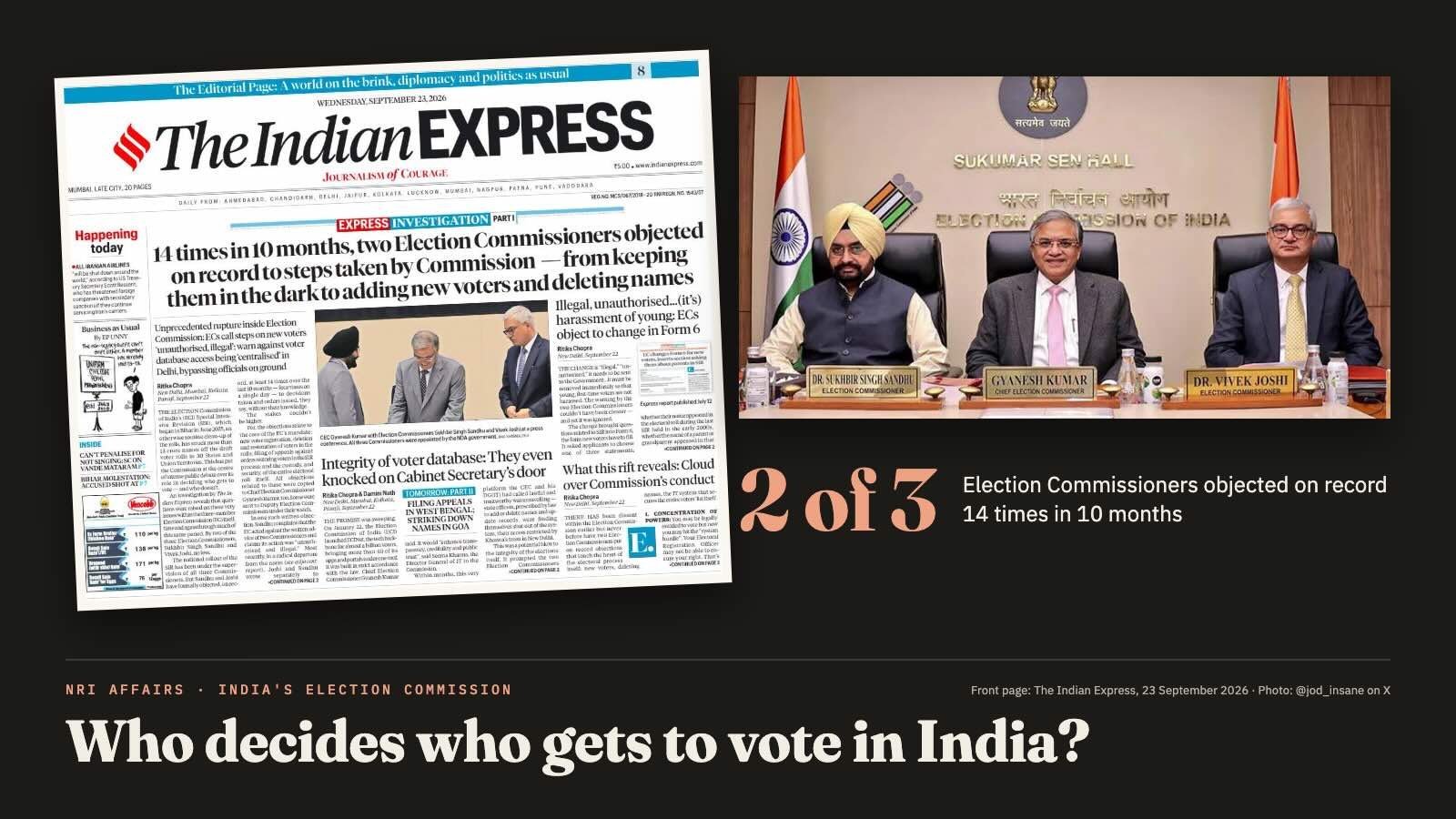
India is rewriting its voter list. Since June 2025, the Election Commission of India (ECI), the independent constitutional body that runs the country’s elections, has been conducting a Special Intensive Revision (SIR). The SIR is a nationwide re-check of who is entitled to vote. So far it has struck more than 130 million names off draft voter rolls in 30 states and Union Territories.
Opposition parties and civil society groups have criticised the exercise for more than a year. Now an investigation by The Indian Express shows that some of the most serious objections came from inside the Commission itself.
How the Commission is supposed to work
The ECI is not one person. It has three members: Chief Election Commissioner (CEC) Gyanesh Kumar, and two Election Commissioners (ECs), Sukhbir Singh Sandhu and Vivek Joshi. All three are equal in rank. The CEC is first among equals, not a boss who can decide alone.
Under Section 18 of the 2023 law that governs the Commission, business must be done unanimously where possible. When members disagree, the majority decides. How the Commission divides its own work requires all three to agree.
Reporter Ritika Chopra found that Sandhu and Joshi, who together form that majority, formally objected on record at least 14 times between October 2025 and August 2026. On one day they objected four times. Their common complaint was that decisions were being taken, and orders issued, in the Commission’s name without their knowledge.
All three members were chosen under the 2023 Act by a panel of the Prime Minister, the Home Minister and the Leader of the Opposition. Each time, the Opposition’s representative recorded dissent.
What the two commissioners objected to
A new question for first-time voters
Every Indian who wants to enrol as a voter fills in Form 6. Its contents are fixed by the Registration of Electors Rules, 1960, which only the central government can change. On 16 May, Joshi warned on file that the form could not be altered to add SIR questions unless the government first amended those rules. Sandhu agreed three days later.
In July, the online form was changed anyway. Applicants now had to say whether they, a parent or a grandparent appeared on the roll of the previous intensive revision in the early 2000s. The question was not marked compulsory, but the form could not be submitted without an answer.
On 13 August, Sandhu recorded that the change was “unauthorised and illegal”. He wrote that it must be removed immediately so young first-time voters could register without harassment. As of Monday this week, the question was still there.
This matters because the right to vote in India rests on age, citizenship and residence, not on whether your parents survived an earlier revision. An 18-year-old whose family was missing from those old rolls could not truthfully tick either of the first two options. The form did not say what would happen if they ticked the third.
Who controls the voter database
By law, each constituency’s voter list is the responsibility of a local Electoral Registration Officer (ERO), usually a sub-divisional magistrate. The ERO hears claims and objections and decides which names stay. For decades, the Commission has answered accusations of rigging by pointing to this design: no single person controls the list; thousands of local officers do.
The two commissioners warned that software was quietly undoing that safeguard. The voter list sits on a system called ERONet. In January, ERONet was absorbed into ECINet, a national platform bringing more than 40 of the Commission’s apps under one roof. What an ERO can actually do on it, whether adding a name, deleting one or reversing a decision, is controlled by the IT division in New Delhi, headed by Director General Seema Khanna.
- 16 April. Sandhu wrote that he had learnt of new IT modules “from media only”.
- 29 May. Joshi warned of the “gradual centralisation of the electoral roll database”. He proposed an independent audit, with an outside expert from the Indian Institutes of Technology, to confirm that only the legally responsible officers could change voter data. Sandhu endorsed the audit in July. By mid-August, nothing had happened.
- 14 August. Sandhu recorded that state and local election officers had told him they could not fully access the system. He wrote that the IT chief had no legal authority to restrict them, and ordered full access restored.
Goa: found eligible, still left off
On 29 January, the Supreme Court ordered that voters flagged by the software for “logical discrepancies” must be allowed to produce documents and be heard. A logical discrepancy might be a misspelt name, or an age gap with a parent that doesn’t add up.
Goa’s EROs heard the cases and found 97 people eligible, but the software had no way to record that decision. Between 11 and 17 February, Goa’s election office wrote eight times to Delhi asking for a fix. There was no response, and all 97 were left off the final roll.
West Bengal: who filed 1.6 million appeals?
West Bengal saw the most bitterly contested SIR. In February, the Supreme Court took the final stage out of the Commission’s hands and asked judicial officers to decide the cases of 6 million flagged voters. The Commission then deleted 2.7 million names, and tribunals of retired judges were set up to hear appeals.
Last week, the Commission told the court that 3.8 million appeals were pending:
- About 2.2 million came from deleted voters seeking to be restored.
- The other 1.61 million sought to delete voters whom the judicial officers had kept on the roll. The Commission did not say who filed them.
Sandhu had asked exactly this in August: “Who actually filed these appeals on behalf of ECI?” Neither he, Joshi nor Bengal’s chief electoral officer had been told.
For balance, SIR deletions exceeded the winning margin in 49 of Bengal’s 294 seats at this year’s state election. But those seats split almost evenly, 26 to the BJP and 21 to the Trinamool Congress, and the Express found no evidence that the SIR decided the result.
Kept in the dark, then a letter to the top
In April, both commissioners told senior officers that communications were going out in the Commission’s name without its approval. Joshi recorded that for more than a year he had received no agenda before Commission meetings and no minutes after them.
On 28 July, Senior Deputy Election Commissioner Maneesh Garg was given temporary charge of administration. Within hours he reallocated work, removing the officer who had overseen the IT division and routed its files to the three members.
The next day, in a step without precedent, Sandhu and Joshi each wrote to Cabinet Secretary T V Somanathan, India’s most senior civil servant, calling the order a clear violation of the law. On 30 July they jointly struck it down. On 9 September, the three members met as a full Commission for the first time in four months.
Chronology, “Dissent on File”
Why this is different
Dissent inside the Commission is not new. In 2009, CEC N Gopalaswami recommended that fellow commissioner Navin Chawla be removed for alleged partisanship; the government rejected it. In 2019, commissioner Ashok Lavasa stopped attending some meetings after being outvoted on complaints against Narendra Modi and Amit Shah.
In each of those cases, one commissioner disagreed with a decision. This time, the Express argues, it is the Commission’s majority saying decisions were taken without it.
The Commission’s response
The ECI rejected the report. It said internal notes, objections and suggestions are a normal part of deliberation in a multi-member body. It also said all its decisions over the past year were unanimous, and that its digital platforms operate under strict data-security protocols. The Express says neither the Commission nor the two commissioners answered the questions it sent on 21 September.
On the same day, the Supreme Court split over whether challenges to the 2023 appointment law need a five-judge Constitution Bench.
Reactions
Opposition parties have demanded the CEC’s removal, impeachment and even arrest. Congress has dubbed the row “Gyaneshgate”.
On the Hindi YouTube channel Nai Parakh, host Abhay Kumar Dubey called the report possibly the most significant exposé of the past decade. He likened it to pulling a loose thread on a sweater: once it starts to unravel, it keeps going.
Senior political analyst Sheetal P Singh explained why decentralisation mattered. With thousands of officers involved, “you can buy ten or twenty people, but not all of them”. Centralise control, he argued, and that protection disappears. He also faulted the Opposition for failing to mobilise in 2023, when the law now governing the Commission was passed.
What to watch
Four questions remain unanswered:
- Will the Form 6 question be withdrawn?
- Will the independent audit go ahead?
- Who filed the Bengal appeals?
- Will the Commission publish the minutes of its decisions?
Goa shows what is at stake. A voter’s eligibility, proven and accepted by the officer the law appoints, no longer guarantees a place on the roll.
Further reading: The Reporters’ Collective’s Electoral Roll Project has tracked the SIR since it began in Bihar.
Key Takeaways (summarised from The Indian Express)
- Two of the Commission’s three members, a majority, lodged 14 formal objections in 10 months, saying key decisions were taken without their knowledge.
- They called the change to the new-voter form unauthorised and illegal. It was made regardless and was still online this week.
- They warned that control of the voter database was being centralised in Delhi, overriding the local officers the law puts in charge. A proposed independent audit never happened.
- In Goa, 97 voters found eligible were left off the roll because the software could not record the decision.
- In West Bengal, 1.61 million appeals to delete voters were filed in the Commission’s name, and the two commissioners were not told who filed them.
- Unlike past dissents by individual commissioners, this is the Commission’s majority saying it was sidelined.