
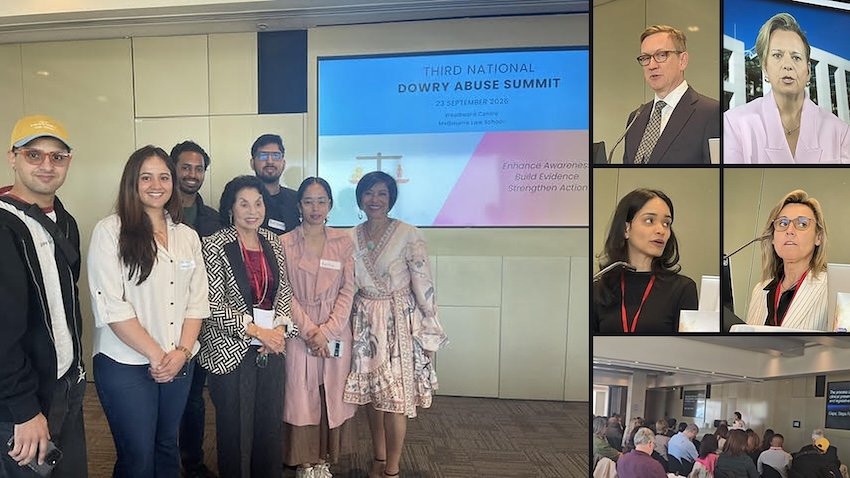
Cultural identity is no licence for coercion and control, Assistant Minister for Immigration and Citizenship Julian Hill told the National Dowry Abuse Summit in Melbourne on Wednesday 23 September. The summit brought together lawyers, policymakers, family violence and settlement workers, researchers and survivors of dowry abuse.
The day-long event at the Woodward Centre, Melbourne Law School, was hosted by the ARC Centre of Excellence for the Elimination of Violence Against Women (CEVAW). Its partners were the AustralAsian Centre for Human Rights and Health (ACHRH), UNSW’s Gendered Violence Research Network, the Social Policy Group, Settlement Services International and inTouch Multicultural Centre Against Family Violence.
It was the third national summit on the issue, and the first since the Family Law Act 1975 was amended to name dowry abuse as an example of economic or financial abuse. Federal Attorney-General Michelle Rowland addressed the gathering by video, and former Victorian Premier Ted Baillieu was among those in the room.
Hill: ‘That’s my culture’ is no defence
In his keynote, Mr Hill said he first met Professor Manjula O’Connor in 2015, in a long queue for chai at a community festival. He credited her with teaching him about dowry abuse “and its pernicious role as a form of family violence”, and said he had attended the first national summit in 2016.
He stressed that dowry abuse is not particular to Indian Australians or South Asians. He said it occurs in many African societies, parts of the Middle East and other communities, with payments flowing either to or from a bride’s family.
Mr Hill pushed back strongly against any suggestion that culture can excuse coercive behaviour. “When you come to Australia, no one expects you to leave your culture at the door,” he said. “But … your right to cultural identity in Australia has always operated within defined limits. Religious beliefs, expressions of faith, or cultural identity do not excuse every action.”
Gender equality, he said, has been a core Australian value since multicultural policy was first framed. “Neither is it acceptable to undertake coercion, control and other things because ‘that’s my culture’,” he said.
From Senate inquiry to Commonwealth law
Mr Hill said he drove the 2018–19 Senate inquiry into dowry abuse at Prof O’Connor’s request, with support from Penny Wong and Senator Louise Pratt. The inquiry found dowry “generally undesirable” but concluded that criminalising it in itself was not the right approach, because such laws overseas had been weaponised and had not worked.
He said dowry was also linked to fraud and misuse of the visa system through a “fake marriage market”. He criticised the former Coalition government for never formally responding to the report, despite private meetings with the then Attorney-General and Social Services Minister.
Labor responded after taking office and, in 2024, amended the Family Law Act to explicitly recognise dowry abuse as a form of economic family violence. “That’s really important to help set a norm, that you can look in the law and see the words ‘dowry abuse’ as a specific example,” Mr Hill said, crediting then Attorney-General Mark Dreyfus.
Visa protections and support
Mr Hill outlined changes for people on visas:
- Family violence provisions extended to about 20 more visa subclasses that lead to permanent residency, including partner, skilled and business visas.
- Information on the Home Affairs website translated into 16 languages.
- A dedicated domestic and family violence support team in Home Affairs, which he said has handled more than 4,000 referrals and carried out more than 550 outreach engagements with legal services, community organisations, courts and police.
He defended the government’s model of having settlement services make “warm referrals” to specialist, culturally responsive family violence services, rather than turning every settlement provider into “a half-baked” family violence service.
A national priority, and new threats online
Placing dowry abuse within the wider National Plan to End Violence against Women and Children 2022–2032, Mr Hill cited $4.4 billion in investment. He listed the permanent Leaving Violence Payment, a 40 per cent funding boost for 1800RESPECT, 500 extra frontline workers, $1.2 billion for emergency and transitional accommodation, and 10 days of paid family and domestic violence leave.
He warned of “dark clouds”, saying misogynistic attitudes are now higher among young men than a generation ago, fuelled by social media algorithms. He said the government would not back down from asserting Australia’s right to set rules about what algorithms serve to young people.
Rowland: ‘a serious form of family and domestic violence’
In a video message, Attorney-General Michelle Rowland described dowry abuse as “a serious form of family and domestic violence that requires ongoing attention and action”. She said it can intersect with migration status, financial insecurity, language barriers and social isolation, creating extra barriers for victim-survivors seeking support.
She said the recent Family Law Act amendments provide “clarity for victim survivors, family law professionals and the broader community that dowry abuse may be relevant in family law proceedings, including property settlements”. The reforms recognise that dowry abuse takes different forms, she said, including coercing a person to give or seek money, assets or other items connected with dowry, or extra dowry from extended family members.
Ms Rowland said dowry abuse can in some cases be connected to forced marriage, “a serious criminal offence that is one of the most commonly reported forms of modern slavery in Australia”. She pointed to the Forced Marriage Specialist Support Program run by Life Without Barriers, which offers support without requiring contact with police. She added that state and territory attorneys-general had recently endorsed national objectives on forced marriage.
As the government develops the second action plan under the National Plan to End Violence against Women and Children 2022–2032, she said it would keep listening to communities. The aim, she said, is for services to respond to forms of violence, including dowry abuse, “that may disproportionately affect culturally and linguistically diverse communities”. She said she had recently hosted a National Plan roundtable on the experiences of those communities.
“While important progress has been made, there’s still more to do,” Ms Rowland said, calling for victim-survivors to be “at the centre of our efforts”.
O’Connor: ‘A defence of the deepest promise of marriage’
Opening the summit, psychiatrist and ACHRH founder Professor Manjula O’Connor asked how “a cherished tradition” becomes a vehicle for coercion and control. She was emphatic that the campaign is not an attack on South Asian communities.
“South Asian families are in fact very loving, generous and protective, and most men do not perpetrate violence, and we must say this clearly,” she said. “Opposing dowry abuse is not an attack on culture, marriage, men or families. It is a defence of the deepest promise of marriage: mutual respect, dignity and safety.”
Prof O’Connor traced the practice to gifts parents once gave daughters so they would not depend on their in-laws. Over time, she said, this flipped into grooms and their families demanding cash and large gifts, a problem that worsened in the colonial era and has grown since Independence as India has become richer.
‘A sense of entitlement grows and grows’
She referred to the testimony of a survivor, identified as Ms G, whose family was first asked for $40,000 for the wedding, on top of gold and cash gifts to the groom’s relatives. Later, when her husband’s sister needed money for legal bills, the new bride became “a pathway to extracting $20,000”, and the abuse began when she did not pay.
Dowry, she said, makes daughters a financial burden, traps women in unsafe marriages and teaches another generation that a woman’s value has a price.
Prof O’Connor also cited the case of a woman killed by her husband in 2019 after repeatedly telling police he was demanding money, including her father’s retirement savings, from her parents in India. She said the coroner noted the demands but did not connect dowry to the killing, and that she was not invited to give expert evidence.
Drawing on her clinical work, she described the psychological injuries she sees: fear, shame, depression, post-traumatic stress and suicidality. Migration can deepen that vulnerability, she said, through visa dependence, social isolation, limited English, financial dependence and fear of dishonouring the family.
Singh: coercion, manipulation and reprisal
Dr Sara Singh, a senior research officer at UNSW’s Gendered Violence Research Network, presented findings from her PhD on dowry and dowry abuse in Indian communities in Australia. She said she first learned of the issue at the second national summit at UNSW in 2019, which set her on the path to a doctorate supervised by Prof O’Connor and Professor Jan Breckenridge.
Her qualitative study drew on 26 participants: four women with lived experience of dowry abuse, eight service providers from the family violence, multicultural, legal and mental health sectors, and 14 members of Indian communities. Dr Singh said dowry abuse should be understood as economic exploitation driven by “a gendered entitlement”, in which women and their families are treated as opportunities for financial gain.
She identified three patterns:
- Coercion: demands that often start as seemingly innocent hints, such as a family saying their son has told friends he will get a scooter, and escalate to threats around visas, housing, safety and children. These can continue for months or years into a marriage.
- Manipulation: perpetrators disguising demands as gifts or “respect”, which she described as a form of gaslighting. She also described serial perpetrators who marry, exploit and abandon women, often in their countries of origin, then find a new target.
- Reprisal: taunts, humiliation and violence when dowry is judged inadequate. One participant described a family having to apologise with folded hands for not giving enough.
Dr Singh urged two shifts. First, dowry abuse should be understood through the lens of coercive control, so subtler tactics are recognised earlier, with training for practitioners as states criminalise coercive control. Second, she called for cross-border cooperation with countries such as India, since dowry is often held by in-laws overseas and some women are abandoned there. Without that collaboration, she said, victim-survivors will keep facing barriers to justice.
No single door, but ‘a really good step’
During questions, Mr Hill was asked whether victims could have a single window for dowry abuse complaints, instead of having to approach several agencies.
“I’m not going to lie to you,” he said, adding that any government service will always have eligibility rules. He pointed to Victoria’s Orange Door as an attempt at a single front door that “doesn’t work for everyone” but is “a really good step” compared with a decade ago, and to 1800RESPECT as the intended default entry point. He said settlement workers, childcare centres and GPs also need training to recognise the signs of family violence.
Mr Hill said it is hard for people born in Australia to grasp the vulnerability of temporary visa status. The threat of “do what I say or I’ll get your visa cancelled” is “an incredibly powerful lever to have over another human being”, he said, and a driver of sexual and workplace exploitation.
But he was blunt that family violence protections will not be extended to visitor or student visa holders. He called it “patently ridiculous” that someone could come on a visitor visa, experience a crime and then stay permanently.
He said police can pursue perpetrators whatever the victim’s visa status. While Home Affairs may not offer a path to permanent residency in such cases, he said, other temporary visas can sometimes be extended to help stabilise a person’s situation.
Background: a campaign more than a decade in the making
Prof O’Connor has said she began seeing dowry-related abuse in her psychiatric practice around 2008, as international students and young brides came to her for help. She co-founded the AustralAsian Centre for Human Rights and Health in 2012, and it launched its anti-dowry campaign in 2013. In 2014, Ted Baillieu tabled a petition from about 600 members of the Indian Australian community in the Victorian Parliament.
ACHRH’s 2015 submission to Victoria’s Royal Commission into Family Violence led to Recommendation 156, which called for dowry-related abuse to be covered by the Family Violence Protection Act 2008. The first National Anti-Dowry Summit, held in Melbourne on 13 December 2016, called for a federal law. Victoria amended its Act in December 2018, and the change took effect in March 2019, making coercive dowry demands an example of family violence and economic abuse.
Nationally, the Senate referred an inquiry into dowry abuse on 26 June 2018. Its February 2019 report made 12 recommendations, including recognising dowry abuse in federal family law and strengthening protections for visa holders, while warning that criminalising dowry itself could push the practice underground. The second national summit, at UNSW Sydney on 22 February 2019, backed those recommendations.
The central recommendation was realised in the Family Law Amendment Act 2024, whose property reforms took effect on 10 June 2025. Courts must now consider the effect of family violence when dividing property, and dowry abuse is named as an example of economic or financial abuse.
Prof O’Connor chairs the RANZCP Family Violence Psychiatry Network Committee and told her story in the book Daughters of Durga: Dowries, Gender Violence and Family in Australia. In 2024 she was named Victorian Senior of the Year and inducted into the Victorian Multicultural Honour Roll.
What next
Prof O’Connor told NRI Affairs the summit “achieved most of our objectives”. Its aim was to bring the new Family Law Act provisions on dowry abuse in property settlements to the attention of policymakers, politicians, family violence experts and community leaders, and to start conversations across those groups.
She said organisers have asked for roundtables with the Department of Social Services and the team behind the National Plan to End Violence against Women and Children 2022–2032. A police commander has raised a possible invitation for victim-survivors and experts to take part in work on the misidentification of perpetrators in multicultural communities, and conversations have begun about ongoing education for judges on family violence linked to dowry demands and extortion.
If you or someone you know is affected by family violence, call 1800RESPECT on 1800 737 732 or inTouch Multicultural Centre Against Family Violence on 1800 755 988. In an emergency, call 000.