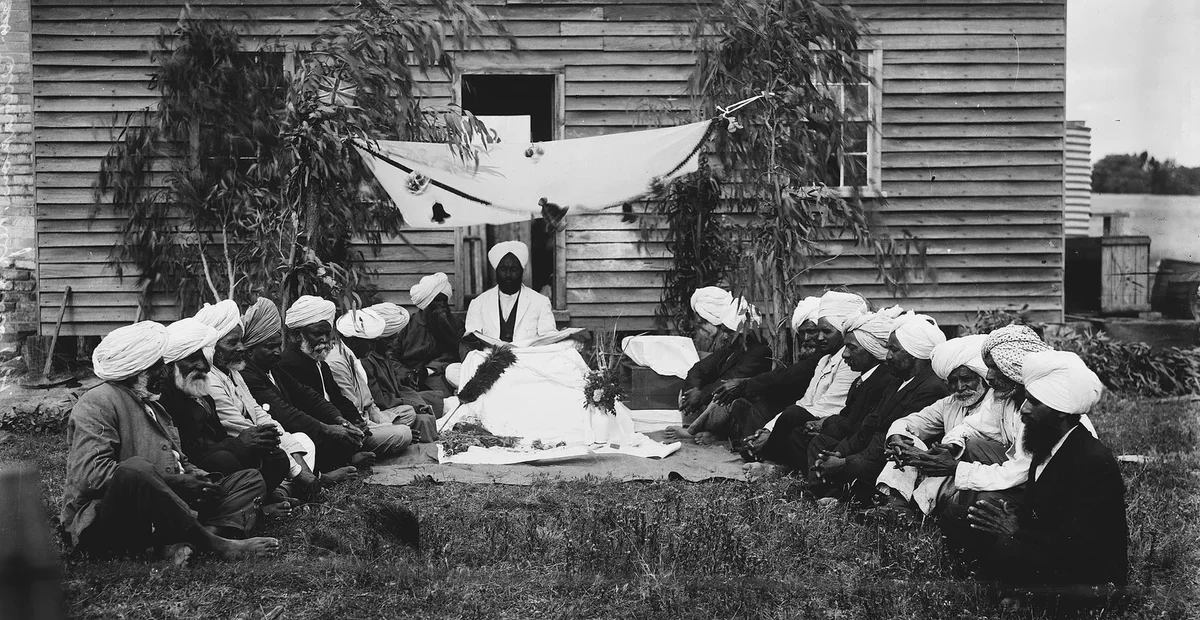
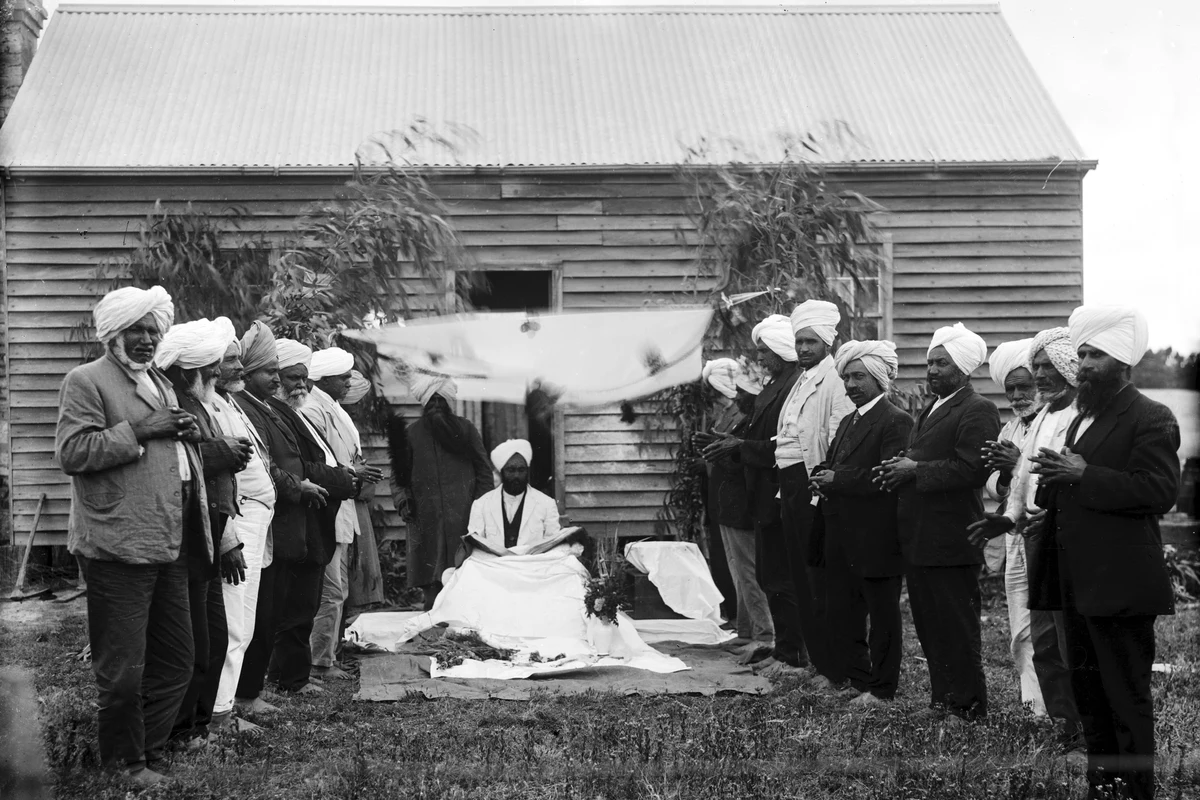
A photograph taken at a Victorian farm on 16 December 1920 preserves a Sikh congregation gathered around the Guru Granth Sahib. Siva Singh, the Benalla hawker and farmer whose property hosted the ceremony, is the subject of a new book by historians Len Kenna and Crystal Jordan.
The Australian Indian Historical Society’s book announcement scheduled the launch of Siva Singh Benalla for 18 October 2026 at the Tomorrow Today Foundation in Benalla. It describes a study of his life in the district between 1897 and 1955, including the scripture’s importation and early Sikh religious gatherings.
The surviving evidence supports a carefully worded claim: the 1920 event is recognised as the first known or confirmed Akhand Path in Australia. It does not settle every question about when a copy of the scripture first entered the country. Earlier newspaper references, collected by Australian Sikh Heritage, make that distinction necessary.
What does the evidence establish about Siva Singh’s gathering?
The documented ceremony took place at his Reef Hills property near Benalla in December 1920, and William John Howship photographed the congregation.
Benalla Art Gallery’s 2022 exhibition records identify 16 December as the date of an Akhand Path held following the scripture’s arrival. The gallery describes roughly 30 Sikhs attending a ceremony for Hernam Singh. Its account draws together the religious event, the farm and the photographs rather than treating the image as an unidentified scene of migrant life.
The photographs belong to the W. J. Howship collection at the University of Melbourne Archives. The collection reference attached to the gathering is 1988.0137.00704. That reference matters because a historical photograph needs a retrievable record, not simply a caption copied from a later social-media post.
The images show how a community created a setting for worship outside a purpose-built contemporary gurdwara. They record people, a modest timber building and the arrangements made for the ceremony. They cannot, by themselves, establish the date of an earlier shipment or prove that no other copy of the scripture existed elsewhere.
Why is “first arrival” different from “first documented reading”?
A first documented reading is an event supported by surviving evidence; a first arrival is a separate claim about when the scripture entered the country.
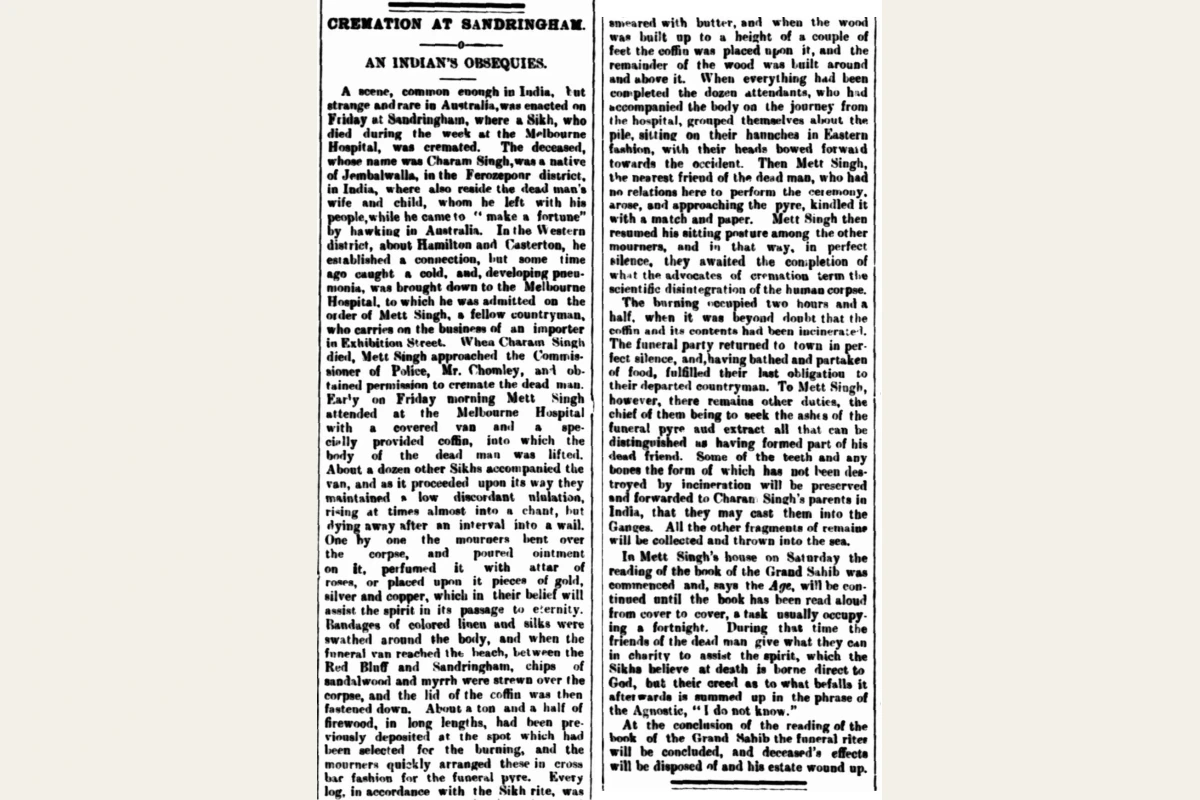
Australian Sikh Heritage’s collection places the Benalla photographs alongside newspaper material from 1895 and 1899. The organisation says an earlier article suggests a copy may have reached Australia in 1895, while describing still earlier accounts as anecdotal.
Those earlier references should not be converted into a newly established arrival date. They do, however, prevent an unqualified assertion that the first copy arrived only in 1920. The stronger formulation is to identify the Benalla ceremony, its documentation and the limits of what each record establishes.
The new book makes claims about importation and the early gurdwara in its own description. A publication announcement is evidence of what the authors say their book covers. It is not a substitute for examining every document behind their argument.
That leaves room for the historians’ contribution without making the historical record more certain than it is. Readers can distinguish a contemporary photograph, a dated newspaper report, later scholarly interpretation and family memory. Each can contribute, but each answers a different kind of question.
What is an Akhand Path?
An Akhand Path is a continuous reading of the Guru Granth Sahib. The Benalla gallery describes the 1920 event as the first known Australian ceremony of this kind involving the scripture. “First known” identifies the surviving evidence rather than ruling out every earlier, undocumented event.
Who was the man behind the Benalla ceremony?
Siva Singh was a Punjabi Sikh hawker, landholder and community figure whose life in north-eastern Victoria crossed religious service and a struggle over voting rights.
The gallery’s historical account places his arrival in Australia at approximately 1896 and his work as a hawker around Benalla from 1898. The society’s new book uses 1897 as the start of its Benalla district narrative. Those are differently framed dates, so neither needs to become a falsely precise claim about the day he arrived in the district.
By 1915, the gallery records, he owned a 320-acre farm. His property became a meeting place for a dispersed community. The same account describes him taking on the responsibilities of a granthi, a custodian of Sikh scripture and religious practice.
His history also includes exclusion from the electoral roll under the White Australia era. The gallery records a decade-long struggle before he regained voting rights in 1925. Religious community formation and civic exclusion therefore belong in the same account of his life, rather than being separated into a celebratory story with the discrimination removed.
The later recognition should not obscure that sequence. A man who helped organise community life also had to contest his own access to political participation. Both elements explain why artists and historians continue to return to his story.
How has Benalla already recognised this history?
The 1920 gathering was part of public commemoration before the latest book appeared.
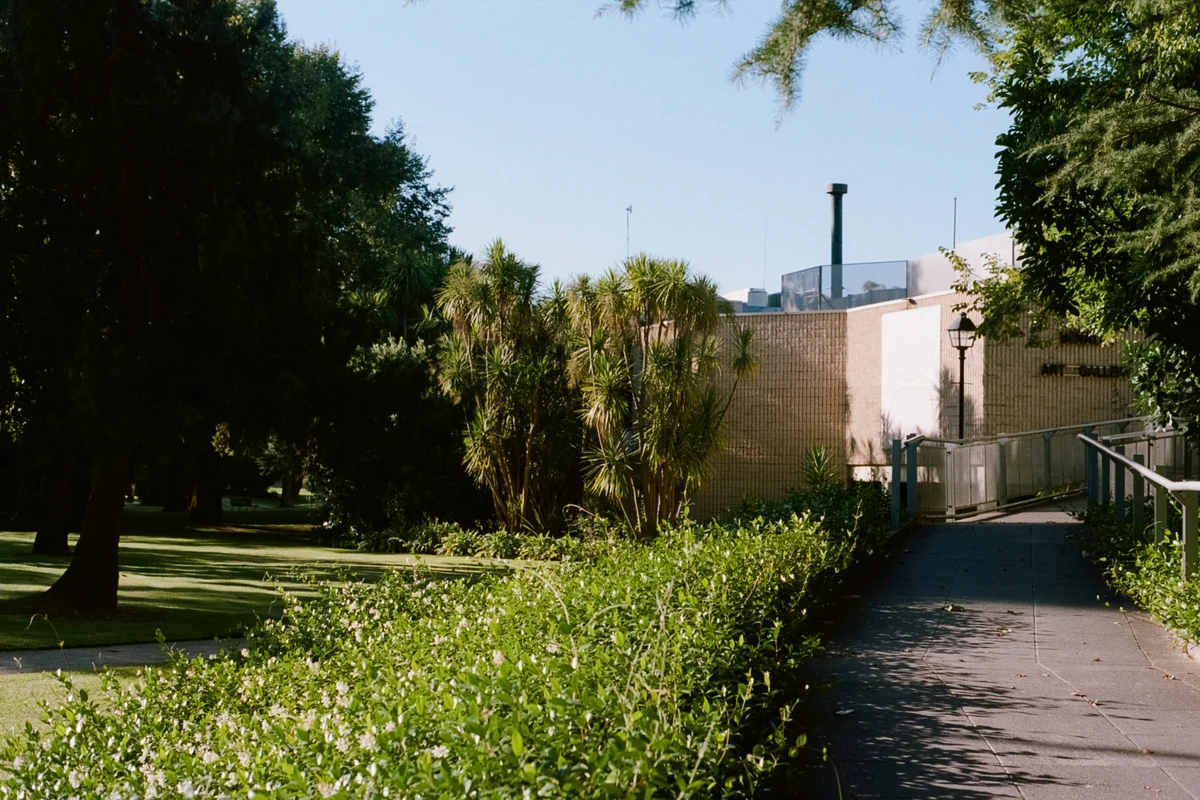
A memorial to Siva Singh was unveiled in 2019. The monument record locates the plaque near Benalla Library and transcribes its reference to the first confirmed Akhand Path on 16 December 1920. It also records his removal from the electoral roll and reinstatement in 1925.
In 2022, Benalla Art Gallery hosted Bush Diwan, developed by 4A Centre for Contemporary Asian Art and curated by Amrit Gill and Reina Takeuchi. The exhibition ran from 5 August to 16 October that year. Its artists responded to migration, community formation and Siva Singh’s experience through contemporary works.
These were earlier acts of interpretation and remembrance, not events taking place this October. Their dates help readers understand what is new: the present book adds to an existing body of research, exhibitions and community recognition. It does not mark the first occasion on which the gathering has been publicly discussed.
The gallery’s acknowledgements name Sikh communities in Benalla, Shepparton and north-east Victoria alongside local historical and migrant organisations. The evidence of community involvement is specific. There is no need to claim that every Sikh Australian shares one view of the history.
Which records should readers compare?
Compare the records according to what they can establish, rather than asking one photograph to prove the entire story.
| Record | What it helps establish | Limit to keep in mind |
|---|---|---|
| Howship photographs, December 1920 | A congregation at the Reef Hills property and the ceremony’s physical setting | A photograph does not establish the earliest importation date |
| Benalla gallery’s 2022 historical material | The documented reading, local biography and exhibition context | It is a later institutional account of the earlier event |
| Newspaper references collected by Australian Sikh Heritage | Evidence relevant to possible earlier presence of the scripture | Earlier presence and a confirmed Akhand Path are different claims |
| Historical society’s October 2026 announcement | The authors, launch details and stated scope of the new book | A book description is not its complete archival argument |
What does this mean for families preserving their own history?
Keep the source reference, date and original context alongside an inherited image or story.
The Howship photographs demonstrate the value of a collection number. It lets a later reader identify the archive and distinguish an original record from a crop, a reproduction or a new caption. A family can apply the same basic discipline by retaining the original file, identifying who supplied it and recording what is known separately from what is remembered.
For photographs of worship, record the event’s name and the evidence for the date. If a person’s identity is uncertain, preserve that uncertainty. An attractive caption should not turn an unidentified figure into a named ancestor without supporting evidence.
The family oral-history guide sets out a related process for interviews, including consent and the handling of uncertainty. The home-language guide considers how everyday family conversations can carry stories between generations.
These are practical ways of retaining material for later scrutiny. They do not promise that a private collection will be accepted by a museum or that one recollection will resolve a disputed date. Preserving the record is useful precisely because future researchers may ask questions its current holder has not considered.
What happens next for the historical record?
The next substantive test is comparison of the new book’s documentation with the surviving archive and earlier references to the scripture.
The society’s announcement provides a starting point for readers seeking the authors’ account. The Benalla gallery and University of Melbourne collection references provide separate routes back to the event’s evidence. Any future claim about the first arrival should explain how it addresses the earlier material, rather than simply replacing one confident date with another.
For now, the December 1920 gathering has a clearly identifiable place in the record. The remaining work concerns what can be established before it, how the scripture travelled and how the histories of a dispersed community can be documented without losing their uncertainty.