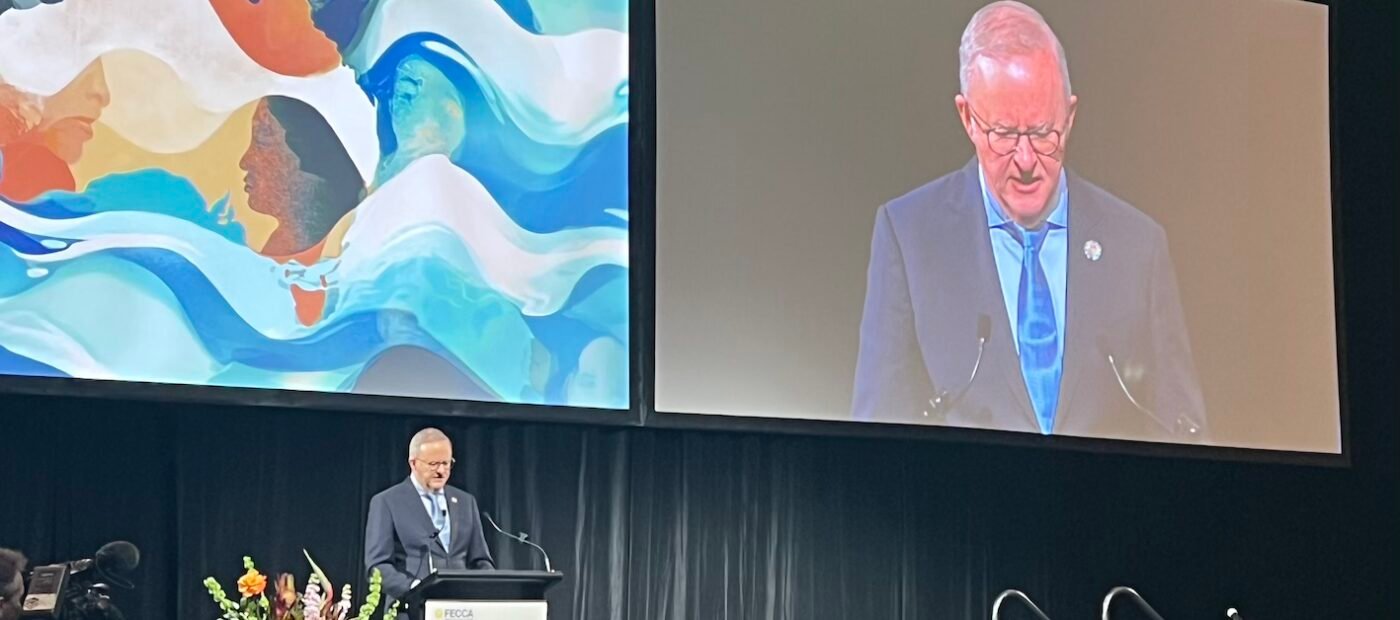
CANBERRA: Prime Minister Anthony Albanese used the opening plenary of the Federation of Ethnic Communities’ Councils of Australia (FECCA) national conference to defend multiculturalism, urging Australians to aim for celebration rather than mere tolerance.
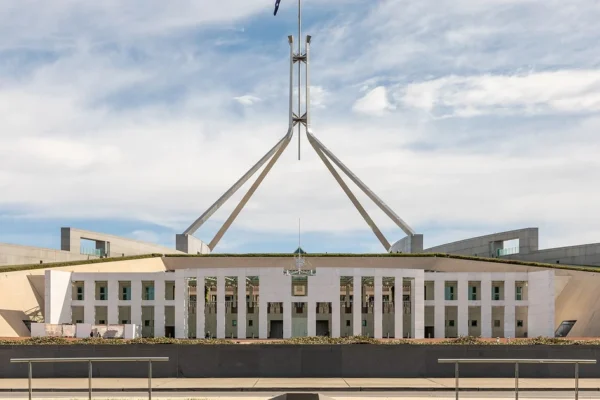
Speaking in the Great Hall of Parliament House on 15 October, at a conference themed “Navigating Change, Shaping Australia: Many Stories, One Future”, Mr Albanese said the national debate was between nostalgia for a past that never existed and a shared future. He said anyone who looks in the rear-vision mirror and sees a monoculture should “get themselves down to the nearest Specsavers”.
He said migrants work hard, pay taxes and lift the nation’s ambitions, and noted that more than a third of small business owners in Australia were born overseas. As economic pressures bite, he said, some are ready to exploit the moment by blaming people who look different.
Referring to the Royal Commission into Antisemitism and Social Cohesion, set up after the Bondi terror attack, he said hatred must be called out in all its forms, acknowledged a rise in antisemitism, and said all racism and discrimination must be stamped out. He said the government had re-established the Federal Office for Multicultural Affairs.
Mr Albanese said nearly 350,000 migrant and refugee women work below their skill level, only 41 per cent work in roles matching their qualifications, and they earn 31 per cent less than Australian-born women with equivalent qualifications. He pointed to an $85 million investment in migration skills recognition reform in this year’s budget.
FECCA leaders
FECCA CEO Prerana Mehta, who emceed the session, said she was guided by three convictions: belonging must be real, racism must be called out, and the sector must be united. She said belonging is not a token acknowledgement or something granted at a citizenship ceremony and withdrawn when the politics turn. She reaffirmed FECCA’s five priorities: health equity, gender equity, economic prosperity, social inclusion and multicultural sector leadership.
Ms Mehta, who was born in Zambia and arrived in Brisbane speaking no English, challenged delegates to decide before leaving on Friday what action they would take, with whom and by when.
FECCA Chair Peter Doukas said FECCA had never had to justify the fabric of multicultural society “until now”. “There has never been a monocultural Australia,” he said, adding that Australia’s First Peoples had practised many cultures and languages long before 1788. He rejected advice to drop the word multiculturalism, saying it should be embraced and defended.
Mr Doukas said FECCA-commissioned research surveying 500 business leaders found 87 per cent believe multiculturalism has benefited the economy over the past 50 years. He said the full report would be released in coming months.
Minister for Multicultural Affairs Dr Anne Aly called for a “substantive multiculturalism” that moves beyond “costume, cuisine, celebration” and shapes policy, service delivery and nation building, starting with representation that becomes meaningful participation. She traced her own family’s story from arrival at the Bonegilla migrant camp in 1969 to a family now spanning many heritages.
Panel: Multiculturalism in Australia Today
In the panel moderated by SBS/NITV’s John-Paul Janke, Independent ACT Senator David Pocock said no one owns Australian values, the flag or cultural identity, and that Australians should decide together what they look like in future. Having arrived from Zimbabwe as a teenager, he said the label “un-Australian” struck him as strange. He said Australia cannot go back to a time that never existed, a pointed reference to some Senate colleagues, and that governments should stop pitting Australians against each other. He contrasted his own experience with that of Black Zimbabwean friends who arrived around the same time, saying racism cannot be ignored.
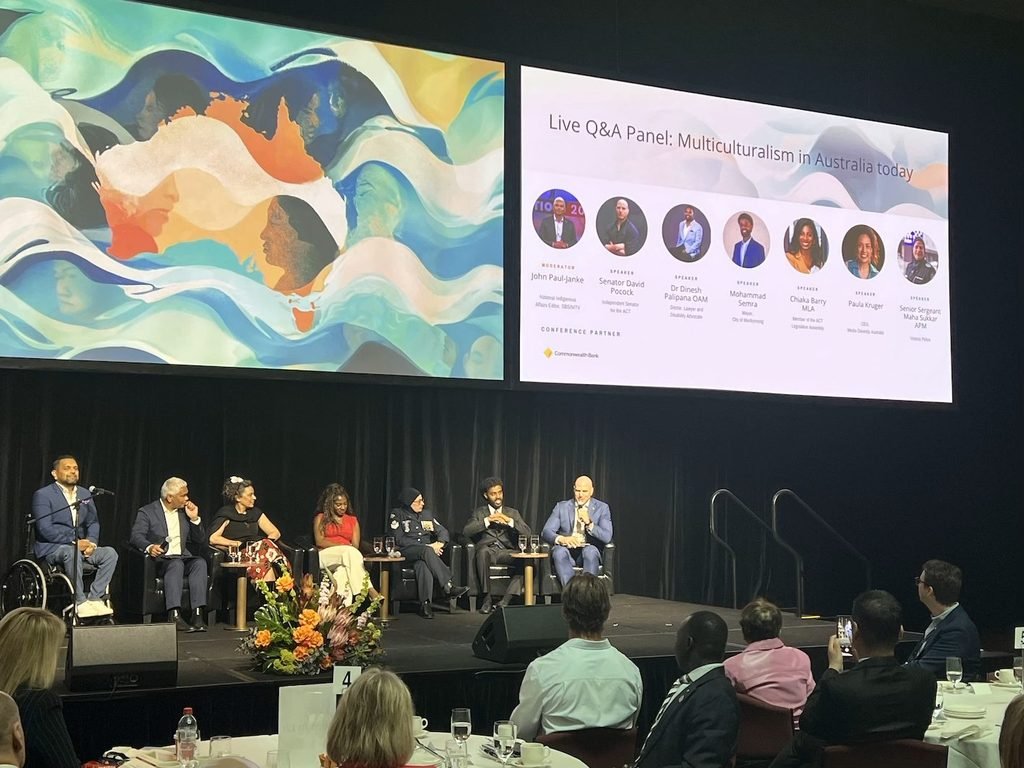
Dr Dinesh Palipana OAM said his family fled Sri Lanka’s civil war and found acceptance in Byron Bay. Maribyrnong Mayor Cr Mohamed Semra, who came to Australia as a refugee from Sudan, said Australian identity is shaped by shared civic values and daily choices, not by name or birthplace. Senior Sergeant Maha Sukkar APM, who migrated from Lebanon and has served in Victoria Police for more than 22 years, said identities intersect rather than compete.
ACT MLA Chiaka Barry asked whether the definition of Australian values is broad enough, saying more makes someone Australian than eating a meat pie. Media Diversity Australia CEO Paula Kruger said media leadership remains “a bit on the white side”, producing a colonial lens that breeds distrust, and urged community leaders to use their earned trust against misinformation.
On the migration debate, Cr Semra said questions about housing and services are legitimate, but migration can be discussed without questioning neighbours’ humanity. He warned that harmful narratives are being manipulated by bad actors.