

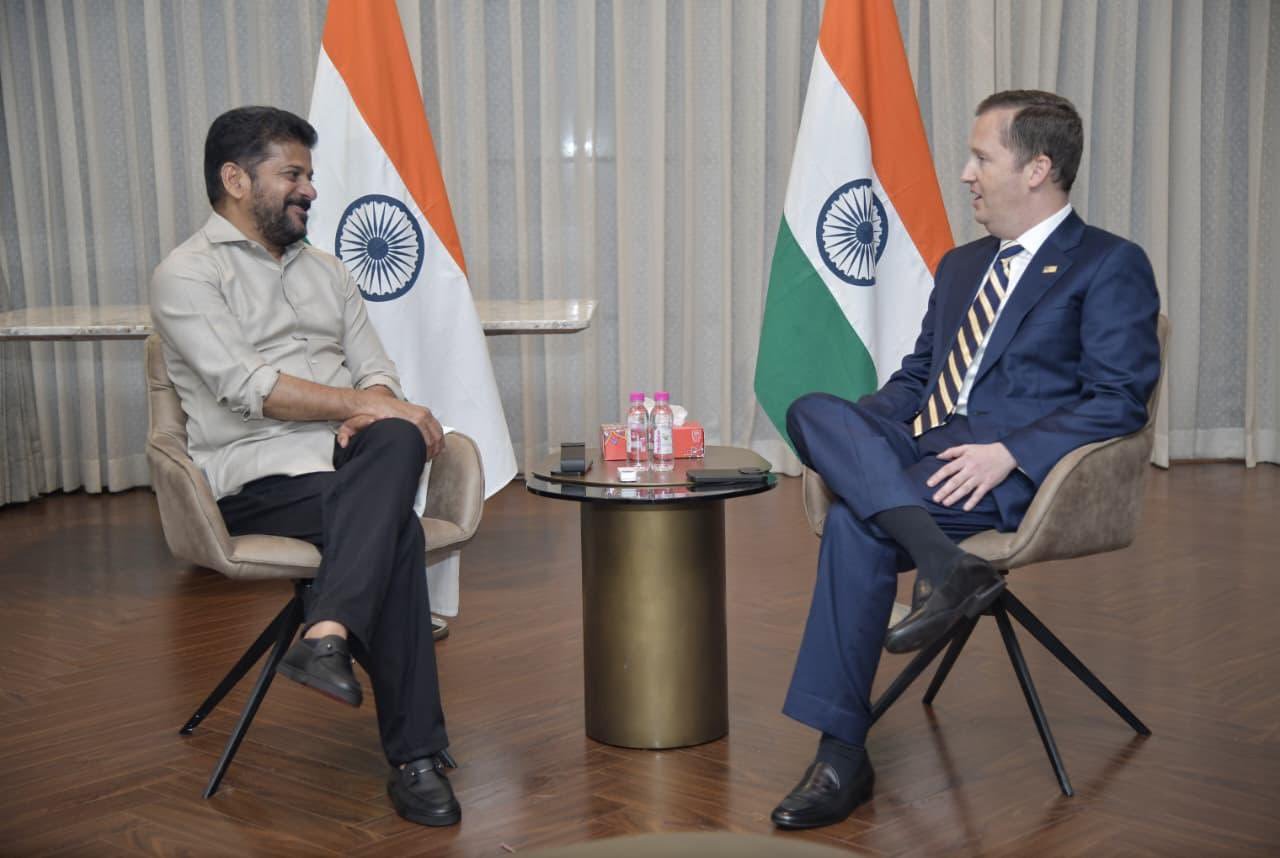
Telangana Chief Minister A Revanth Reddy has taken the visa frustrations of his state’s students and professionals directly to the US ambassador in New Delhi, requesting faster H-1B processing and more student visa allocations for Telangana applicants.
Reddy met US Ambassador to India Sergio Gor in New Delhi on Wednesday, 5 August 2026, during a courtesy call that lasted more than 30 minutes. According to a statement issued by the Telangana state government, Reddy requested an increase in the number of visas issued to students from Telangana pursuing higher education in the US, sought support to ensure visa appointments are available on time, and urged the Ambassador to increase visa interview slots and expedite the processing of applications.
Reddy also raised concerns specifically affecting working professionals from Telangana, requesting that the US simplify H-1B visa processing, renewal, and stamping procedures to avoid delays. He additionally asked Gor to share information in advance whenever US authorities plan to update visa regulations, a request aimed at giving Telangana students and professionals more time to plan around policy changes.
Ambassador Gor assured Reddy of “full cooperation” in expanding trade, investment, cultural exchange and people-to-people ties between Telangana and the United States, according to the state government’s statement.
What prompted the meeting
Telugu students and software professionals working on H-1B visas have faced significant difficulty securing visa appointment slots and renewals over the past year, as the Trump administration has tightened visa processing norms and scrutiny.
The scale of Telangana’s exposure to US visa policy is substantial. The US Consulate in Hyderabad processes thousands of applications from Telugu-speaking states each year, covering both Telangana and neighbouring Andhra Pradesh, making the region one of the most consulate-dependent parts of India for US immigration processing outside the major metros of Delhi and Mumbai.
Who is Sergio Gor
Sergio Gor, born Sergey Gorokhovsky in Tashkent in the former Soviet Union, has served as the US Ambassador to India since January 2026. He previously served as Director of the White House Presidential Personnel Office from January to October 2025, and has held the position of United States Special Envoy for South and Central Asian Affairs since August 2025, a role he continues to hold alongside his ambassadorship.
What is the role of a US Ambassador to India in visa policy?
What is the role of a US Ambassador to India in visa policy?
The US Ambassador to India oversees the diplomatic mission responsible for bilateral relations between the two countries, but does not personally set US visa policy, which is determined by the State Department and, for immigration categories like H-1B, jointly administered with the Department of Homeland Security and US Citizenship and Immigration Services in Washington.The Ambassador’s practical influence lies in relaying concerns from Indian state and central governments to Washington, and in overseeing the operational capacity of US consulates in India, including staffing levels that affect how quickly visa interview appointments become available. Requests like Reddy’s, for more interview slots and faster processing, are matters the Ambassador can advocate for operationally, even though broader policy changes, such as H-1B fee structures or work permit review, are decided at the federal level in the US.
Beyond visas: the investment pitch
Reddy used the meeting to position Telangana as a partner for American companies, highlighting investment opportunities across information technology, artificial intelligence, life sciences, pharmaceuticals, startups, research and advanced technologies. He requested support in encouraging US universities to establish collaborations with educational institutions in Telangana, and proposed expanding student exchange programmes, joint research initiatives, innovation partnerships and skill development programmes across education, technology and employment.
The meeting also touched on cultural ties. Reddy noted that Telugu is one of the fastest-growing Indian languages in the United States, and praised Gor for what he described as a deep understanding of India’s history and culture, alongside an interest in Telangana’s traditions and cuisine. The Telangana government had earlier renamed a road adjoining the US Consulate in Hyderabad as Donald Trump Avenue, with Gor attending the unveiling ceremony on 23 June 2026.
Why this matters for Telugu families in the diaspora
For Telugu-speaking families with members studying or working in the United States, and for the broader Indian diaspora in Australia, the UK and elsewhere with Telangana or Andhra Pradesh roots, Reddy’s intervention reflects a pattern increasingly common among Indian state governments: direct diplomatic engagement with US officials on visa processing issues that fall largely outside a state government’s formal authority but carry significant weight for constituents’ daily lives and career plans.
Whether the meeting translates into concrete operational changes, more interview slots at the Hyderabad consulate, faster H-1B stamping turnaround, or advance notice on regulatory shifts will depend on decisions made well beyond the Ambassador’s office, at the State Department and USCIS level in Washington. The meeting itself, however, signals that Telangana’s state leadership considers the current visa friction significant enough to raise directly and publicly with the US mission in India.
What Telugu students and professionals need to know
Did this meeting result in any confirmed changes to H-1B or student visa processing?
No specific policy changes were announced as a result of the meeting. Ambassador Gor assured general cooperation on trade, investment and people-to-people ties, but no concrete commitments on visa interview slot increases, processing timelines or advance notice of regulatory changes were confirmed in the government’s statement or subsequent reporting.
Does the US Ambassador to India have the authority to change H-1B processing rules?
Not directly. H-1B visa policy, including processing procedures, fee structures and eligibility criteria, is set by the State Department, Department of Homeland Security and USCIS in Washington. The Ambassador can advocate for operational improvements, such as consulate staffing and interview slot availability, and relay concerns to Washington, but does not independently set federal immigration policy.
Why does the Hyderabad consulate matter specifically for Telugu applicants?
The US Consulate in Hyderabad is the primary processing point for visa applications from Telangana and Andhra Pradesh, the two Telugu-speaking states. Its capacity and staffing levels directly affect how quickly Telugu applicants can secure interview appointments compared to applicants processed through Delhi or Mumbai.
Has Telangana engaged with the US on visa issues before this meeting?
Yes. The state government has pursued broader engagement with the US, including the June 2026 renaming of a road adjoining the Hyderabad consulate as Donald Trump Avenue, reflecting a sustained state-level effort to build direct ties with US officials beyond routine diplomatic contact.
What should Telugu students currently applying for US study visas do given ongoing delays?
Apply as early as possible given documented wait times at Indian consulates, monitor the official US visa scheduling site for real-time interview slot availability, and ensure all application documentation is complete and consistent, since administrative delays and processing backlogs affect the entire applicant pool regardless of state-level diplomatic engagement.







Comments 1