
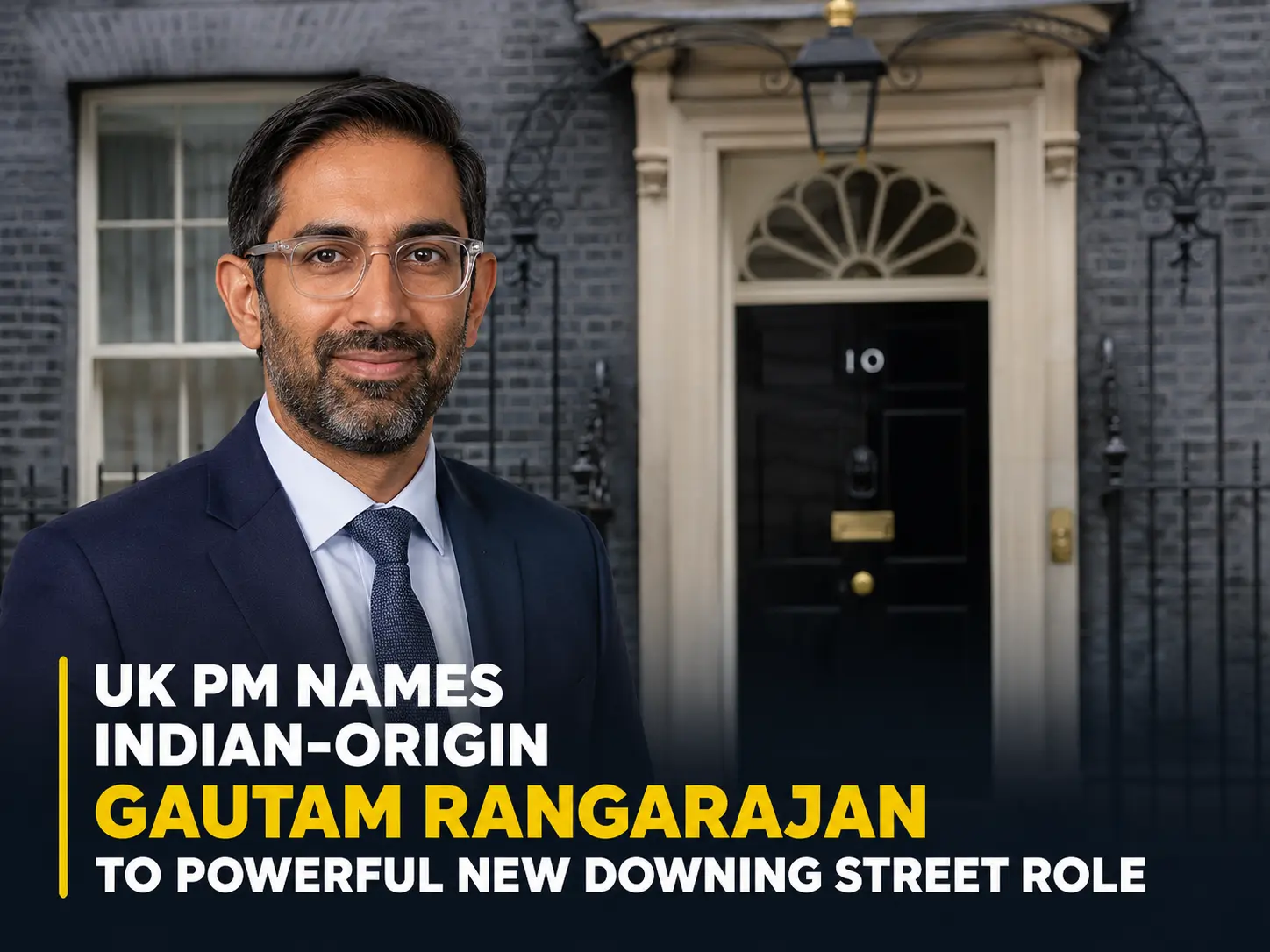
Andy Burnham has been Britain’s Prime Minister for barely three weeks. One of his early moves has been to bring an Indian-origin media and corporate strategist into the heart of his Downing Street operation.
Burnham has appointed Gautam Rangarajan as Expert Adviser on Structure and Process, a newly created role at Number 10, according to a brief announcement from the Prime Minister’s office. “Gautam Rangarajan has been appointed as an Expert Adviser on Structure and Process,” the statement read. “Gautam brings significant experience in corporate strategy and transformation.” Rangarajan takes up the position this week.
Who is Andy Burnham, and how did he become Prime Minister
Burnham’s path to Downing Street has been unusually rapid. He served as Mayor of Greater Manchester from 2017, earning the nickname “King of the North” for his advocacy of regional investment and his outspoken defence of northern England during the Covid-19 pandemic. He had previously run for the Labour leadership twice, in 2010 and 2015, and had been widely tipped since 2025 as a potential challenger to then-Prime Minister Keir Starmer, though Labour’s rules meant only sitting MPs could stand for the leadership.
That barrier fell in June 2026. Burnham won a by-election in Makerfield on 18 June with a majority of more than 9,000 votes, returning him to Parliament for the first time in nearly a decade. Four days later, on 22 June, Starmer announced his resignation as Labour leader, citing a lack of confidence in his leadership among his own MPs, after his government had lost seats to a populist anti-immigration party in May’s local elections.
Nominations for the Labour leadership opened on 9 July and closed on 16 July. Burnham secured 379 nominations, more than 94% of all Labour MPs, the highest proportion of nominations ever recorded in a modern Labour leadership contest, exceeding Gordon Brown’s 88% in 2007. He was the only eligible candidate and was acclaimed as Labour leader on 17 July. Three days later, on 20 July 2026, he was invited by King Charles III to form a government, becoming the United Kingdom’s seventh Prime Minister in a decade.
Burnham is the first Labour Prime Minister to be a member of the Co-operative Party.
What is Number 10’s Expert Adviser role
What is an Expert Adviser at 10 Downing Street?
An Expert Adviser is a specialist appointment brought into the Prime Minister’s office to advise on a specific area outside the traditional civil service or elected political structure, typically drawing on private-sector, technical or professional expertise rather than a background in government or party politics. Such roles are created at the Prime Minister’s discretion and can vary widely in scope and influence depending on the individual government’s structure. Rangarajan’s title, Expert Adviser on Structure and Process, suggests a mandate focused on how government itself is organised and how decisions move through it, rather than on a specific policy portfolio.
How this fits into Burnham’s broader restructuring of government
Rangarajan’s appointment is one part of a wider reorganisation Burnham has undertaken in his first weeks in office. He has established a new Office for the Prime Minister and Cabinet, described in Parliament by Baroness Angela Smith, Leader of the House of Lords, as designed to “house No. 10 Downing Street, No. 10 North and teams within the Cabinet Office directly serving the Prime Minister and Cabinet.” The new office is led by Cabinet Office Minister Louise Haigh and Cabinet Secretary Dame Antonia Romeo.
Burnham has also launched No. 10 North in Manchester, a physical extension of the Prime Minister’s office outside London, symbolising his devolution agenda for regions across the country. He realigned several government departments inherited from Starmer, expanding the Department for Business and Trade into a new Department for Business, Innovation, Science and Trade. His Cabinet selections have already prompted some internal disagreement: he reappointed Shabana Mahmood as Home Secretary but moved several members of Starmer’s team out of their roles, appointing former Labour leader Ed Miliband as Foreign Secretary in place of Yvette Cooper, and John Healey, previously Defence Secretary, as Chancellor.
Who is Gautam Rangarajan
Rangarajan describes himself, on his professional profile, as an experienced strategist and creative content producer with more than 20 years in media and the creative industries, previously working as a strategist at the BBC. He is also a professional choral singer and music producer, a detail he has highlighted alongside his corporate background, saying he is driven by delivering “meaningful impact at scale.”
Beyond the brief Downing Street announcement, detailed specifics of his mandate within the new Office for the Prime Minister and Cabinet have not yet been made public. He is expected to play a role in the structural transformation Burnham is pursuing at the centre of government during this period.
Why this matters for the Indian diaspora in the UK
Rangarajan’s appointment continues a pattern of Indian-origin professionals reaching senior advisory and political positions in UK government under successive administrations, spanning both Conservative and Labour governments over the past decade. For a diaspora community whose British-born and British-raised generations increasingly occupy positions across law, medicine, business, media and now the machinery of government itself, appointments of this kind carry symbolic as well as practical significance, particularly given how new and untested Burnham’s own government still is, having taken office barely three weeks before this appointment.
The appointment also arrives during the UK’s parliamentary summer recess, a period Burnham has used for a nationwide tour rolling out what his office has termed “everyday fixes” aimed at easing cost of living pressures, alongside responding to a national emergency: Burnham chaired a COBRA meeting this week in response to extreme heatwave conditions that have triggered wildfires and drought across parts of the UK.
What the Indian-British community is asking
Is Gautam Rangarajan a civil servant or a political appointee?
The Downing Street announcement describes Rangarajan as an Expert Adviser, a role typically filled outside the traditional civil service structure, drawing on outside professional expertise rather than a background in Whitehall or party politics.
What exactly will Rangarajan be responsible for?
His title, Expert Adviser on Structure and Process, indicates a focus on the organisation and functioning of government itself, likely connected to Burnham’s broader restructuring of Number 10 through the new Office for the Prime Minister and Cabinet. Detailed specifics of his day-to-day mandate have not been made public.
How did Andy Burnham become Prime Minister without a general election?
Under the UK’s parliamentary system, a governing party can change its leader, and therefore the Prime Minister, mid-term without a general election, provided the new leader can command the confidence of the House of Commons. Burnham became Labour leader after Keir Starmer’s resignation and was then invited by King Charles III to form a government, a standard constitutional process in the UK.
Is this Rangarajan’s first role in UK government or politics?
Public information on Rangarajan focuses on his private-sector career, including a strategist role at the BBC and his background in media and the creative industries. Specific prior government or political roles have not been detailed in current reporting.
What other structural changes has Burnham made since taking office?
He has created a new Office for the Prime Minister and Cabinet, launched a Manchester-based “No. 10 North,” reorganised several government departments, and made a series of Cabinet changes, including appointing Ed Miliband as Foreign Secretary and John Healey as Chancellor.