
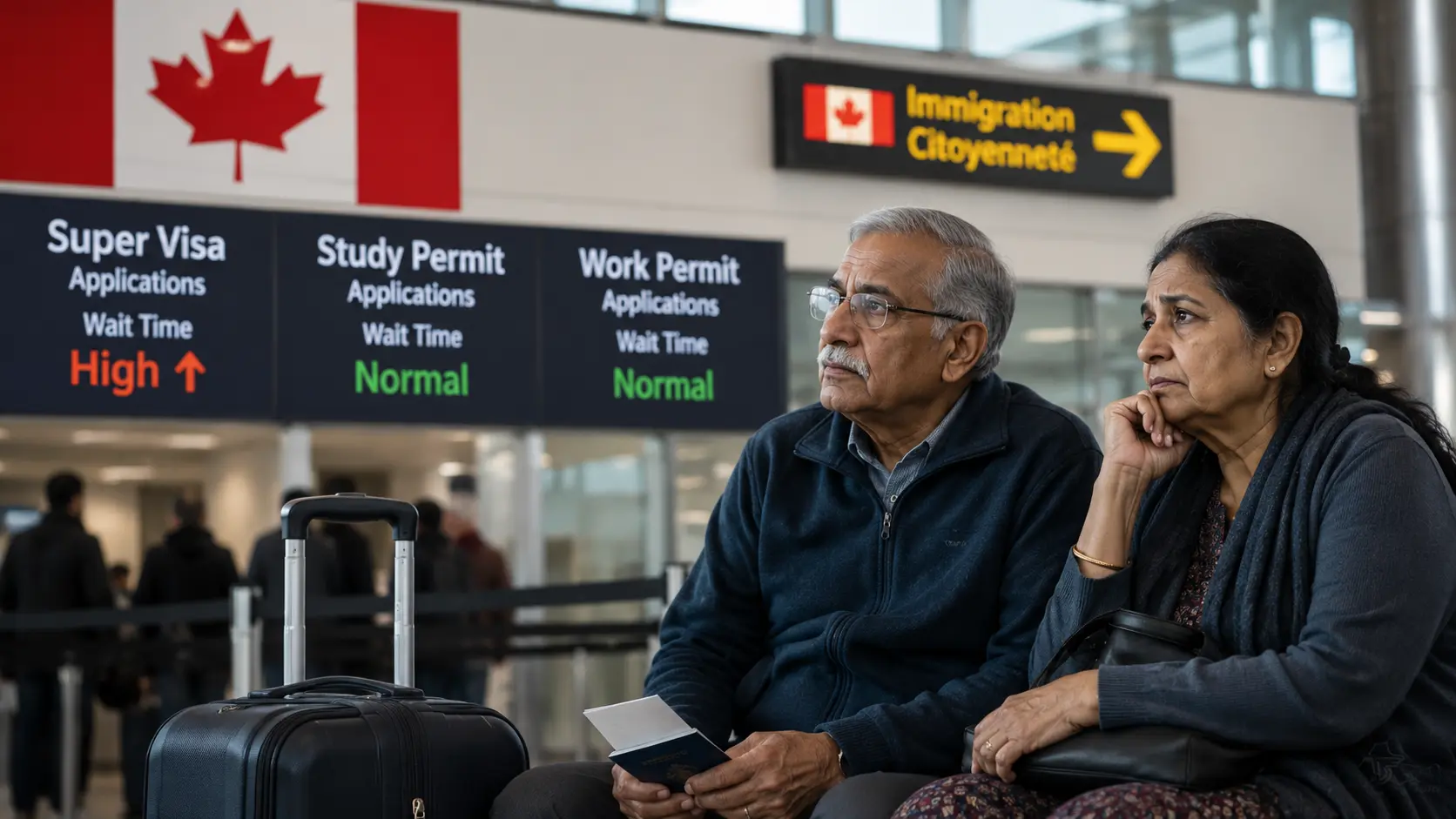
For months, Canada’s processing data told a consistent story for Indian applicants: Super Visa waits falling sharply, other categories holding steady. The latest weekly update from Immigration, Refugees and Citizenship Canada breaks that pattern.
Study permit and work permit processing times for Indian applicants remained unchanged in IRCC’s most recent weekly release, while visitor visa and Super Visa processing times both edged higher, a reversal after weeks in which the Super Visa category in particular had delivered the fastest improvements of any temporary residence category tracked for India.
What changed and what did not
IRCC updates its temporary residence processing time estimates weekly, tracking how long the department is taking to finalise newly submitted applications across the top source countries, including India.
In the most recent release, study permit processing times for Indian applicants held at their prior level, following a run of updates earlier in July that had already pushed study permit waits up by a week for both in-Canada and India-based applicants. Work permit processing times for India also held steady in the latest release, after several consecutive weekly updates in June and early July that had brought work permit waits down significantly, including a 15-day improvement in one cycle and a further reduction to the lowest level recorded so far in 2026.
Visitor visa and Super Visa processing times moved in the opposite direction, both recording modest increases for Indian applicants in the latest data. This follows a period in which Super Visa processing for India had improved dramatically, falling by 44 days in one update and by more than two weeks in another, driven by IRCC’s March 2026 income-eligibility reforms that broadened the pool of Canadian sponsors able to meet the Super Visa’s financial threshold.
What is IRCC’s weekly processing times update?
What is IRCC’s weekly processing times update?
Immigration, Refugees and Citizenship Canada publishes processing time estimates for temporary residence applications, covering study permits, work permits, visitor visas and Super Visas, on a weekly basis. These are calculated using the department’s current application inventory and processing capacity, giving applicants a forward-looking estimate rather than a guarantee. Permanent residence and citizenship processing times are updated monthly rather than weekly. IRCC’s formal service standards, which set official targets for how long processing should take, are reviewed far less frequently than the weekly estimates and were last revised in 2018-2019, meaning the published service standard for a category can differ significantly from the current forward-looking estimate applicants actually experience.
Where each category stands for Indian applicants right now
Work permit processing for India has been on a broadly improving trend since June, with the most recent stall following several weeks of consistent gains, including a period in which India was among the countries recording the sharpest reductions of any tracked nationality.
Study permit processing for India has been more volatile, moving between unchanged periods and incremental one-week increases across recent cycles, without the sustained improvement seen in the Super Visa or work permit categories.
Super Visa processing for India remains, even after the latest uptick, dramatically faster than at the start of 2026, when Indian applicants faced waits of around 210 days. The 44-day and subsequent improvements pushed India’s Super Visa waits down to roughly 50 days at their lowest point, well inside the programme’s 112-day service standard. A modest increase in the latest update does not erase that underlying gain; it simply interrupts the run of consecutive improvements.
Visitor visa processing for India has held in a relatively narrow band throughout 2026, described by immigration analysts as reflecting balanced operational capacity across the visa offices handling temporary resident visa applications, rather than any structural shift in either direction.
Why the numbers move week to week
IRCC’s own guidance is explicit that these weekly figures are estimates only and do not guarantee any individual application will be finalised within the stated window. Processing times for any given applicant depend on factors including the completeness of the application, whether additional documentation is requested, security screening requirements, and seasonal fluctuations in application volume across each visa category.
The scale of IRCC’s overall caseload gives context to why individual categories can shift from week to week even without any change in policy. The department finalised more than 1.2 million temporary residence applications in the first five months of 2026 alone, with over 404,000 applications still pending as of 31 May. A caseload of that size means even modest shifts in staffing allocation or application volume within a single visa office can move the published estimate for a specific country by days or weeks.
What this means for Indian applicants planning a Canada trip
For Indian families with a Super Visa application in progress, the current uptick is worth monitoring but does not signal a return to the multi-month waits seen at the start of 2026. Applicants should continue to check IRCC’s published processing times directly before finalising travel plans, since the estimate can move again in either direction at the next weekly update.
For prospective students, the unchanged study permit timeline this week follows a less consistent trend than the sharp, sustained improvements seen in the Super Visa category, meaning study permit applicants should plan around the current multi-week estimate rather than anticipate a near-term acceleration.
For work permit applicants, the pause follows several months of genuine improvement, and IRCC’s own guidance suggests the recent stability likely reflects the department’s processing capacity settling into equilibrium with current application volumes rather than any policy-driven slowdown.
What Indian applicants need to know
Where can I check the current, exact processing time for my specific application category?
IRCC publishes live processing time estimates directly on its website, updated weekly for temporary residence categories including study permits, work permits, visitor visas and Super Visas. Always check the current published figure before making travel or enrolment decisions, as the estimate changes weekly and the figures referenced here reflect the specific week analysed.
Does a longer estimated wait mean my specific application will definitely take longer?
No. IRCC’s processing time estimates are general guidance based on current inventory and capacity, not a guarantee for any individual case. Actual processing time depends on the completeness of your specific application, any additional documentation requested, and security screening requirements specific to your file.
Has the Super Visa income-eligibility reform from March 2026 been reversed?
No. The rule change allowing Canadian sponsors to use either of their two most recent tax years to meet the income threshold, and permitting a visiting parent or grandparent’s own income to contribute where the sponsor meets at least 75% of the requirement independently, remains in effect. The recent uptick in Super Visa processing time is a routine weekly fluctuation, not a policy reversal.
Why do study permit and work permit processing times sometimes move in opposite directions for the same country in the same week?
Each temporary residence category is processed by different teams and visa offices within IRCC, and each carries its own application volume and complexity profile. A surge in study permit applications ahead of a semester intake, for example, can lengthen that category’s processing time in a given week without affecting work permit or visitor visa processing at all.
When will the next IRCC processing times update be published?
IRCC publishes updated temporary residence processing times on a weekly basis, generally on the same day each week. Check IRCC’s official processing times page directly for the most current release date and figures.