Fifty days. That is how long Indian applicants are now waiting for a Canadian Super Visa decision, down from 66 days in the previous IRCC weekly update. The 16-day reduction in a single cycle is the largest improvement recorded for Indian super visa applicants in 2026 and pushes wait times well below the programme’s 112-day service standard for the first time this year.
Immigration, Refugees and Citizenship Canada published the updated processing times in its weekly data release, cited by CIC News. For Indians in Australia, the UK, the US, New Zealand and the UAE who have family members in Canada and want to bring parents for an extended visit, the number matters directly.
What the super visa improvement means
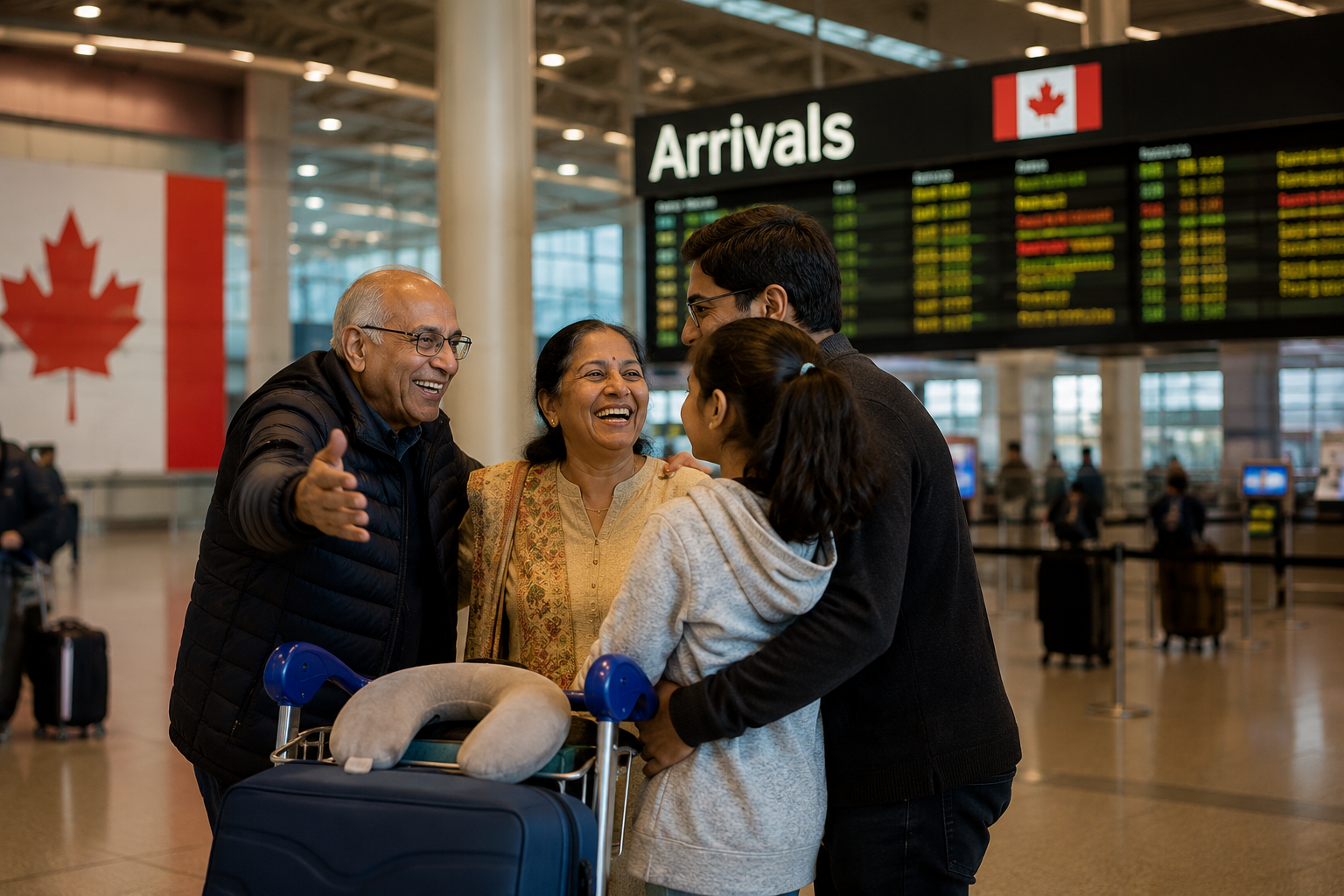
The Super Visa allows parents and grandparents of Canadian citizens and permanent residents to visit Canada for up to five years at a time, with multiple entries over ten years. It is the primary route for Indian families in Canada to reunite with parents without waiting for the Parents and Grandparents Programme, which has not opened new permanent residence intake rounds since 2020.
What is the Super Visa?
The Super Visa is a multiple-entry temporary resident visa for parents and grandparents of Canadian citizens and permanent residents. It allows stays of up to five years per visit and multiple entries over ten years. The host in Canada must meet income requirements based on family size, set at the Low Income Cut-Off plus 30%. Since 31 March 2026, IRCC has allowed hosts to use either of their two most recent tax years to meet the income threshold, and has allowed the visiting parent’s own income to contribute to the calculation where the host meets at least 75% of the requirement independently.
At 50 days, the current processing time is 62 days below the 112-day service standard. For context, Indian super visa applicants were waiting 210 days at the start of the year. The improvement across 2026 has been consistent, with the latest weekly update delivering the sharpest single drop.
The income rule changes that took effect on 31 March 2026 have already broadened the pool of eligible sponsors. Hosts who had a lower-income year due to parental leave, a career change or business disruption can now qualify using the stronger of their two most recent tax years. A parent or grandparent’s own pension or investment income can now also contribute to the income calculation, provided the Canadian host independently meets at least 75% of the required threshold.
The four categories at a glance
| Visa category | Current processing time (India) | Direction |
|---|---|---|
| Super Visa | 50 days | Down 16 days in one cycle |
| Visitor Visa | Stable | No significant change |
| Work Permit | Stable or slight improvement | No significant change |
| Study Permit | Slow | Lagging other categories |
Visitor visa and work permit processing times for Indian applicants held steady or showed modest improvement in the same update cycle, according to IRCC data. Neither category showed the sharp movement seen in the super visa figure, but neither deteriorated.
Study permits are the exception. Processing times for Indian study permit applicants have not kept pace with the improvements in other categories. The slower pace comes against a backdrop of structural constraints that processing speed alone cannot resolve: Canada’s overall study permit cap for 2026 stands at 408,000, down 20% from two years ago, and India’s study permit refusal rate remains near 80%.
Why the study permit picture is harder
The refusal rate is the number that matters most for Indian students and their families. Faster processing of a refusal is not the same as faster access. Education agents advising Indian students for the September 2026 intake have been warning since May that submitting a complete, SDS-compliant application as early as possible remains the strongest hedge against both processing delays and refusals.
SDS, the Student Direct Stream, is available to Indian applicants and provides faster processing where specific conditions are met: a Guaranteed Investment Certificate, upfront medical clearance, and paid first-year tuition must all be in place at the time of application. Applications that qualify under SDS can be processed in under 14 days. Those that do not are routed to standard processing and face the full queue.
The study permit cap affects how many applications IRCC will approve in a calendar year, not how quickly it processes them. Indian students competing for a limited number of approvals face both a processing delay and a volume constraint simultaneously.
What this means for Indian families in Canada and abroad
For the approximately 1.8 million Indian-origin people living in Canada, the super visa improvement is the most actionable news in this update. Parents or grandparents in India who want to visit for an extended period now face a processing wait of 50 days, the shortest in years, with more flexible income eligibility for the Canadian sponsor.
For Indian students and families in Australia, the UK, the US, New Zealand and the UAE who are planning Canadian study permit applications for 2026 or 2027, the processing speed improvement does not resolve the refusal rate or cap constraints. Submitting a strong, complete application remains the primary variable within an applicant’s control.
For Indian professionals on work permits in Canada, the stable processing times provide planning certainty for renewals and extensions during the second half of 2026.
What Indians planning to visit or move to Canada are asking
How do I apply for a Super Visa for my parents in India?
The host in Canada, the Canadian citizen or permanent resident child or grandchild, applies on the parent’s behalf through the IRCC online portal. The parent submits the application from outside Canada. Required documents include proof of the host’s income for either of the two most recent tax years, a letter of invitation from the host, private health insurance of at least CAD 100,000 from a Canadian-approved insurer for a minimum of one year, and an immigration medical exam from an IRCC-approved physician. Check the current document checklist at canada.ca before applying, as requirements are updated regularly.
My parents have a pension in India. Can that income count towards the Super Visa income requirement?
Yes, under the rules that took effect on 31 March 2026, the visiting parent or grandparent’s own regular, recurring income can be included in the calculation, provided the Canadian host independently meets at least 75% of the required Minimum Necessary Income threshold. IRCC has not published the exact minimum percentage required to unlock this option. Consult a registered Canadian immigration consultant before relying on this provision.
Why is India’s study permit refusal rate so high?
IRCC does not publish a country-by-country explanation of refusals. Immigration consultants and agents attribute the high refusal rate for Indian applicants to a combination of factors: incomplete applications, insufficient proof of funds, weak ties to India, and high overall demand relative to the available cap. The refusal rate is not affected by processing speed improvements. A faster decision on an incomplete or weak application is still a refusal.
Can I apply for a Super Visa if I am on a work permit in Canada, not a permanent resident?
No. The host must be a Canadian citizen, permanent resident, or a person registered under the Indian Act. Temporary residents on work or study permits cannot sponsor a Super Visa application. You would need to obtain permanent residence first.
How often does IRCC update processing times?
IRCC updates temporary residence processing times, covering visitor visas, study permits, work permits, and super visas, weekly. Permanent residence and citizenship processing times are updated monthly. The figures represent how long it took IRCC to process 80% of completed applications and are not a guarantee for any individual application. Check the official IRCC processing times tool at canada.ca before making any travel or application decisions.