

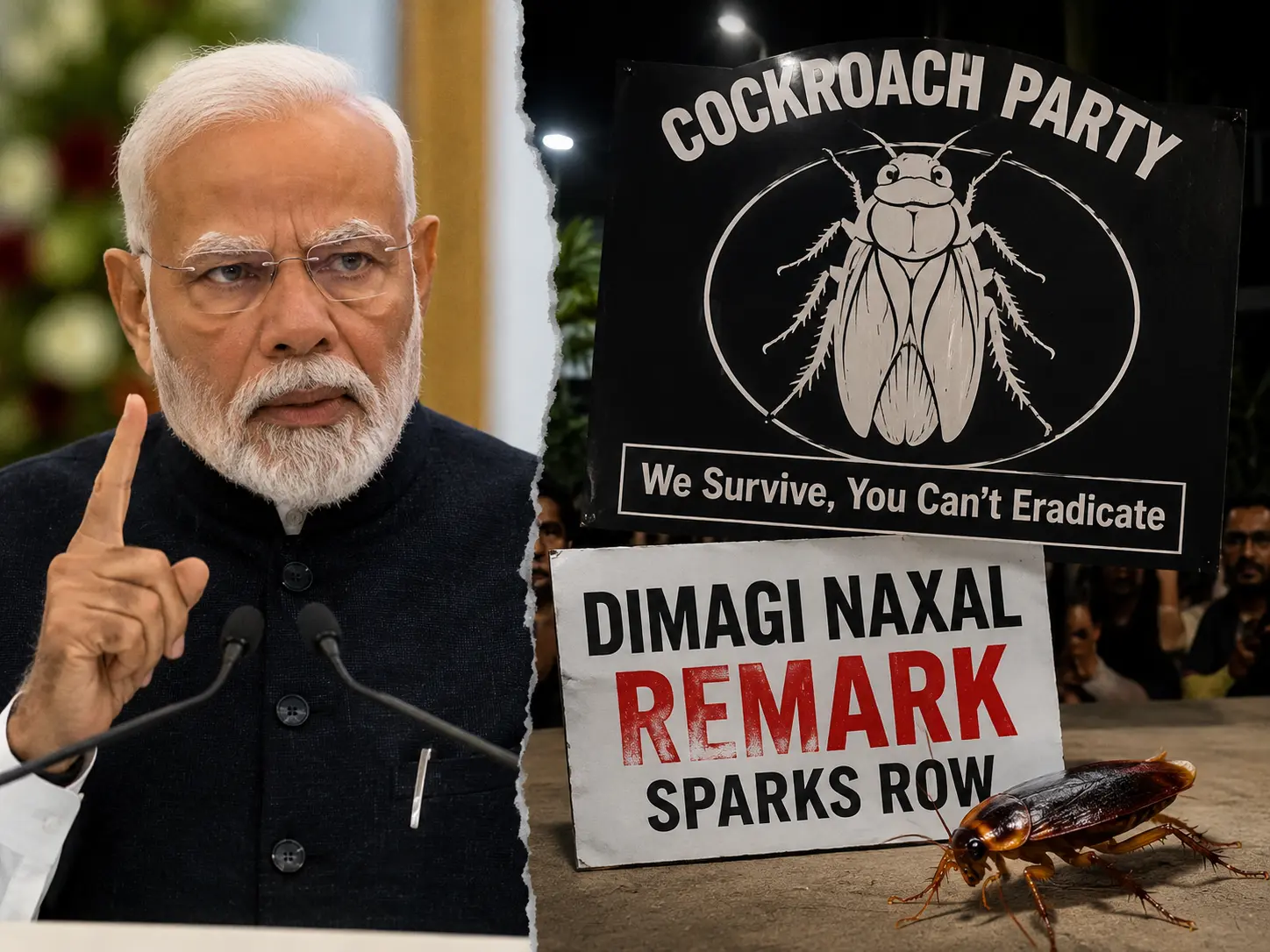
Prime Minister Narendra Modi did not name the Cockroach Janta Party in his Independence Day speech. The movement’s spokesperson made sure everyone understood who he was talking about anyway.
Cockroach Janta Party chief spokesperson Saurav Das hit out at Modi on Saturday, 15 August 2026, over the Prime Minister’s reference to “dimagi Naxals” during his address from the Red Fort marking India’s 80th Independence Day, arguing that educated young people cannot be branded “Naxalis” simply for questioning the government.
What Modi actually said
In his Independence Day address, Modi said that while the menace of armed Naxalism was nearing its end, a different threat had emerged in its place: individuals with what he called a “dimagi Naxal” mindset, using education and intellect rather than weapons to create violence and unrest and take the country in the wrong direction. He said such individuals needed to be identified and isolated, and that the country’s youth needed to be actively brought into the mainstream.
“We have succeeded in getting rid of armed Naxals in the jungles, but ‘dimagi Naxals,’ intellectual Naxals, are looking for opportunities to create violence and unrest. They want to drag society on the wrong path,” Modi said, according to reporting on the speech.
Modi did not name the Cockroach Janta Party or any specific protest movement in his remarks. He did, however, spend a significant portion of the speech highlighting government initiatives aimed specifically at young Indians, including AI skills training and free online coaching for competitive examinations, subjects directly connected to the grievances that fuelled the CJP’s protests earlier this year.
What is a “dimagi Naxal”?
What does “dimagi Naxal” mean?
“Dimagi Naxal” translates roughly as “intellectual Naxal” or “mental Naxal” in English. It echoes an earlier politically charged term, “urban Naxal,” which Modi and leaders of the Bharatiya Janata Party have used since around 2018 to describe activists, academics, intellectuals and other government critics accused of sympathising with or advancing Maoist ideology through non-violent, intellectual or media-based means rather than armed insurgency. Naxalism refers to a decades-long Maoist insurgency in parts of central and eastern India. The term “dimagi Naxal” applies a similar framing to the specific set of people Modi described in his Independence Day speech: educated individuals allegedly working to destabilise the country through non-violent, intellectual channels rather than armed conflict.
Why the timing matters
The remark landed weeks after the Cockroach Janta Party emerged as one of the most significant grassroots challenges to Modi’s government since he returned to office, a youth-led movement that grew from a satirical response to a Supreme Court remark in May into a nationwide protest wave. That wave brought tens of thousands of protesters to the streets of New Delhi in a march toward Parliament, and ultimately contributed to the resignation of Union Education Minister Dharmendra Pradhan over alleged NEET examination irregularities, a resignation NRI Affairs covered in detail when it happened.
Foreign Policy magazine described the movement’s arc as showing how “a splintered society can start to coalesce,” noting the protests were directed squarely at Modi’s government and represented an unusually broad, generational mobilisation in a country where V.S. Naipaul had once described political sentiment as fractured into a “million mutinies.” While Modi’s speech did not reference the protests by name, the juxtaposition of his youth-focused policy announcements alongside the “dimagi Naxal” warning was widely read by commentators and by the CJP itself as a direct response to the movement’s success.
Das’s broader message beyond the rebuttal
In a separate Independence Day message posted the same day, Das struck a markedly different, more reflective tone than his direct rebuttal to Modi. He said that after what he described as 12 long years, the country was celebrating Independence Day “in its truest sense,” because “something within us has finally broken free: the fear.”
He said a generation that had been told to remain silent had found its voice, and a generation told that nothing would change had begun to believe again. “An era of awakening has begun. An era of peaceful protest has begun,” Das wrote, predicting that ordinary people would gradually “weed out the old, the corrupt, the incompetent and the arrogant” from positions of power. He added, in a line directly evoking the movement’s origin at Delhi’s Jantar Mantar protest site, that “a Jantar Mantar is being born in every district of this country,” where people who had previously felt hopeless would now find a platform.
The political response beyond the CJP
Modi’s remark triggered a separate, sharper political confrontation between the BJP and the Congress party on the same day. BJP national spokesperson Pradeep Bhandari directly linked the phrase to Congress leader Rahul Gandhi, posting on X: “Rahul Gandhi is unfit to be LoP. Rahul Gandhi’s mindset reflects that of a ‘Dimagi Naxal’ ecosystem!” Bhandari also claimed Gandhi had skipped the Independence Day event because he “hates the Vande Mataram,” a claim that prompted its own separate exchange after the full Vande Mataram was played at Congress party headquarters the same day, in an apparent direct response.
Congress representatives pushed back on the “dimagi Naxal” framing itself, with reports describing Congress figures pressing the BJP to “describe that phrase” and define exactly who it was meant to capture, a demand that echoed the CJP’s own core objection: that the label is vague enough to be applied to almost any government critic.
What comes next
Neither Modi’s office nor the government has issued any specific clarification defining who qualifies as a “dimagi Naxal” or what concrete action, if any, “identifying and isolating” such individuals might involve. The CJP’s response, alongside the Congress-BJP exchange it triggered, suggests the phrase is likely to remain a point of political contention well beyond the Independence Day news cycle itself, particularly given the movement’s demonstrated capacity this year to convert online rhetoric into large-scale, real-world mobilisation.
What readers following this story are asking
Did PM Modi name the Cockroach Janta Party directly in his speech?
No. Modi’s Independence Day address referred generally to individuals with a “dimagi Naxal” mindset without naming any specific movement or organisation. The CJP’s spokesperson and multiple commentators have interpreted the remark as an indirect reference to the movement, given its timing and the government’s recent experience with youth-led protests.
What is the difference between “Naxalism” and “dimagi Naxal”?
Naxalism refers to a decades-long armed Maoist insurgency active in parts of central and eastern India. “Dimagi Naxal,” or “intellectual Naxal,” is a political term applied to individuals accused of advancing similar destabilising goals through non-violent, intellectual or media-based means, such as activism, academic commentary, or online organising, rather than armed conflict.
Has the government named any specific individuals or organisations as “dimagi Naxals”?
No specific individuals or organisations have been officially named under this label in connection with Modi’s 15 August remarks. The term has historically been applied loosely by BJP figures to activists, academics and government critics.
What triggered the Cockroach Janta Party movement in the first place?
The movement began in May 2026 as a satirical response to a remark by the Chief Justice of India comparing unemployed young people to “cockroaches.” It grew rapidly into a broader protest movement over alleged NEET examination irregularities, ultimately contributing to the resignation of the Union Education Minister.
Is the Cockroach Janta Party a registered political party?
No. According to its own public information, the CJP is not registered with the Election Commission of India and describes its own ideology as political satire.