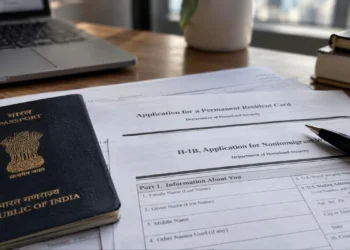


UK study visa applications fell 16% in the year to August 2026, Home Office figures released on 10 September show, with just 360,700 main applicants against the same period last year.
For Indian students weighing a UK student visa against Canada, Australia or the US, the number is more than a statistic. It is the clearest signal yet that the UK’s own policy churn, not just global competition, is pushing Indian student visa applicants elsewhere. August is the single busiest month for UK study visa applications, sitting just ahead of the September intake, which makes this year’s drop harder for universities and agents to wave off as noise in the data.
Table of Contents
The headline numbers behind the UK study visa applications fall
Home Office statistics put sponsored study visa main applications at 360,700 for the year ending August 2026, down 16% on the year ending August 2025. Applications from dependants of international students fell even further, down 22% to just 17,000, continuing the collapse that began after the UK barred most taught master’s and undergraduate students from bringing family members from January 2024.
August itself, the peak month before the autumn intake, told the same story for UK student visa 2026 applicants. Applications came in just under 100,000, down from 120,300 in August 2025 and roughly a third below the 147,200 recorded in August 2023.
| August applications | Main applicants |
|---|---|
| August 2022 | 144,200 |
| August 2023 | 147,200 |
| August 2024 | 122,100 |
| August 2025 | 120,300 |
| August 2026 | Just under 100,000 |
Separate data from visa-processing platform Enroly found Certificate of Acceptance for Studies issuances down 27% year-on-year for the September 2026 intake, with business and management courses, traditionally a strong pull for Indian students applying for a UK student visa, down more than 45%.
Where Indian students fit into the UK study visa applications picture
India is named directly among the nationalities hit hardest by the fall in UK study visa applications, alongside Pakistan, Bangladesh, Sri Lanka, Ghana and Nigeria, according to sector reporting on the Home Office release.
| Course level | |||
|---|---|---|---|
| up 16% | |||
The pattern is consistent across the sources reporting it. Taught postgraduate and undergraduate applicants, the bulk of Indian demand for a UK student visa, are pulling back hard, while PhD numbers, largely unaffected by the dependant ban since research students remain exempt, are still growing. That split is the clearest evidence that policy, not just cost or competition, is doing the damage to UK study visa applications from India.
Why UK study visa applications are falling
Three UK policy decisions sit behind the numbers, and none of them is finished playing out.
The January 2024 ban on most students bringing dependants remains the single biggest driver behind falling UK study visa applications. It has taken 88% off dependant applications compared with the year before the rule changed, and it disproportionately hit Indian students applying for a UK student visa through the one-year taught master’s route, which more Indian applicants used to bring family than students from almost any other country.
The UK Graduate Route, the two-year post-study work visa that lets international graduates stay and work in the UK, is being cut to 18 months for bachelor’s and taught master’s graduates from January 2027, the UK government confirmed. Students who want the fuller two-year window under the current UK Graduate Route have until 31 December 2026 to apply. PhD graduates keep the three-year route. For Indian students, whose UK student visa decisions are made overwhelmingly on post-study work prospects, an 18-month UK Graduate Route is a materially weaker pitch than what Canada, Australia and even the US currently offer.
Then there is money. Student visa fees rose to 558 pounds from 524 pounds in April 2026, and the monthly maintenance funds applicants must show jumped to 1,529 pounds in London and 1,171 pounds outside it for anyone applying for a UK student visa in 2026, both increases layered on top of a currency that has not made the UK any cheaper for Indian families paying in rupees.
A fourth factor has not yet hit the UK study visa applications numbers but is already rattling the sector: a new international student levy, confirmed at 925 pounds per student per year from August 2028, with a Treasury pledge that the money funds maintenance grants for disadvantaged domestic students. Russell Group chief executive Libby Hackett said the visa application data “underlines the volatility in the international student market,” and argued that tying UK universities’ international income to domestic funding schemes “does not make sense.” UCU general secretary Jo Grady went further, calling the levy a case of the government “scapegoating migrants instead of addressing the real, deep-rooted challenges facing higher education.”
One narrower measure, the “visa brake” introduced in March 2026, refuses entry clearance applications by nationality. It currently applies only to Afghanistan, Cameroon, Myanmar and Sudan, not India, and the Home Office itself has said it covers a small share of applications. It is not a driver of the Indian decline in UK study visa applications, but it is a marker of how comfortable the current government is with blunt, nationality-based tools, a tone Indian applicants and their consultants are clearly picking up on even without being directly targeted.
The deadline Indian students on a UK student visa track cannot afford to miss
For anyone already holding an offer or weighing one for January 2027 entry, the calendar matters more than the commentary. The 31 December 2026 deadline to lock in the current two-year UK Graduate Route is now the single most consequential date on the UK student visa calendar for Indian applicants, and it sits inside a wider pattern: three cost and access changes landing inside 18 months, with a fourth already scheduled for 2028. The same date also closes the UK’s eVisa transition window, so applicants juggling both should not leave either to the last week of December.
Whether that adds up to a UK that is done courting Indian students, or a government trying to have both stricter migration numbers and a thriving university sector at the same time, is the question the next set of UK study visa applications data, due in the new year, will start to answer.