Table of Contents
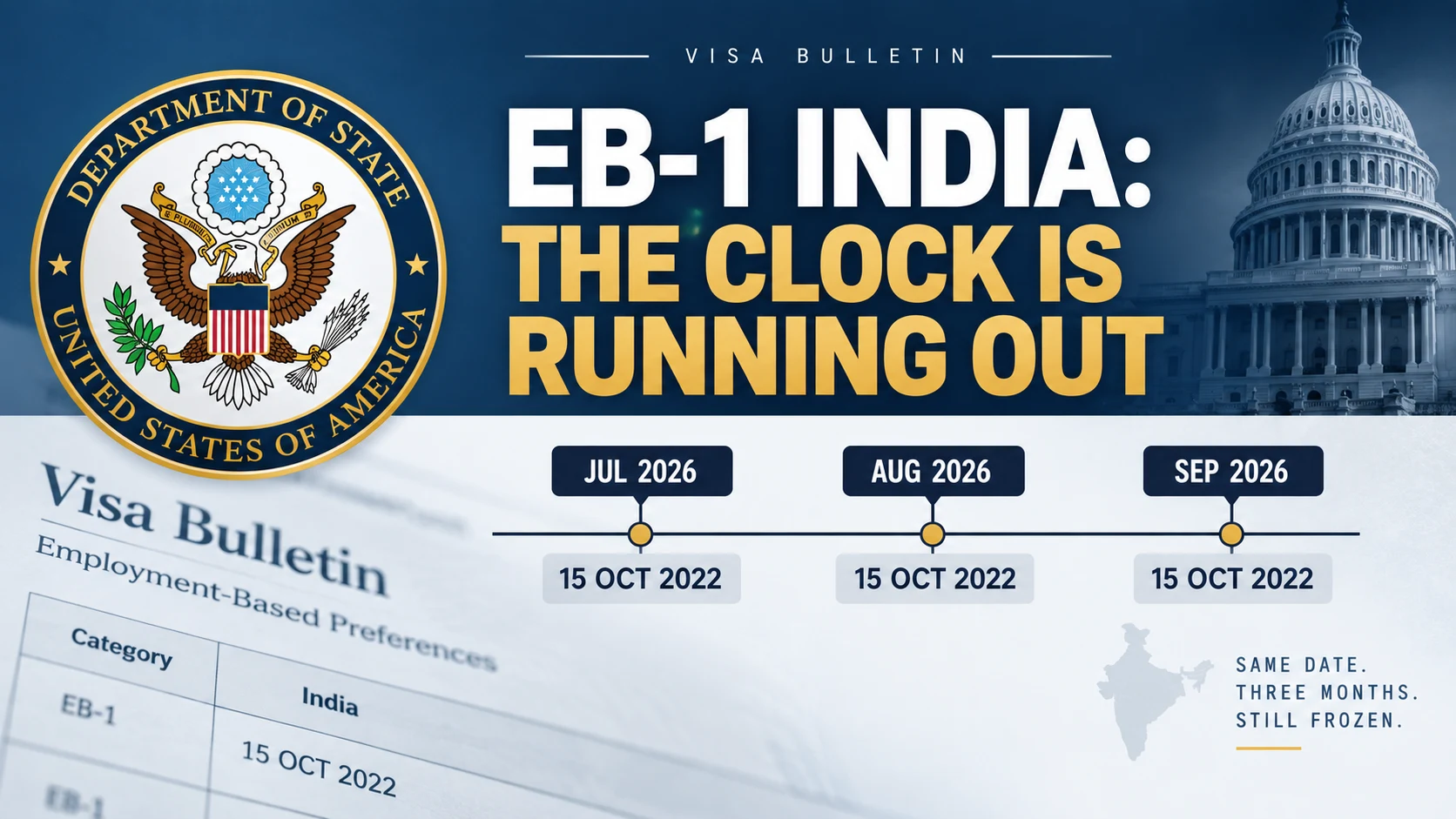
The September 2026 visa bulletin, published by the U.S. Department of State as Number 18 of Volume XI, holds the Employment-Based First Preference (EB-1) Final Action Date for India at 15 October 2022. That is the same date it has shown since July, when it retrogressed two months from 15 December 2022. It has now held there through July, August, and September without moving in either direction. EB-2 India remains marked “Unavailable” (U) in the same three bulletins, meaning no EB-2 green cards can be issued to Indian applicants at all until the new fiscal year opens on 1 October.
What is new in the September 2026 visa bulletin is not a date. It is a warning, stated by the Department of State itself in the bulletin’s own text: “High demand and number use by aliens chargeable to India in the EB-1 visa category may necessitate making the category unavailable in the coming weeks if India’s pro-rated limit in the EB-1 category is reached before the fiscal year ends.” A near-identical warning applies to EB-2 more broadly.
Neither warning is new phrasing, bulletins carry versions of this cautionary language most months, but with the fiscal year closing on 30 September and this September bulletin published against that three-week runway, the warning applies with real force for the first time this cycle.
Why the September 2026 visa bulletin froze in the first place
Under the rules the September 2026 visa bulletin applies, employment-based green cards are capped by both a worldwide annual limit and a per-country limit. For fiscal year 2026, the worldwide Employment-Based preference limit is 186,317 visas, and the per-country limit is fixed at 7% of the combined family and employment totals, 28,862 visas before carryover adjustments, or 29,136 with carryover included.
India, the country at the center of this September 2026 visa bulletin story, along with China, Mexico, and the Philippines, is one of a small number of countries that routinely exhausts its per-country allocation well before other nations do, because far more Indian nationals have pending employment-based petitions than the per-country cap was ever designed to absorb in a single year. When that allocation runs out before the fiscal year does, the State Department’s only tools are to push the Final Action Date backward (retrogression) or freeze the category entirely (Unavailable) until the next fiscal year’s numbers open up, exactly the choice the September 2026 visa bulletin recorded for EB-1 and EB-2 India.
What actually changed in the September 2026 visa bulletin between July and September
NRI Affairs’ own July 16, 2026 coverage reported both moves behind today’s September 2026 visa bulletin as they happened: the EB-1 India retrogression from 15 December 2022 to 15 October 2022, and EB-2 India’s shift to Unavailable, sourced to the July 2026 Visa Bulletin published by the State Department on 2 June 2026. Reading that piece against this one shows the real trajectory: both categories moved sharply in June, then went flat.
August and September brought no further movement in either direction, leaving the September 2026 visa bulletin numbers exactly where July left them. For EB-1 India applicants specifically, that flat line has a double edge. Anyone with a priority date between 15 October 2022 and 14 December 2022, who had briefly become eligible to file, lost that eligibility the moment the July retrogression took effect, and nothing has reopened it since.
The September 2026 visa bulletin’s stall is also a reversal from where this queue stood further back. NRI Affairs’ March 2025 coverage reported EB-2 and EB-3 India priority dates actually advancing, movement in the applicants’ favor. Eighteen months later, EB-2 India is not just stalled, it is fully unavailable, and EB-1 India, historically the fastest-moving employment category, is the one now carrying the State Department’s own unavailability warning.
Why the September 2026 visa bulletin matters specifically for NRIs in the US, not applicants in India
The September 2026 visa bulletin, at its core, is not a story about people applying from India. The Final Action Date and Dates for Filing charts govern two different groups: individuals adjusting status from inside the United States (mostly H-1B holders already living and working there, filing Form I-485 with USCIS) and those consular processing from abroad. The overwhelming majority of Indians affected by EB-1 and EB-2 retrogression are the former, working professionals already in the US on H-1B status, many mid-way through a PERM labor certification or I-140 process that can take a decade or more end to end, the exact population this September 2026 visa bulletin update is about.
For that population, a category going Unavailable under the September 2026 visa bulletin is not an abstraction. It can mean a pending adjustment application stalls, a work permit and travel document renewal cycle continues indefinitely, and a decision about buying a home, changing employers, or having a child gets made against a backdrop of genuine uncertainty about status. None of that applies to a comparable degree to someone applying for the same category from India directly, which is exactly why the September 2026 visa bulletin is a live, developing story for this publication’s UK, US, and Australia readership and not a domestic Indian visa story.
What to actually do with this September 2026 visa bulletin information
For the September 2026 visa bulletin cycle, USCIS, not the State Department, decides each month whether adjustment-of-status applicants must use the Final Action Dates chart or the more generous Dates for Filing chart; that determination is published separately at USCIS’s official visa bulletin guidance page and can change month to month, so it is worth checking directly rather than assuming last month’s rule still applies.
Beyond that, there is no individual action that changes where the Final Action Date sits, it is a function of aggregate demand against a fixed annual cap, not something an individual applicant’s paperwork can move. Under the September 2026 visa bulletin, what is worth doing now, with three weeks left in fiscal year 2026, is treating any pending EB-1 or EB-2 filing with added urgency: confirming premium processing status if applicable, and watching for the October 2026 bulletin closely, since fiscal year 2027’s fresh numbers open on 1 October and historically bring the year’s most significant movement, in either direction.
FAQs
Does the September 2026 visa bulletin affect green card applicants who are still living in India?
Only indirectly, and only for the categories this September 2026 visa bulletin actually affects. The Final Action Dates chart primarily governs applicants adjusting status from inside the US, mostly H-1B holders. Someone applying from India through consular processing follows the same dates but is a much smaller share of the affected population for these two categories specifically.
Is EB-1 India actually unavailable in the September 2026 visa bulletin right now?
No. As of the September 2026 visa bulletin, EB-1 India’s Final Action Date is 15 October 2022, not marked Unavailable. The Department of State’s own bulletin text warns that could change before 30 September if demand in the category continues at its current pace.
Why did EB-2 India become unavailable in the September 2026 visa bulletin while EB-1 India only retrogressed?
Both are governed by the same per-country cap mechanics behind the September 2026 visa bulletin, but EB-2 India’s pro-rated annual limit was fully exhausted, forcing a hard stop, while EB-1 India’s demand pushed the date backward without exhausting the full annual allocation, at least as of September.
Will October’s bulletin bring good news after the September 2026 visa bulletin?
Not knowable in advance from this September 2026 visa bulletin alone. The start of a new fiscal year (1 October 2026) resets annual per-country limits, which historically produces the year’s largest single movement in Final Action Dates, but the direction and size of that movement depends on demand data the State Department does not publish until the bulletin itself is released.