India is running for the United Nations Security Council again.
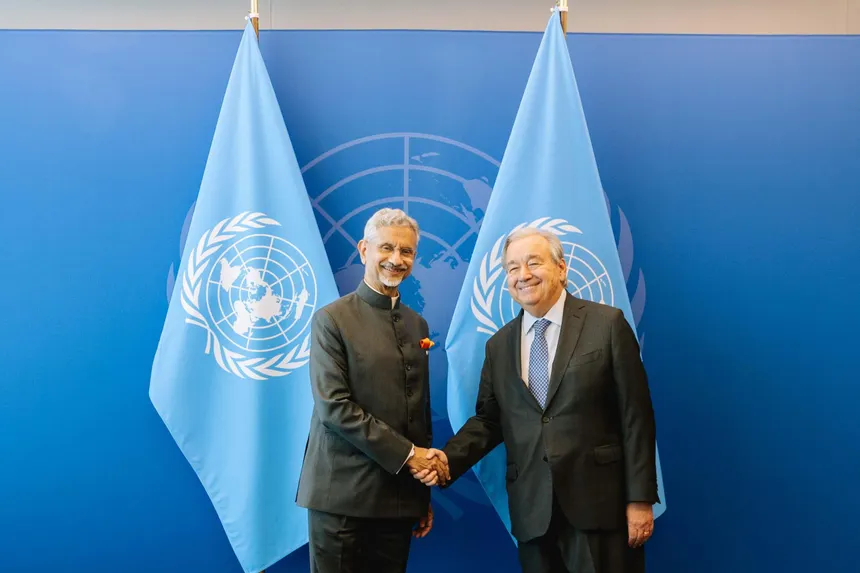
External Affairs Minister S. Jaishankar formally launched India’s campaign for election as a non-permanent member of the UN Security Council for the 2028-29 term at a special event at UN Headquarters in New York on 14 July 2026. The same afternoon, he met UN Secretary-General Antonio Guterres to discuss global developments including West Asia, Ukraine and Sudan.
“Glad to meet Antonio Guterres, Secretary-General of the United Nations in New York today. Discussed global developments, including West Asia, Ukraine and Sudan. Also recognised the strength of India-UN cooperation,” Jaishankar posted on X after the meeting.
The campaign launch and the Guterres meeting mark the formal opening of India’s push for a return to the UN Security Council horseshoe table, where it last sat for the 2021-22 term. The election for the 2028-29 seats will be held in June 2027, giving India approximately 11 months to secure the votes of the UN General Assembly’s 193 member states.
India will compete against Tajikistan for the single non-permanent seat available to the Asia-Pacific Group.
What India is campaigning on
Jaishankar outlined India’s campaign priorities at the launch event, presenting them under the acronym SHANTI, the Sanskrit word for peace.
He anchored the campaign in India’s peacekeeping record, one of the most extensive of any UN member state. “Peacekeeping has been a crucial element of maintenance of international peace and security since the very inception of the United Nations. India has always been in the forefront of discharging that responsibility. Our cumulative contribution is nearly 300,000 deployments in about 50 missions worldwide,” Jaishankar said. “Currently, we have 4,300 personnel across 10 of the 11 active UN missions.”
He said India would advocate for better-equipped, technologically enabled and realistically mandated peacekeeping operations, and would champion the Women, Peace and Security agenda within the UN framework.
India’s campaign also emphasises its commitment to multilateralism, its role as the world’s most populous democracy, and its position as a voice for the Global South in international institutions.
What is the UN Security Council?
What is the UN Security Council?
The United Nations Security Council is the UN’s primary body responsible for the maintenance of international peace and security. It has 15 members: five permanent members with veto power (the US, UK, France, Russia and China, known as the P5) and ten non-permanent members elected by the UN General Assembly for two-year terms. Non-permanent seats are allocated by regional group. The Asia-Pacific Group has two non-permanent seats in the Council at any given time. India is seeking one of those seats for the 2028-29 term. Elections are held annually in June. A candidate needs two-thirds of voting member states to win.
The diplomatic context
The UNSC campaign launch came at the end of a sustained diplomatic circuit for Jaishankar. He completed an official visit to Qatar, Bahrain, Kuwait and Oman from 5 to 10 July before arriving in the United States. After New York, he is scheduled to attend the 3rd India-EU Trade and Technology Council meeting in Brussels on 14 and 15 July, where he will meet his EU and Belgian counterparts.
The New York trip places the UNSC campaign within a broader pattern of Indian diplomatic engagement that has intensified significantly in 2026. Modi’s three-nation Indo-Pacific tour covering Indonesia, Australia and New Zealand concluded on 11 July. Jaishankar’s Gulf tour and New York visit immediately followed. The Brussels engagement adds a European dimension to the multilateral outreach.
The geopolitical backdrop to the UNSC campaign is consequential. The UNSC elections will come amid significant geopolitical shifts as the world continues to grapple with challenges such as the Ukraine war, Gaza conflict and the US-Israel war against Iran. India’s stated positions on these conflicts, including its policy of strategic autonomy and its refusal to vote for Western-sponsored resolutions on Russia-Ukraine, have been both a point of differentiation and a source of diplomatic friction in its relations with Western UNSC members.
India versus Tajikistan: the Asia-Pacific Group race
India and Tajikistan will compete for the sole seat in the Asia-Pacific Group category in the June 2027 UNSC election.
Tajikistan is a landlocked Central Asian country with a population of approximately 10 million and a significantly smaller diplomatic footprint than India. On paper, India’s candidacy is overwhelmingly stronger: the world’s most populous country, the fifth-largest economy, a founding member of the UN and a country that has served on the Security Council seven times since 1950. India’s record of six previous non-permanent memberships gives it institutional credibility that Tajikistan cannot match.
However, UNSC elections have produced surprising results in the past. Bloc voting, bilateral trade and aid relationships, and shifting geopolitical alignments mean that larger and more diplomatically prominent countries have lost to smaller competitors. India’s foreign ministry is not taking the outcome for granted.
The last contested Asia-Pacific Group UNSC race India entered was for the 2021-22 term, for which it ran unopposed after China withdrew its candidate. The 2028-29 race against Tajikistan is a contested election.
India’s UNSC history and the permanent seat question
India has served as a non-permanent UNSC member seven times: 1950-51, 1967-68, 1972-73, 1977-78, 1984-85, 1991-92 and 2021-22. It is seeking an eighth term for 2028-29.
The non-permanent seat campaign runs alongside India’s longer-standing push for a permanent seat on the Security Council. India, alongside Germany, Japan and Brazil as the G4, has consistently argued that the UNSC’s current structure, designed in 1945, does not reflect the contemporary world. The G4 campaign for permanent seat expansion has not advanced materially in recent years due to P5 resistance, particularly from China.
Jaishankar has been direct about India’s position on UNSC reform. He has described the current structure as “anachronistic” and argued that the world’s most populous country and one of its fastest-growing economies deserves a permanent voice at the table. The 2028-29 non-permanent seat campaign does not advance the permanent seat goal directly, but it keeps India visible and active at the UN at a moment when multilateral institutions are under significant strain.
What the Guterres meeting covered
The Jaishankar-Guterres meeting on 14 July focused on global developments rather than the UNSC campaign specifically. Jaishankar’s X post confirmed the discussion covered West Asia, Ukraine and Sudan. He described the meeting as recognising “the strength of India-UN cooperation.”
The UN Secretary-General’s office confirmed the meeting took place at UN Headquarters on Monday afternoon, consistent with a schedule of meetings released by the UN prior to Jaishankar’s arrival.
No formal readout beyond Jaishankar’s X post was available at the time of publication. The meeting was a bilateral diplomatic engagement, standard for ministerial-level visits to New York, and not a formal UNSC or General Assembly session.
What it means for the Indian diaspora
India’s return to the Security Council, if the 2027 election is won, would have indirect but real significance for the global Indian diaspora. A UNSC seat gives India a platform to raise issues affecting Indian nationals abroad, including consular protection, migration governance, and the concerns of diaspora communities in conflict-affected regions.
More directly, India’s diplomatic positioning on the UNSC is closely watched by the 5.2 million Indian-Americans, the approximately 900,000 Indian-Australians, and the large Indian communities in the UK, UAE and Canada, all of whom live in countries that are either permanent UNSC members or regular non-permanent members. The alignment or divergence between India’s UNSC positions and those of their countries of residence is a live issue for diaspora communities navigating dual loyalties in an increasingly multipolar world.
What India’s UNSC campaign means in practice
What is the SHANTI campaign and what does the acronym stand for?
Jaishankar introduced SHANTI as the framing for India’s UNSC campaign at the 14 July launch event. He described it as encapsulating India’s priorities for its non-permanent membership. The full expansion of the acronym was not published in the sources available at the time of publication. NRI Affairs will update this report when the MEA releases the full campaign document.
When is the UNSC election and how does India win?
The election for the 2028-29 non-permanent UNSC seats will be held in June 2027 at the UN General Assembly in New York. A candidate needs two-thirds of voting member states, approximately 129 of 193, to win. The Asia-Pacific Group will elect one non-permanent member. India and Tajikistan are the two declared candidates for that seat.
How many times has India served on the UNSC?
India has served as a non-permanent UNSC member seven times since 1950. Its most recent term was 2021-22. A successful 2027 election would give India its eighth non-permanent membership.
Does this campaign affect India’s push for a permanent UNSC seat?
Not directly. India’s campaign for a permanent seat, pursued alongside Germany, Japan and Brazil as the G4, is a separate and longer-term diplomatic objective that requires amendment of the UN Charter and agreement among the P5. The non-permanent seat campaign and the permanent seat campaign run on different tracks.
Which countries are India’s key vote targets in the Asia-Pacific Group race?
India has not published its vote-seeking strategy. Historically, UNSC election campaigns involve bilateral outreach across all five UN regional groups. India’s diplomatic engagement in the Gulf, Southeast Asia, Africa and Latin America in 2026 is partly directed at building the coalition of 129-plus votes needed to win in June 2027.