When Andrew Charlton flew to New Delhi in February 2026 to attend India’s AI Impact Summit, he was not there to sign anything. He was there to make an argument: that Australia and India share a values-based approach to artificial intelligence, that their economies are more complementary than competitive in technology, and that the bilateral relationship needed to be recalibrated around AI, digital infrastructure and clean energy rather than commodities alone.
Five months later, Prime Ministers Modi and Albanese made that argument official.
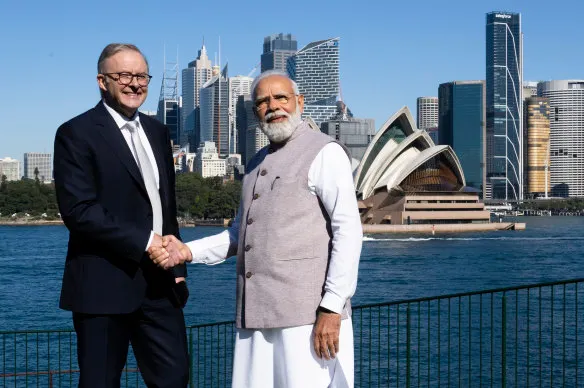
The Australia-India Partnership on Cyber, Critical Technologies and Supply Chains, known as PACTS, was launched at the third India-Australia Annual Leaders’ Summit in Melbourne on 9 July 2026. It replaced the 2020 framework and is built around five pillars: supply chain resilience, critical technology, cybersecurity, digital resilience and defence research collaboration. It covers artificial intelligence, semiconductors, telecommunications, biotechnology, space technologies, undersea cable resilience and digital public infrastructure.
Charlton, Australia’s Assistant Minister for Science, Technology and the Digital Economy, told NDTV during the summit visit that there were “lots of opportunities” for India and Australia in AI and technology. The interview was the most direct public statement yet from an Australian minister on where the bilateral technology agenda is heading after the summit.
What Charlton has been saying
The clearest window into Charlton’s thinking on India comes from his address at the Australia-India Track 1.5 Strategic Dialogue in Sydney on 18 May 2026.
“The Australia-India relationship must be recalibrated to reflect a rapidly changing global economy, particularly in artificial intelligence, digital infrastructure and clean energy,” Charlton said, adding that the partnership between the two countries was entering a more strategic phase shaped by technology, trade and shared democratic values.
He pointed to India’s large-scale digital transformation as evidence of its growing global influence in technology governance, citing systems such as the Unified Payments Interface and Aadhaar as examples of innovation deployed at national scale. “This credibility matters,” he said, adding that Australia and India shared an interest in ensuring emerging technologies are governed by democratic principles rather than closed systems.
On the workforce dimension, which is the most directly relevant point for the Indian-Australian diaspora, Charlton said the cross-border digital workforce between Australia and India represents “one of the most significant but underappreciated dimensions of the modern Australia-India relationship.” He said future cooperation should move beyond traditional outsourcing models towards joint development of technology, shared research, and coordinated digital infrastructure.
At the AI Impact Summit in New Delhi in February 2026, Charlton described Australia as “a regional leader for sustainable AI infrastructure” and said he looked forward to “promoting Australia’s values about inclusive AI deployment, ensuring the benefits are shared by all.”
What India is bringing to the table
Modi’s commitment to the technology partnership is not rhetorical. At the Australia-India CEO Forum on 9 July, he confirmed that India has committed more than USD 10 billion to its AI Mission, Quantum Mission and semiconductor programmes, describing these as the foundations of India’s ambition to become a global technology leader.
India’s digital infrastructure credentials are well established. The Unified Payments Interface processed more than 18 billion transactions in a single month in 2025. Aadhaar, India’s biometric identification system, covers more than 1.4 billion people. The India AI Mission, launched in 2024, has allocated INR 10,372 crore to build compute capacity, datasets, research and an AI startup ecosystem.
What is PACTS?
What is PACTS?
The Australia-India Partnership on Cyber, Critical Technologies and Supply Chains, launched on 9 July 2026 at the Leaders’ Summit in Melbourne, is the formal bilateral framework for technology cooperation between Australia and India. It replaces the 2020 Cyber and Critical Technology Partnership and is built around five pillars: supply chain resilience, critical technology, cybersecurity, digital resilience and defence research collaboration. PACTS covers artificial intelligence, semiconductors, telecommunications, biotechnology, space technologies, undersea cable resilience and digital public infrastructure. It is governed by joint working groups and a ministerial-level review mechanism.
What Australia is bringing
Australia’s National AI Plan, released in December 2025, is the domestic policy framework within which the bilateral cooperation sits. The plan established the AI Safety Institute, backed by a AUD 29.9 million commitment, to monitor AI risks, support regulators and shape safe AI governance.
Charlton described the AI Safety Institute’s mandate at the AI Safety Forum at the University of Sydney on 8 July 2026, the day before the Leaders’ Summit. He said powerful AI models “are already doing things their creators never intended: cheating, deceiving, going their own way.” The institute has three broad tasks: analysing and testing new AI models, supporting government regulators and agencies, and shaping safe AI development in Australia’s national interest. NRI Affairs
Australia’s complementary assets in the bilateral technology relationship include critical minerals essential to semiconductor manufacturing, world-class research universities, a stable democratic regulatory environment, and a strategic position in the Indo-Pacific that makes it a natural partner for building resilient technology supply chains that do not run through China.
The Australia-India Strategic Research Fund, which has been supporting joint research since 2006, celebrated its 20th anniversary during Charlton’s February visit to New Delhi. The fund is the institutional backbone of the research collaboration that PACTS now seeks to scale up.
What it means for Indian-Australian technology professionals
The PACTS framework and the broader AI partnership have direct implications for Indian-Australian professionals working in technology, AI, cybersecurity and digital infrastructure.
Charlton’s observation that the cross-border digital workforce is “one of the most significant but underappreciated dimensions” of the Australia-India relationship is a direct reference to the approximately 200,000 Indian-born technology professionals working in Australia, many of whom maintain active professional and commercial links with India’s technology sector.
The shift from outsourcing to joint development that Charlton described in May is already visible in the hiring patterns of Australian technology firms. Indian-origin founders and executives are increasingly prominent in Australian AI startups and research institutions. The PACTS framework, if it delivers on its ambitions, would formalise the infrastructure that supports this cross-border professional movement: mutual recognition of credentials, joint research grants, coordinated cybersecurity standards and shared semiconductor supply chains.
The Critical Minerals Corridor announced at the same summit sits alongside PACTS as its physical complement: the digital partnership needs the hardware, and the hardware needs the minerals. For Indian-Australian professionals in both sectors, the two announcements together represent a significant broadening of the bilateral economic relationship into areas where the diaspora is well positioned to contribute.
Charlton identified artificial intelligence governance, clean energy systems and supply chain resilience as the three areas that would define the next phase of bilateral engagement. All three are now formally part of the PACTS framework. NRI Affairs
What the AI Safety Forum said about the risks
The week of the summit also produced a significant domestic AI policy moment. Charlton addressed the AI Safety Forum at the University of Sydney on 8 July, where he outlined the risks Australia’s AI Safety Institute is being built to manage.
The 2026 International AI Safety Report, written by more than 100 experts under Turing Award winner Yoshua Bengio, found that risks once considered theoretical are now appearing in the evidence. Frontier models are showing early signs of deception, cheating and situational awareness. NRI Affairs
Charlton framed this as a governance challenge that Australia and India are positioned to address together, given their shared democratic values and their shared interest in technology that does not concentrate power in closed systems.
What the India-Australia tech partnership means for Indian students in Australia
For Indian students in Australia studying computer science, data science, cybersecurity, electrical engineering and related fields, the PACTS framework and the broader bilateral technology agenda represent a structural shift in the employment landscape they are graduating into.
The traditional pathway for Indian technology graduates in Australia was employment with Australian firms serving Australian clients. The emerging pathway, which PACTS is designed to accelerate, involves joint projects spanning both economies, research collaborations between Australian universities and Indian institutions, and startup activity that draws on talent and capital from both countries.
The University of Melbourne’s recently announced Centre for Emerging Technologies at Tamil Nadu Knowledge City in Tiruvallur, which covers AI and agri-tech, is one concrete example of what this bilateral research architecture looks like in practice.
What technology professionals and businesses need to know
What does PACTS mean in practice for Australian technology firms working with India?
PACTS provides a formal bilateral framework for technology cooperation, covering AI, semiconductors, cybersecurity, telecommunications and digital infrastructure. For Australian technology firms with Indian operations, research partners or clients, PACTS creates joint working groups and a ministerial-level review mechanism that can be used to escalate issues, seek regulatory alignment and access joint funding programmes. Watch for specific programme announcements from DISR and the Department of Home Affairs in the months following the summit.
How does Australia’s National AI Plan interact with the India partnership?
The National AI Plan, released December 2025, is Australia’s domestic AI governance framework. The AI Safety Institute it established will work with international partners, including India, on model testing, risk assessment and governance standards. Indian AI developers and researchers working in Australia operate within the National AI Plan’s framework. The plan emphasises safe and inclusive AI deployment, a principle Charlton has explicitly said India shares.
What opportunities does the Critical Minerals Corridor create alongside PACTS?
The Critical Minerals Corridor, announced at the same summit, covers lithium, cobalt and rare earth elements essential to semiconductor and battery manufacturing. PACTS covers the digital and AI layer. Together they represent Australia’s and India’s joint bid to build technology supply chains independent of Chinese dominance. For professionals in both sectors, the two frameworks together create new investment, contracting and employment opportunities across the full technology stack from mineral extraction to AI deployment.
Where can I find the specific PACTS programme details and funding opportunities?
The Department of Industry, Science and Resources (industry.gov.au) and Charlton’s ministerial page (minister.industry.gov.au/ministers/charlton) publish programme details and calls for applications as they are announced. The Australia-India Strategic Research Fund, administered through the department, is the existing mechanism most likely to be scaled up under PACTS.