

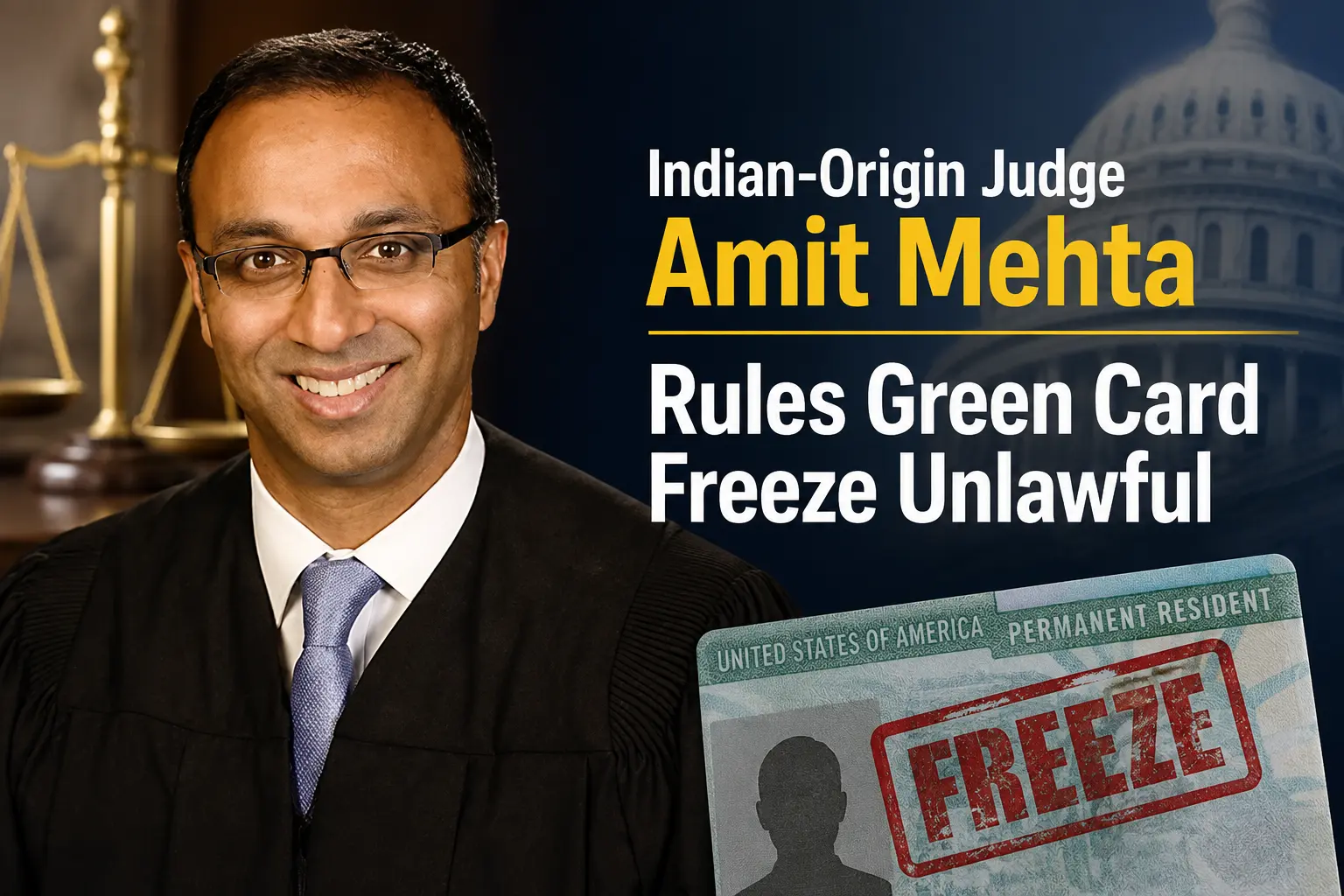
An Indian-origin federal judge has dealt a significant legal blow to one of the Trump administration’s most sweeping immigration restrictions of 2026. The policy itself, however, does not apply to India.
US District Judge Amit Mehta of the District of Columbia ruled on 31 July that the State Department’s “public charge” policy, which froze immigrant visa issuance for nationals of 75 countries starting in January, exceeds the authority Congress granted the department under the Immigration and Nationality Act. “Under the Public Charge Policy, the Secretary of State is doing precisely what the INA prohibits: he is controlling individual visa application determinations,” Mehta wrote in his opinion.
The ruling has been widely reported across Indian and Indian-American media as a story about an Indian-origin judge striking down a Trump immigration policy, and it is that. But it is important to state plainly what the ruling does not do: India is not among the 75 countries covered by the frozen policy, and the ruling therefore does not directly restore green card processing for Indian nationals, who were never subject to this specific freeze.
Who is Judge Amit Mehta
Mehta was born in 1971 in Patan, in India’s Gujarat state, and raised in the United States. He earned his undergraduate degree from Georgetown University in 1993 and his law degree from the University of Virginia School of Law in 1997. After clerking for a judge on the Ninth Circuit Court of Appeals and working in both private practice and as a public defender in Washington DC, he was nominated to the US District Court for the District of Columbia by President Barack Obama in 2014 and confirmed by the Senate that December, becoming the first Asian Pacific American judge on that court.
Mehta has presided over several high-profile cases, including the landmark 2024 ruling that Google had illegally maintained a monopoly in internet search, and multiple cases connected to the January 6, 2021 Capitol attack. He also serves on the US Foreign Intelligence Surveillance Court.
What the policy actually did, and who it covered
The State Department’s public charge policy, introduced by Secretary of State Marco Rubio, took effect on 21 January 2026 and indefinitely paused the issuance of immigrant visas, permanent, not temporary visas, for nationals of 75 countries, based on the department’s assessment that applicants from those countries carried a heightened risk of relying on US public benefits.
What is a “public charge” in US immigration law?
What is a public charge in US immigration law?
A public charge is a legal term describing a non-citizen who is considered primarily dependent on the US government for financial support, typically through cash assistance programmes or long-term institutional care at government expense. US immigration law has long allowed consular officers to deny a visa or green card to an individual applicant if, after an individualised assessment, that officer determines the specific applicant is likely to become a public charge. The 2026 State Department policy departed from that individualised approach by applying a blanket assumption to entire nationalities, rather than assessing each applicant separately, which is the core legal defect Judge Mehta identified in his ruling.
India does not appear on the State Department’s list. Four of its South Asian neighbours do: Bangladesh, Bhutan, Nepal and Pakistan. The remaining countries span Africa, Latin America, the Middle East, Eastern Europe and Southeast Asia, including Nigeria, Russia, Brazil, Pakistan, Iran and Colombia among the larger source countries for US immigration.
India does not appear on this list. Four of India’s near neighbours in South Asia do: Bangladesh, Bhutan, Nepal and Pakistan.
What the ruling covers, and what it does not
The case, De Moura Gomes v. Rubio, was brought by a Brazilian national whose EB-5 investor immigrant visa application had been halted under the policy. Mehta’s injunction specifically bars the State Department from applying the public charge policy to that individual plaintiff’s visa application, and orders his case to be adjudicated individually once his consular officer deems it complete.
The ruling does not, on its face, strike down the policy for all 75 affected countries automatically. It is a ruling in one plaintiff’s case that establishes the legal reasoning that the policy is unlawful because it strips consular officers of the individualised discretion Congress specifically assigned to them, which other plaintiffs from the affected countries, and the broader class-action litigation already underway against the same policy in New York and DC district courts, are expected to rely on.
Mehta also rejected the government’s argument that the doctrine of consular nonreviewability, which typically shields individual visa decisions from court review, should block the case. He held that the doctrine does not apply here because the lawsuit challenges the State Department’s broader policy, not a single consular officer’s individual decision.
What comes next
The Trump administration is expected to appeal the ruling. Separate lawsuits challenging the same 75-country freeze remain active in federal courts in New York and Washington DC, brought by organisations including the Centre for Constitutional Rights on behalf of a broader group of affected applicants.
If those broader challenges succeed on the same legal theory Mehta applied, normal individualised visa processing would resume for applicants from all 75 listed countries, and visa applications refused since the policy took effect in January would become eligible to proceed. That outcome remains pending, not yet confirmed.
Why this still matters for Indian and South Asian families
While India itself is not on the affected list, the ruling carries two forms of real relevance for the Indian diaspora.
First, families with connections to Bangladesh, Bhutan, Nepal or Pakistan, commonly given cross-border family ties across South Asia, are directly affected by the underlying policy Mehta ruled against, and should watch how the broader litigation develops.
Second, the ruling matters as a legal precedent limiting how far the executive branch can go in applying blanket, nationality-based restrictions to immigrant visa processing without individualised review. Should any future policy attempt to extend similar blanket treatment to India or Indian nationals, Mehta’s reasoning in this case, that Congress assigned individualised discretion to consular officers and the Secretary of State cannot override that by policy fiat, would stand as a relevant legal check.
What families need to know
Does this ruling restore green card processing for Indian nationals?
No. India is not among the 75 countries covered by the State Department’s public charge policy. Indian nationals were not subject to this specific freeze and this ruling does not change Indian applicants’ visa processing.
Which countries with South Asian ties are affected by this policy?
Bangladesh, Bhutan, Nepal and Pakistan are all on the list of 75 affected countries. India is not.
Does Mehta’s ruling immediately restore visa processing for all 75 countries?
Not automatically. The ruling directly applies to the individual plaintiff in the case, a Brazilian EB-5 investor. It establishes a legal precedent that other pending lawsuits, including broader challenges in New York and DC courts, are likely to rely on, but it does not by itself order the government to resume processing for every applicant from every affected country.
Is the ruling likely to be appealed?
Federal government agencies typically appeal adverse rulings of this kind, and the Trump administration has consistently defended its immigration restriction policies through appeal in similar cases throughout 2025 and 2026. No confirmation of an appeal in this specific case has been reported as of the date of publication.
Who is Judge Amit Mehta and is he connected to India?
Judge Mehta was born in Patan, in India’s Gujarat state, in 1971, and raised in the United States. He was appointed to the US District Court for the District of Columbia by President Obama in 2014, becoming the first Asian Pacific American judge on that court. He has no other reported personal connection to this specific case beyond his role as the presiding judge.





Comments 1