


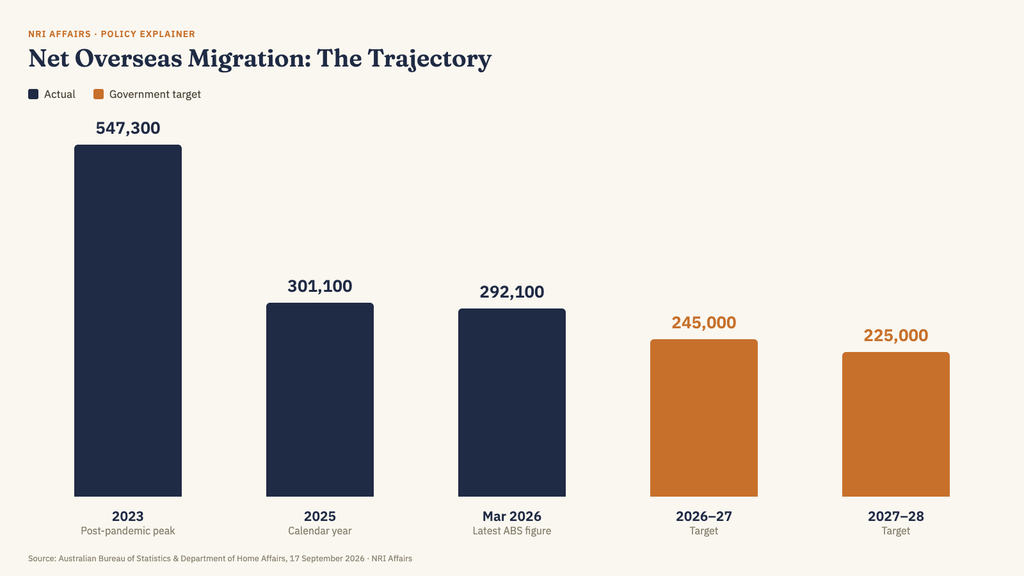
Home Affairs Minister Tony Burke has unveiled the Albanese government’s long-awaited migration overhaul, telling the National Press Club the changes are designed to bring net overseas migration (NOM) down to 245,000 this financial year and 225,000 by 2027–28, from 292,100 recorded in the year to March. The official policy statement and minister’s release frame this as ending “rorts” while still attracting needed skills.
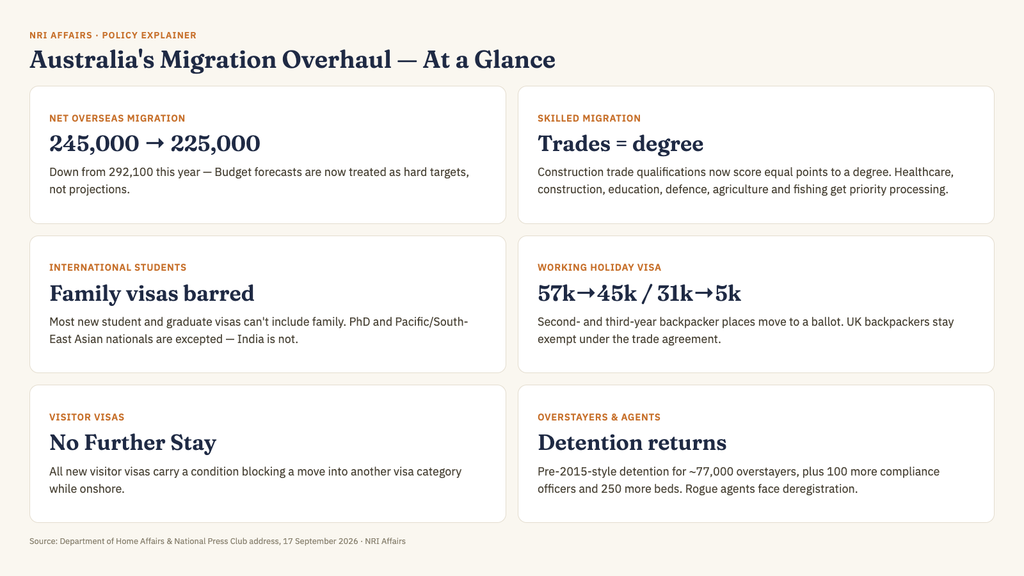
Key highlights: Skilled migration priority (Ministerial Direction 119) now fast-tracks healthcare, construction, education, law enforcement, defence, resources, agriculture and fishing, and housing-trade qualifications now score the same points as a university degree. Most new international student and graduate visa holders can no longer bring a partner or children — exceptions apply to PhD candidates and to Pacific and South-East Asian nationals, a list that does not include India. Working Holiday Maker (backpacker) second- and third-year stays move to a ballot, capped at 45,000 and 5,000 places respectively (down from 57,000 and 31,000), with UK backpackers exempt under the bilateral trade deal. All new visitor visas get a “No Further Stay” condition to stop onshore visa-hopping. Migration agents who knowingly lodge baseless claims face deregistration. Visa overstayers (an estimated 77,000 people) face a return to pre-2015 detention as a deterrent, backed by 100 more compliance officers and 250 more detention beds — see ABC’s full breakdown.
Justifications and rebuttals: Burke rejects the idea Australia faces “mass migration,” citing the 47 per cent fall from the post-pandemic peak, and denies immigration causes the housing crisis, attributing it instead to shrinking household sizes [though migration researchers cited by SBS note cuts to international students specifically could ease city rents, while cuts to migrant construction labour could worsen supply — a genuine trade-off, not a settled question]. He also rejects comparisons to Trump-style ICE raids and denies the package amounts to a “race to the bottom” with One Nation or the Coalition, arguing deeper cuts would gut healthcare, aged care and construction, since roughly half of doctors and construction workers, and two-thirds of nurses, arrive with a family member.
Political reaction: The Coalition, without a finalised policy of its own, called the plan “more of the same” (Opposition Leader Angus Taylor) and “tinkering around the edges” (Shadow Immigration Minister Jonno Duniam), while Shadow Housing Minister Andrew Bragg has floated — not yet as formal policy — a NOM target below 180,000 tied to housing completions. One Nation, which announced its own plan three days earlier, wants 750,000 fewer temporary visa places over three years, family visas for students and skilled migrants cut to zero, and student numbers roughly halved. The Greens’ David Shoebridge accused Labor of following “Donald Trump’s playbook” on detention and called it a “race to the bottom with One Nation.” SA Premier Peter Malinauskas and Treasurer Jim Chalmers also weighed in, with Chalmers accusing the Coalition of having its policy “determined by One Nation.”
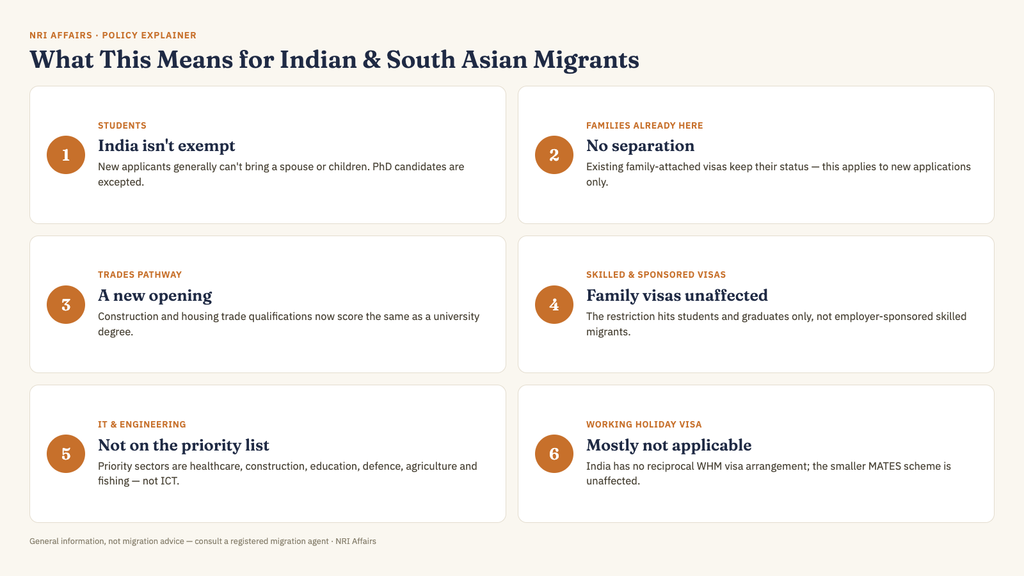
For Indian and South Asian readers specifically: this is not a marginal change. India is one of Australia’s largest source countries for international students (well over 120,000 currently enrolled) and is not on the exemption list, so new Indian students generally cannot bring a spouse or children going forward — existing families already here won’t be separated. The trades-points change is a genuine new opening for those with construction qualifications. Family visas remain intact for skilled, employer-sponsored migrants, so healthcare and construction workers on that pathway aren’t affected the same way students are. Worth noting: the newly prioritised sectors don’t explicitly include IT or general engineering, categories that have traditionally carried a large share of Indian skilled visas — an observation about the list, not a confirmed cut. A Perth migration agent of Indian origin, Manpreet Mann, told the ABC he supported most measures but feared reputational damage to “Australia as a brand” against cheaper, family-inclusive alternatives in Europe. India also has no reciprocal backpacker visa arrangement, so the Working Holiday changes largely don’t apply.
Civil society reaction was mixed. The Asylum Seeker Resource Centre‘s Kon Karapanagiotidis called it “a dark day for multicultural Australia” and likened the detention expansion to US immigration enforcement. The Refugee Council of Australia was more measured, welcoming Burke’s assurances on the protection system but noting “critical questions” remain unresolved on work rights and claim time-limits. FECCA, the national multicultural peak body, warned the family-visa restrictions risk pushing global talent to competitor countries, with chair Peter Doukas noting migration “has helped build modern Australia” and calling for policy driven by workforce needs rather than “short-term political pressure.” Universities Australia warned of a hit to a $55 billion export industry, and grassroots voices reported by SBS — including an Indian-origin Perth teacher on a stalled skilled visa — described feeling “looked at… as just numbers.”
Most changes take effect by regulation over the next 12 months without needing Parliament; asylum-claim reforms remain stalled without Coalition support. The next ABS migration data, due in December, will be the first real test of whether the targets are being met.