

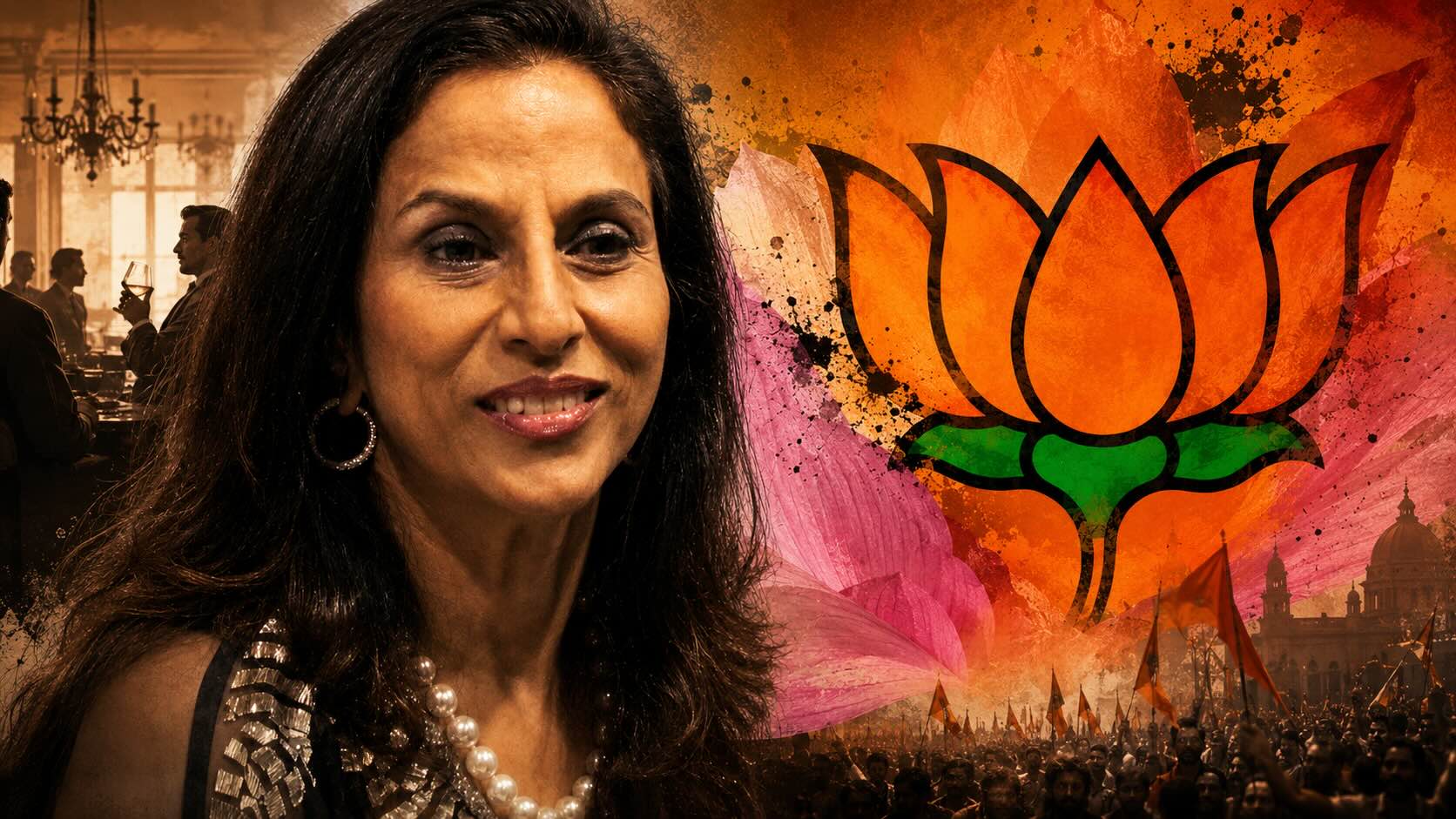
So Shobhaa De is “a bhakt of her own beliefs.” How charming. How original. How utterly, depressingly familiar.
Reading her latest column in The Print — that breezy little victory dance over Mamata Banerjee’s defeat in Bengal, complete with the obligatory ellipses and the obligatory Yay and the obligatory martyr-pose about being trolled — I felt something I have not felt in a while. Not anger, exactly. Not even disappointment, because to be disappointed you must first have expected something. What I felt was a kind of weary recognition. Because we have read this column before. We have read it for forty years. Only the political object of affection keeps changing.
In the eighties, it was the glamour of Bombay’s high society. In the nineties, it was the giddy promise of liberalisation. In the noughties, it was the page-three carousel of designers and starlets and royals. And now, in 2026, with the bulldozers running and the lynch mobs televised and the women of Manipur still waiting for justice, it is the lotus. Let a thousand lotuses bloom, she writes, and one wonders whether she has paused, even once, to ask what soil they bloom in. Whose blood waters them. Whose home was demolished to make room for the flower bed.
The cognac and the cough syrup
The column’s most revealing line is also its most casual. Jyoti Basu, sipping cognac in the lounge of the Bengal Club, is “sophisticated, erudite, urbane.” Mamata Banerjee, swigging cough syrup from a Maruti’s glove compartment as she tears across the villages of Bengal building a movement that will eventually unseat the very man in the lounge, is a “tiny energy ball.” A curiosity. A slightly comic figure. A woman who must be told, by Shobhaa De, to improve her Bangla.
You could not, even if you tried, write a more perfect distillation of the politics at work. The Bhadralok male, with his snifter and his erudition, gets the dignity. The mofussil woman, with her movement and her mass base, gets the patronising pat on the head. This is not commentary. This is the ancient snobbery of the salon, dressed up in the language of feminism and mailed out as a column.
And let us be honest: there is plenty to indict Mamata for. Her cynical communalism. Her party of thugs. Her abandonment of the women of Sandeshkhali. Her failure of the young doctor at R.G. Kar — Abhaya, whose name we will speak in a moment because it must be spoken. But none of that is what De is doing. De is simply doing what she has always done, which is to read Indian politics through the lens of who would or would not be welcome in her drawing room.
The alibi of the unwavering self
When the trolls came, as trolls do, De gave us the line that was clearly pre-loaded and waiting: “A bhakt of my own beliefs, which do not waver. Never have.”
It is a beautiful sentence, in the way that all alibis are beautiful. It says nothing and protects everything. It allows her to bank the credit of dissent — look, I am being trolled, I am being attacked, I am the brave individual standing alone — while quietly cashing the cheque of consensus.
And what, we are entitled to ask, are these unwavering beliefs? The column will not tell us. There is not a single sentence in it about Bilkis Bano. Not a syllable about Hathras. Not a word about the women of Manipur. Not a whisper about calls for economic and social boycotts.
There is the airy phrase “anyone was better than Didi. Even the BJP.” That little word — even — is the whole column. It is the moral knowledge of what the BJP is, and the simultaneous decision to look past it.
The risqué as a market stall
We have to talk about the longer arc, because the column does not exist in isolation. It is the latest issue of a magazine Shobhaa De has been publishing for four decades.
Call it Liberation As Lifestyle. Call it Ambition As Ethics. It is the brand built on the appearance of transgression — frank talk about sex, naughty-aunty irreverence — that never actually challenges structures of caste, class, or patriarchy.
This is feminism as careerism. Feminism as personal brand. Feminism as the right of the upper-caste woman to be as ruthlessly ambitious as the upper-caste man, and to call that ambition a politics.
And when asked to take a side on Hindutva, it takes the side that protects the drawing room.
The pink petal and the saffron petal are petals of the same flower.
My Pishimoni’s feminism
Let me tell you about another kind of feminism.
My Pishimoni was an AIDWA woman — an organiser, a comrade. She did not write columns or cultivate a public persona. What she had was a life spent walking into fields where women had not been paid, into villages where justice was denied, into police stations where complaints were ignored.
If you had asked her what feminism was, she might not have used the word at all. She would have said: there is a woman in the next village whose children are hungry — we are going.
The going was the politics.
Her feminism asked one question:
How can I lend my body to the struggle of another woman rendered voiceless by structures she did not build?
Compare this to the question that organises market feminism:
How do I optimise myself within the market?
One asks: how can I be useful?
The other asks: how can I be visible?
The feminism that fought for Abhaya
Now consider what was happening in Bengal while such columns were being written.
A young doctor at R.G. Kar Medical College was found brutalised after a long shift. The system attempted silence. It attempted erasure.
And it was the left — the much-dismissed left — that marched. Women organised. Protesters faced violence. They named the crime, the cover-up, and the structure behind both.
They refused the false binary between competing powers.
This is feminism:
The woman on the street at midnight, refusing erasure.
What the column does not say
You can always tell the truth of a column by what it avoids.
It does not name victims.
It does not name caste.
It does not name Muslims.
It does not interrogate power.
This is not accidental. It is structural silence — the defining feature of elite neoliberal feminism.
The work in front of us
I write this as an upper-caste man, aware of what that position entails.
The task is not absolution. The task is work — clearing space for those whose struggles define the politics of justice.
The fight is not just against Hindutva.
It is not just against the market.
It is against the system that produces both.
This requires refusing comfortable allies — the careerist, the performative radical, the commodified movement.
A genuine politics of solidarity asks, constantly:
Am I clearing space, or occupying it?
Pishimoni would not call this radical.
She would say: there is work to do.
And she would go.
That is the politics. That has always been the politics. The columnists can keep their lotus. We have work to do.