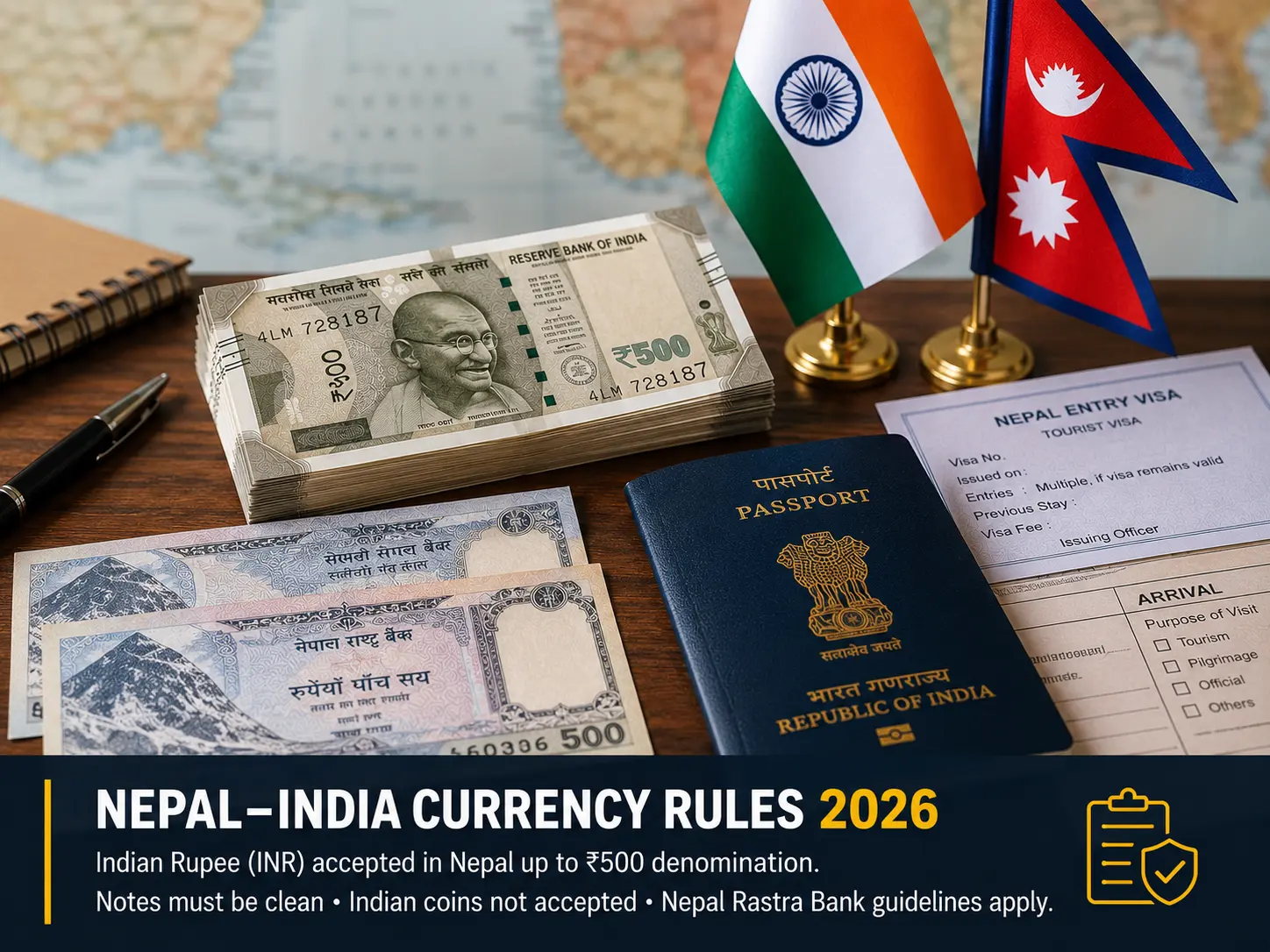
Nepal has ended a currency restriction that has quietly complicated travel and trade with India for nearly a decade.
The Nepal Rastra Bank, Nepal’s central bank, confirmed on 24 July 2026 that Indian and Nepalese nationals may now carry Indian currency notes of Rs 200 and Rs 500 denominations into and out of Nepal, up to a combined limit of Rs 25,000 per person. The notes must have been issued on or after 9 November 2016, the date immediately following India’s demonetisation of the old Rs 500 and Rs 1,000 notes.
The restriction being lifted has been in place since January 2019, when Nepal’s central bank banned the use, carrying and holding of Indian currency notes in the Rs 200, Rs 500 and Rs 2,000 denominations. That ban followed India’s 2016 demonetisation, after which Nepal declined to recognise the newly issued higher-denomination notes as legal tender within its borders.
What exactly is allowed now
The Nepal Rastra Bank’s notice, reissued on 24 July 2026 to reiterate and clarify rules that had technically already been notified through Nepal’s official gazette in February 2026, sets out the specific parameters travellers need to know.
Indian Rs 200 and Rs 500 notes issued on or after 9 November 2016 can now be carried into or out of Nepal, up to Rs 25,000 total per person. These notes can also be used for transactions within the Nepali market, and banks in Nepal have been authorised to exchange them without difficulty.
Indian Rs 500 and Rs 1,000 notes issued before November 2016, the ones demonetised by India in 2016, remain prohibited in Nepal. The Rs 2,000 note also remains banned and cannot be carried into, held within, or used in Nepal under any circumstances.
What is the Nepal Rastra Bank?
What is the Nepal Rastra Bank?
The Nepal Rastra Bank is Nepal’s central bank, responsible for monetary policy, currency regulation and banking oversight within the country. It functions as Nepal’s equivalent of the Reserve Bank of India. Because India and Nepal share an open border and a close economic relationship, with Indian currency widely used and held within Nepal alongside the Nepali rupee, the Nepal Rastra Bank regulates the circulation and cross-border movement of Indian currency within Nepal in coordination with the Reserve Bank of India.
Why this restriction existed in the first place
The root cause traces directly back to India’s demonetisation of high-value currency notes on 8 November 2016, when the Indian government invalidated existing Rs 500 and Rs 1,000 notes overnight and introduced new Rs 500 and Rs 2,000 notes in their place.
Nepal held a significant volume of the old, now-worthless notes within its banking system at the time, reported by Peoples’ Review to have exceeded Rs 700 million in old Rs 500 and Rs 1,000 notes. Nepal made repeated requests for India to allow an exchange mechanism for these notes, which the Indian government did not approve, leaving Nepali banks holding demonetised currency with no way to redeem it.
As a defensive measure, and because the Reserve Bank of India had not issued the regulatory notification needed to make the newly circulated higher-denomination notes legal tender in Nepal, Nepal’s central bank formally banned the use of the Rs 200, Rs 500 and Rs 2,000 notes altogether in January 2019.
What changed to allow this reversal
The reversal became possible after two separate developments over the past year. The Reserve Bank of India amended its Foreign Exchange Management Regulations, 2015, to allow high-denomination Indian currency notes to be carried between Nepal and India. This gave Nepal’s central bank the regulatory basis it needed on the Indian side.
On the Nepali side, Nepal Rastra Bank spokesperson Guru Prasad Paudel confirmed that a mechanism was established allowing commercial banks in Nepal to collect eligible Indian currency notes from the public, forward them to the central bank, which then deposits them into its own account held with the Reserve Bank of India. This closed the practical gap that had left Nepali banks unable to process the notes even after the regulatory change.
What travellers need to know
The Rs 25,000 limit applies per person and covers the combined total of Rs 200 and Rs 500 notes carried, not Rs 25,000 in each denomination separately.
An important restriction accompanies the currency change: Nepalese nationals cannot bring Indian currency into Nepal from any country other than India itself, and cannot carry Indian currency out of Nepal to any country other than India. This closes off any use of the relaxed rule as a broader currency conversion route through third countries.
Separately, Nepal’s customs declaration threshold remains unchanged. Nepalese nationals and foreign visitors, including Indian travellers, can bring up to USD 5,000 or its equivalent in other foreign currencies into Nepal without making a customs declaration. Amounts exceeding that threshold must be declared to customs on arrival. For Indian currency specifically, that USD 5,000 equivalent, approximately Rs 4.83 lakh, applies without a customs declaration only when the notes carried do not exceed Rs 100 denomination; the newly permitted Rs 200 and Rs 500 notes are governed separately by the Rs 25,000 limit outlined above.
Why this matters for NRIs and Indian travellers
India is Nepal’s largest trading partner and its single largest source of tourists. Thousands of Nepalese citizens also live, work and study in India, making cross-border cash movement between the two countries a routine part of daily and commercial life for millions of people on both sides of the open border.
For Indian nationals, including NRIs visiting India before or after a trip to Nepal, the change removes a persistent practical friction: carrying standard Rs 500 notes, the most commonly used higher-denomination Indian note, previously risked confiscation or refusal at Nepali borders and banks. Indian tourists visiting Nepal, and the substantial Nepali workforce that regularly moves earnings and savings between the two countries, are the two groups the Nepal Rastra Bank specifically named as beneficiaries of the change.
For NRIs planning travel that includes both India and Nepal, whether for family visits, pilgrimage travel to sites such as Pashupatinath or Lumbini, or business, the practical takeaway is straightforward: standard Rs 500 notes issued after November 2016 can now be carried and used in Nepal within the Rs 25,000 limit, without the previous risk of being turned away at the border or unable to exchange the notes at a Nepali bank.
What travellers need to know before their next trip
Can I carry Rs 2,000 notes into Nepal now?
No. The Rs 2,000 note remains banned in Nepal under all circumstances. Only Rs 200 and Rs 500 notes issued on or after 9 November 2016 are covered by this change.
What happens if I am carrying old, pre-2016 Rs 500 notes?
Old Rs 500 and Rs 1,000 notes issued before India’s November 2016 demonetisation remain prohibited in Nepal and were never legal Indian currency in the first place, as India itself demonetised them. Do not attempt to carry these notes into Nepal.
Is the Rs 25,000 limit per person or per family or group travelling together?
The Nepal Rastra Bank’s notice specifies the limit as Rs 25,000 per person. Confirm with Nepali customs authorities directly for guidance on group or family travel arrangements before your trip.
Can I use these notes for purchases within Nepal, or only carry them across the border?
Both. The Nepal Rastra Bank’s notice confirms these notes can be used for transactions within the Nepali market, and Nepali banks have been authorised to exchange them without difficulty.
Does this affect digital or UPI payments between India and Nepal?
This specific change concerns physical currency notes only. Separate discussions between the two countries on enabling QR code and digital payment interoperability for Indian tourists in Nepal have been ongoing since earlier in 2026, but are a distinct development from this currency notes rule.