
India in the World
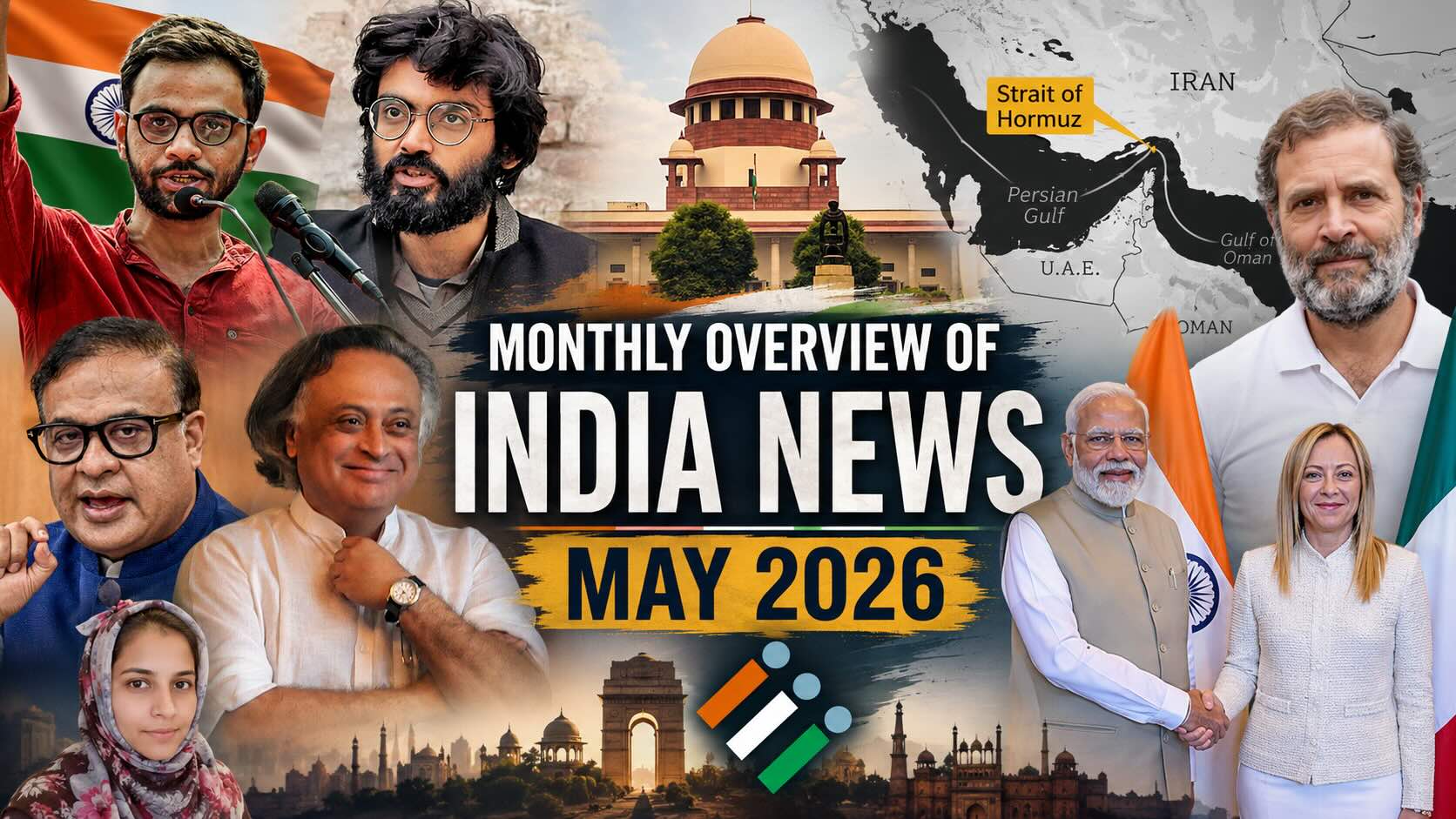
- From the 15th to the 17th of May, PM Modi visited the Hague to elevate the ties between India and the Netherlands to ‘strategic partnership’ in semiconductors, trade and investment, water management, clean energy, critical minerals, migration, and education. The visit produced a broad “Roadmap of India-Netherlands Strategic Partnership 2026–2030” and several agreements, including a MoU between Tata Electronics and ASML to support semiconductor manufacturing in India. While talking to journalists before meeting PM Modi, Dutch Prime Minister Rob Jetten stated that concerns regarding “developments in India” under Modi’s BJP remain, particularly about press freedom and minority rights; concerns that were dismissed by Indian diplomat Sibi George as a “lack of understanding”.
- On the 15th of May, PM Modi visited The United Arab Emirates to sign an agreement on fuel supply and storage. The non-legally binding agreement confirms a collaboration of LPG and LNG storage withing India and states that the Abu Dhabi National oil Company would ‘potentially’ store up to 30 million barrels of crude in India’s strategic petroleum reserves including in facilities which bypass the Hormuz strait.
- On the 19th of May, India and the Nordic countries decided to elevate their ties to a Green Technology and Innovation Strategic Partnership, focusing on clean energy, sustainability, innovations and emerging technologies. During a joint press appearance, PM Modi decided not to take questions but was confronted by a Norwegian journalist requesting him to respond to critical media questions. Congress leader Rahul Gandhi critiqued the PM for his avoidance, “when there is nothing to hide, there is nothing to fear,” he stated on X.
- On the 20th of May, Prime Minister Modi and Italian Prime Minister Giorgia Meloni upgraded their ties to a special strategic partnership during Modi’s final stop of his six-day Europe tour. They further committed to increase their trade target from 14 billion euros to 20 billion euros as they “take advantage” of the FTA between the EU and India. Italian defence companies had previously been barred from the Indian defence market due to corruption allegations over the AgustaWestland deal, but this changes as the countries agreed on a defence industrial roadmap.
Civil society, human rights defenders, and journalists
- On the 18th of May, Supreme Court’s bench of Justices B.V. Nagarathna and Ujjal Bhuyan questioned its earlier decision to deny bail to activists Umar Khalid and Sharjeel Imam in the 2020 Delhi riots conspiracy case under the Unlawful Activities (Prevention) Act (UAPA). While granting bail in a separate case, the two judges expressed “serious reservations” about the judgment of January 2026 in Gulfisha Fatima v. State for not properly following the binding precedent set by a three‑judge bench in Union of India v. K.A. Najeeb (2021), which had established that prolonged incarceration and delays in trial can justify granting bail even under stringent laws like the UAPA. The case is viewed as part of a larger pattern of political repression targeting Muslim activists, student leaders and protest movements opposing laws they consider discriminatory.
- The Election Commission is preparing to conduct the Special Intensive Revision (SIR) of the electoral rolls in Manipur, raising fears of disenfranchisement among already displaced communities amid ongoing ethnic violence and mass displacement. With thousands of people living in relief camps or outside the state, house-to-house verification may exclude those lacking documents or access to their original addresses. Civil society groups have warned that the process could unfairly impact tribal communities and legitimise the effects of displacement. The Supreme Court has asked the ECI to include voter ID cards as admissible documents for verification as tribal communities may not have access to the 11 documents required.
- On the 22nd of May, the Supreme Court granted six month’s interim bail to Khalid Saifi and Tasleem Ahmad, both arrested under the Unlawful Activities Prevention Act (UAPA) during the 2020 Delhi riots. The Supreme Court bench granted interim relief to Saifi and Ahmad while raising concerns about the prolonged pre-trial incarceration and delays in judicial proceedings, with several activists continuing to remain behind bars without trial. The bench also referred a key constitutional question to a larger bench whether prolonged incarceration without trial should outweigh the stringent bail restriction imposed under the UAPA.
Hate Crimes and Hate Speech against Minorities
- The Gujarat High Court has upheld the acquittal of five Hindutva men accused in a 2002 mob killing, citing a lack of evidence. The men were accused of throwing a Muslim man into a fire during the 2002 Muslim genocide, during which Hindutva groups VHP, RSS and BJP unleashed massive violence against Muslims in Gujarat, killing thousands. The High Court noted that multiple witnesses, including Kasamkhan’s wife, were not able to identify the specific rioters as the incident was carried out by a large mob of approximately 400-500 people at night. “The witness had not stated anything beyond the mere presence of the accused persons at the place of occurrence,” the court said. Since 2002, at least 150 accused of the 2002 Gujarat genocide have been acquitted by the Gujarat’s courts.
- On the 12th of May, four Muslim men in West-Bengal were brutally beaten and handed over to the police by senior BJP leaders and members of the Bajrang Ral for allegedly smuggling cattle. The police arrested the four injured men and not the attackers, they were released on bail on the 15th of May. The Katwa police station has refused to make a statement on the arrests. The attackers claimed that the absence of a transport permit had proved that the cattle were being smuggled to Bangladesh. However, local traders stated that the men had been paid to transport the herd to another town, a common event in the area. BJP Vice-President Seema Bhattacharya, who was present at the attack, stated that the BJP had taken up the efforts to “punish” smugglers.
Religious Freedoms and Minority Rights
- On the 13th of May, the Karnataka Congress Government reversed the 2022 Hijab ban order for students, allowing religious and customary symbols to be worn along with prescribed uniforms in schools and colleges. The controversial 2022 bill passed by the BJP government at the time severely impacted access to education for Muslim women as students reported discrimination, mental distress and exclusions from classrooms due to the dress-code enforcement. The new order allows students to wear “limited traditional and practice-based symbols” including Hijabs, as long as they do not affect discipline, safety, cleanliness or identification.
- On the 13th of May, Congress leader and former Union Environment Minister Jairam Ramesh flagged the violations of tribal rights in infrastructure projects, alleging serious violations of tribal rights in the planned mega‑infrastructure projects on Great Nicobar Island. In the letter to the Union Minister for tribal affairs, Ramesh argued that the process has breached the Forest Rights Act of 2006, a law meant to protect both individual and community rights of tribal populations, and claimed that approvals for diverting over 13,000 hectares of forest land were given by village councils dominated by non-tribal settlers rather than by the indigenous Nicobarese and Shompen communities, who are legally entitled to decide under the law. He describes this as illegal and based on “fraudulent” consent, undermining both individual and community rights. Similar concerns were also raised by the National Commission for Scheduled Tribes.
- On the 18th of May, the West Bengal government decided to discontinue welfare assistance programmes based on religious categorization from June onwards. In line with a Calcutta High Court judgement, the new BJP cabinet scrapped the existing list of communities considered ‘socially and educationally backward’ and announced plans to set up a new panel to determine quota eligibility. The old list contained 113 sub-groups, the majority of them Muslim communities. Critics argue that the new BJP government has introduced several measures that disproportionately affects Muslims, including tighter restrictions on animal slaughter and public prayers on roads.
Internet and Technology
- On the 11th of May, the Tamil Nadu Police Cyber Crime Wing has issued a notice to X to block over 20 accounts and posts critical of Tamilaga Vettri Kazhagam (TVK), a political party, citing threats to public order. Police instructed X to “immediately remove or disable access” to the selected accounts and to take “proactive measures” to prevent similar future content. If X fails to comply with said measures, they could lose intermediary liability protections, exposing them to potential legal prosecution under Indian domestic law.
- On the 25th of May, the Environmental Reporting Collective (ERC) demanded public explanation from Meta regarding the restriction of access in India to an Instagram reel, which has been linked to cross-border investigation in a proposed Google data centre project, as well as carrying reported impact on Dalit communities and lands, and asked for the restoration of access to the video in the country ECR defended their content and urged Meta and the authorities to publicly explain the basis of restriction and restore access to the video.
Political Parties
- On the 12th of May, Assam Chief Minister Himanta Biswa Sarma was sworn in for his second successive term. Prime Minister Modi, Home Minister Amit Shah, Defence Minister Rajnath Singh, BJP national president Nitin Nabin, top industrialists, and religious leaders were present at the ceremony. In a post on X, Sarma claims that he freed “1.5 lakh bighas (traditional unit of land measurement) of land from encroachment” and promised to reclaim “5 lakh more bighas for the people of Assam” in the next 5 years. The Chief Minister referred to BJP’s ‘anti-encroachment campaign’ which involved mass evictions drives and home demolitions of self-constructed homes and slums, often without offering rehabilitation which is against High Court orders.
Police and authorities
- On the 25th of May, Manipur Chief Minister Y Khemchand Singh announced a commitment to strengthening police forces to maintain peace in the state. Manipur has witnessed ethnic violence between Meiteis and Kuki-zo groups for the past 3 years, resulting in more than 260 people killed and 60,000 dissplaced. The Chief Minister urged citizens to refrain from violent protests that have erupted since a bomb blast in April killed two children. Protesters, in turn, have requested police not to use force and escalate confrontations. Many protesters are requesting the BJP government to step down, arguing that have failed to engage with both communities and have taken no accountability for the resulting violence.
Judiciary
- On the 27th of May, in a crucial ruling regarding the powers of the Election Commission, the Supreme Court held that the Election Commission of India (ECI) is equipped with the powers to undertake limited investigation into the citizenship of an individual, to determine their eligibility for the inclusion in the electoral roll. However, it is specified that such determination is not to be seen nor treated as a conclusive decision on the question of citizenship. When it comes to the Commission’s scrutiny on the citizenship status during the exercise, the bench held that the powers of the ECI come from constitutional responsibility to ensure the participation of eligible persons and factual electoral rolls. However, the Court clarified that the Commission’s conclusions cannot be used to determine the status of citizenship of an individual.
- On the 26th of May, a Delhi court was seeking responses from the Assam Chief Minister, Himanta Biswa Sarma as well as the Delhi Police regarding a revision petition filed by Harsh Mander activist, on the FIR registration over alleged hate speech targeting Bengali-speaking Muslims against a BJP leader. The complaint targets Sarma and accuses him of making statements that are allegedly promoting enmity and public mischief, such as urging for “troubles Miyas” and “Miya’ removal from electoral rolls about the electoral rolls during Assam’s Special Intensive Revision exercises. During the hearing, Mander’s council claimed that the trial court was wrong in rejecting the plea on jurisdictional grounds, based on Section 173(1) of the BNSS, invoking the “Zero FIR” principle. The court noted the submissions and scheduled the matter for hearing for the 15th of July 2026.
Compilation by: Diaspora in Action for Human Rights and Democracy.