
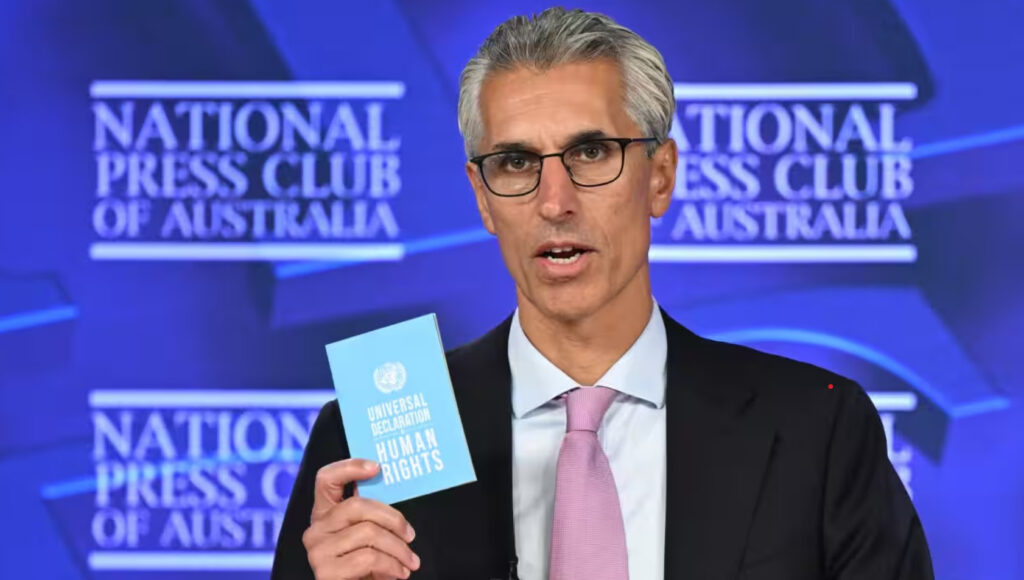
Australian Human Rights Commission President Hugh de Kretser has placed the rising hostility towards Indian migrants squarely on the national agenda, naming the “March for Australia” rallies in a landmark address at the National Press Club this week — the first of what will become an annual public assessment of Australia’s human rights record.
Delivering the inaugural Australian Human Rights Assessment 2026, de Kretser drew on his own family’s migration history to push back against what he described as a dangerous return to the worst instincts of Australia’s past.
“Australia rightly binned the last vestiges of the white Australia policy in the 1970s. Yet today we have people who seemingly want to bring parts of it back,” he said. “The March for Australia rallies targeted migration from India. Others have targeted Muslims and migration from Lebanon and Palestine and scapegoated migrants for social problems including our housing crisis.”
“These attacks on migrants must stop. They fuel racism, hate and division in our community. They increase the risk of violence.”
The Commission’s accompanying report card lists anti-Indian and anti-Muslim agitation as among the urgent human rights issues facing the country, noting that “some political leaders have called for discriminatory migration policies and targeted Muslim migration”.
De Kretser, whose father migrated from Sri Lanka to Port Melbourne as an eight-year-old boy in 1949 and went on to become Governor of Victoria, framed the defence of multicultural Australia in deeply personal terms. “My dad arrived as an eight-year-old boy in Port Melbourne with dark skin and a thick accent. He went on to be a world-leading medical researcher and the Governor of Victoria,” he said, before reminding the audience that over 80% of Australians consistently support multiculturalism.
“Australia rightly binned the last vestiges of the white Australia policy in the 1970s. Yet today we have people who seemingly want to bring parts of it back. The March for Australia rallies targeted migration from India. Others have targeted Muslims and migration from Lebanon and Palestine and scapegoated migrants for social problems including our housing crisis.” ~ Australian Human Rights Commission President
A wave of hate, three communities struck
The Commission’s assessment is unsparing about the scale of racial and religious violence Australia has lived through over the past year. In December 2025, an antisemitic terrorist attack on a Hanukkah celebration in Sydney killed 15 people, including a 10-year-old girl. In January 2026, a homemade fragment bomb was thrown into a crowd of around 2,500 First Nations people and supporters at the Boorloo (Perth) Invasion Day rally. The following month, a man was arrested in Western Australia over an alleged terror plot targeting mosques, police and the WA Parliament — reportedly driven by white supremacist ideology.
“These attacks send shock waves through the affected communities,” de Kretser said. “When we fail to protect a minority group from harm, we fail as a nation.”
The 2023–24 figures cited in the report card are stark: a 316% rise in anti-Jewish incidents reported by the Executive Council of Australian Jewry compared with the previous year, and a 250% increase in online and 150% increase in in-person Islamophobic incidents over the same period.
“We must not accept Jewish families sending their children to schools which have to be protected by armed guards,” de Kretser told the Press Club. “We must not accept Muslim women being abused, spat at and assaulted.”
He drew explicit parallels with the experience of First Peoples, saying communities must not accept that “First Peoples parents, fearing their children and grandchildren will be harmed by police and justice systems meant to protect them” should be a normalised reality of Australian life.
Government still sitting on anti-racism framework
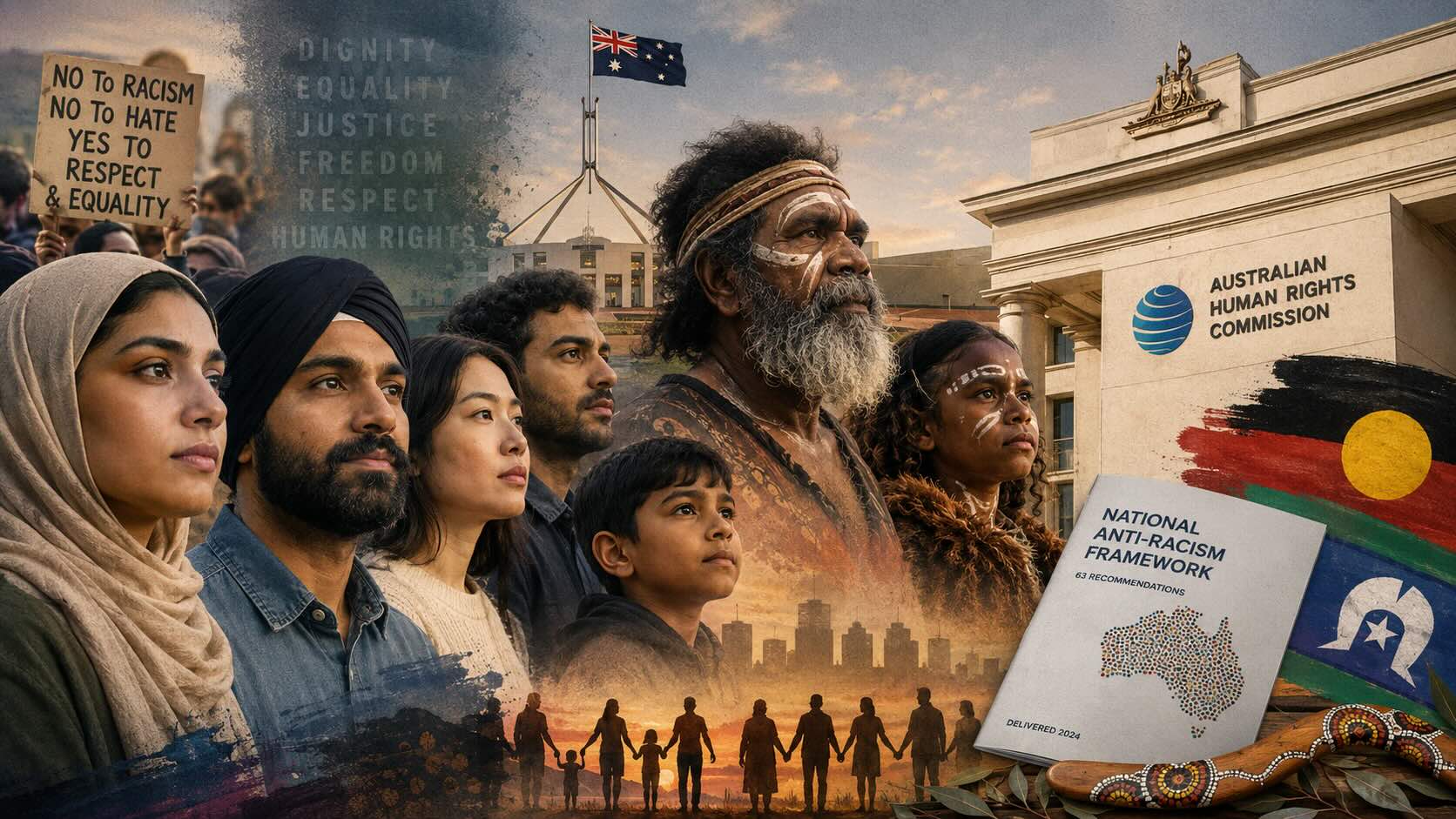
The Commission’s central political demand is that the Albanese government finally act on the National Anti-Racism Framework, which the Commission delivered to government in 2024 with 63 recommendations spanning justice, health, education, workplaces, media and the arts.
“Special Envoys against antisemitism and Islamophobia support it. Yet, the Australian Government still hasn’t agreed to implement any of its recommendations,” de Kretser said. “We’re urging the government to set up a taskforce or similar body to progress implementing the framework in a planned and prioritised way, and we stand ready to work with government on this.”
The framework has the backing of more than 150 civil society organisations, including a wide coalition of faith, disability, multicultural and First Nations bodies that have signed an open letter pressing the government to fund implementation.
“Special Envoys against antisemitism and Islamophobia support it (AHRC’s Anti-Racism Framework). Yet, the Australian Government still hasn’t agreed to implement any of its recommendations”
First Peoples: progress and regression
While welcoming Victoria’s historic statewide treaty, signed in 2025 with the First Peoples’ Assembly of Victoria, and South Australia’s progress on representation and treaty, de Kretser was scathing about regression elsewhere. Queensland abolished its truth-telling and treaty processes; the Northern Territory abandoned its own treaty work and lowered the age of criminal responsibility from 12 back to 10.
“Only four of the 19 Closing the Gap targets are on track and some are going backwards,” he said. Two areas in particular were singled out — the over-imprisonment of First Peoples, and child removals under state child protection regimes.
“Mandatory sentencing, sentencing children as adults, abolishing the principle of detaining children as a last resort. These are lazy, non-solutions,” he said. “At the same time as we’re banning children under 16 from having a social media account, the age of criminal responsibility in most of the country is 10. This means that primary school age children can be arrested, prosecuted and locked up. And it’s First Peoples communities and families who are hit hardest by these laws.”
The report card notes that 17 years have passed since Australia endorsed the United Nations Declaration on the Rights of Indigenous Peoples, with no national implementation plan in place despite a parliamentary committee recommending one two and a half years ago.
“At the same time as we’re banning children under 16 from having a social media account, the age of criminal responsibility in most of the country is 10. This means that primary school age children can be arrested, prosecuted and locked up. And it’s First Peoples communities and families who are hit hardest by these laws.”
The case for a Human Rights Act
Threaded through the assessment is the Commission’s long-standing call for a federal Human Rights Act — a reform supported by a 2024 parliamentary committee recommendation but not yet taken up by government.
“A Human Rights Act would help to avoid the injustice that sparked royal commissions into aged care and abuse against people with disabilities,” de Kretser argued. “A Human Rights Act with rights to a fair hearing and to equality would have helped to avoid the harm of Robodebt.”
Pressed during questions on the practical meaning of such legislation, he pointed to housing: “It would really shift that focus from housing as a commodity to housing as a right.” With home ownership receding for younger Australians and homelessness rising, particularly among older women, he said the country’s tax settings and supply of social housing both required urgent rethinking.
Trust, unity — and what it means to be Australian
Closing his address, de Kretser returned to a theme that will resonate with diaspora communities long accustomed to being told that “Australian values” are defined by others.
“How do we define what it is to be Australian? For me, you define it in connection to those human rights values — freedom, equality, safety, dignity, respect, equal opportunity, democracy, the rule of law. And you apply that to a migration policy. You don’t go back to a migration policy that is the white Australia policy that discriminates against people based on the colour of their skin or their faith.”
The Commission’s full Human Rights Assessment 2026 report card, fact sheets and supporting material is available on its website. It will now be issued annually.