

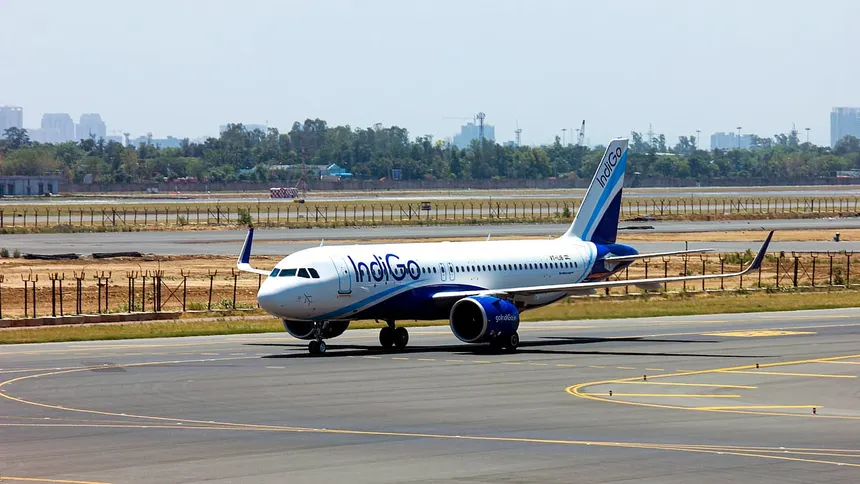
A Dubai-Mumbai IndiGo flight with 194 people on board was diverted to Rajkot in Gujarat on Monday, 27 July 2026, after the crew declared an emergency on detecting a smoke indication in the aircraft’s cargo hold.
Flight 6E-1452, an Airbus A321, was en route to Mumbai when the cockpit received the cargo hold smoke indication. Following standard aviation safety procedure, the crew diverted the aircraft to Rajkot International Airport rather than continuing to its scheduled destination. Airport authorities declared a full emergency at 2.45 pm to prepare for the aircraft’s arrival, with fire tenders, ambulances and other emergency response teams deployed and on standby as the aircraft approached.
The aircraft landed safely. All 194 passengers deboarded without injury.
What IndiGo said
“IndiGo flight 6E 1452, operating from Dubai to Mumbai, was diverted to Rajkot International Airport today as a precautionary measure due to a technical issue,” the airline said in a statement.
“The aircraft landed safely at Rajkot, and all passengers have deboarded securely. An inspection of the aircraft is currently underway before it is cleared to resume operations. An alternate aircraft is being arranged to complete the journey and in the meantime, we are assisting our customers and making all necessary arrangements to ease the waiting time,” an airline spokesperson said. “We sincerely regret the inconvenience caused to our customers due to this unforeseen situation. At IndiGo, the safety of our passengers and crew remains our utmost priority.”
Why cargo hold smoke indications trigger an immediate diversion
Why does an aircraft divert immediately when cargo hold smoke is detected?
Under international aviation safety procedures, any indication of smoke or fire in an aircraft’s cargo compartment is treated as a critical emergency requiring the nearest suitable landing, regardless of the aircraft’s scheduled destination. Cargo holds on commercial aircraft are fitted with smoke detection systems that alert the cockpit crew the moment particulate levels cross a threshold.Because a cargo hold fire can spread quickly and is not directly accessible to crew during flight, pilots are trained to treat any such indication as a potential fire event and land at the closest suitable airport rather than assess the cause mid-flight. This is why the precautionary diversion happened even though the underlying cause of the alert may ultimately prove to be a false indication or a minor technical fault, which investigators will determine on the ground.
Rajkot International Airport was the nearest suitable airport to the aircraft’s position at the time of the alert, which is why the flight was diverted there rather than returning to Dubai or continuing to Mumbai.
What happens next for affected passengers
IndiGo has confirmed an alternate aircraft is being arranged to complete the journey to Mumbai, with the airline assisting passengers and making arrangements to reduce waiting time at Rajkot. The original aircraft remains grounded at Rajkot pending a full technical inspection before it is cleared to resume operations.
The broader pattern
Cargo hold smoke indications leading to precautionary diversions are not unique to this incident. Similar diversions have occurred on other India-Gulf routes in recent years, including a Qatar Airways Delhi-Doha flight diverted to Karachi in 2022 after an identical cargo hold smoke indication, and IndiGo’s own Sharjah-Hyderabad flight diverted to Karachi in 2022 following a technical defect. Aviation regulators treat every such incident as requiring investigation regardless of the eventual finding, precisely because the crew’s decision to divert is made on the conservative assumption that the indication reflects a genuine risk until proven otherwise.
IndiGo is India’s largest airline by market share, operating flights to more than 80 domestic and over 30 international destinations, with a fleet built primarily around the Airbus A320 and A321 family alongside ATR 72-600 turboprops on regional routes. The airline’s parent company, InterGlobe Aviation, reported a consolidated net loss of Rs 238 crore for the first quarter of FY27 last week, a separate financial development unrelated to this incident.
What passengers travelling on Dubai-Mumbai IndiGo flight need to know
Were any passengers injured during the diversion?
No. IndiGo and multiple independent reports confirm all 194 passengers deboarded safely and without injury at Rajkot.
What caused the smoke indication in the cargo hold?
The specific cause has not been confirmed. IndiGo described the diversion as prompted by “a technical issue,” and the aircraft is undergoing inspection at Rajkot before being cleared to resume operations. The exact source of the smoke indication will be established through that technical inspection.
How are affected passengers getting to Mumbai?
IndiGo has confirmed an alternate aircraft is being arranged to complete the journey to Mumbai. The airline said it is assisting passengers and making arrangements to reduce waiting time at Rajkot while this is organised.
Is this a common type of incident on India-Gulf routes?
Cargo hold smoke indications leading to precautionary diversions have occurred on other India-Gulf routes in the past, including previous incidents involving Qatar Airways and IndiGo itself. Airlines and regulators treat every such indication as a serious safety event requiring immediate diversion and full investigation, regardless of the eventual technical finding.
Will passengers be compensated for the delay?
IndiGo’s statement expressed regret for the inconvenience and confirmed it is making arrangements to assist affected customers. The airline has not detailed specific compensation terms in its public statement. Passengers seeking compensation details should contact IndiGo directly through its customer service channels.