
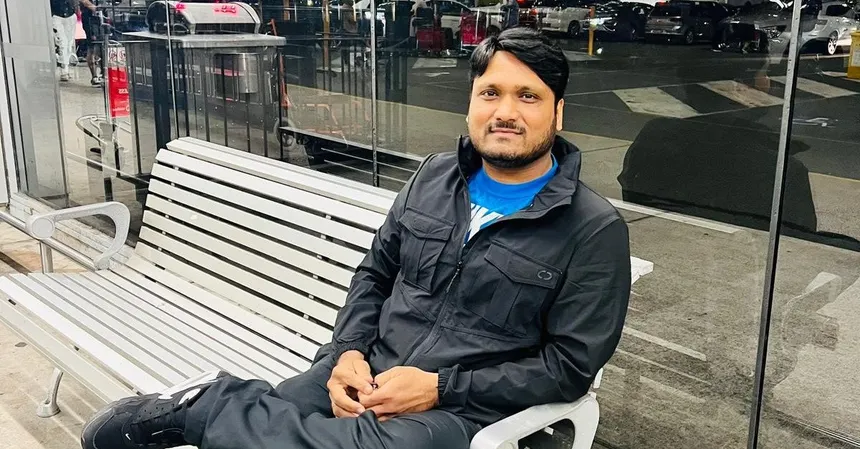
When gunmen opened fire on a Hanukkah celebration at Bondi Beach on 14 December 2025, Rahmat Pasha, a Hyderabad Cab Driver, did not run.
The 37-year-old Uber driver from Mehdipatnam, Hyderabad, was near Archer Park when the attack began. For nearly three hours, he stayed at the scene, helping injured victims, transporting people to safety and providing emergency support until police and paramedics took full control of the situation. His actions are credited with saving between 18 and 20 lives.
Eight months later, the Australian government has recognised that bravery in the most concrete way available to it. Pasha has been granted Australian permanent residency, a decision that allows his wife and three young children, currently living in Mehdipatnam, to join him and settle in Australia permanently.
What happened at Bondi Beach
The attack Pasha responded to was Australia’s deadliest mass shooting in nearly three decades. On the evening of 14 December 2025, two gunmen opened fire at Archer Park near Bondi Beach in Sydney, where approximately 1,000 people had gathered for a public Hanukkah celebration. Sixteen people were killed, including one of the attackers. Forty-one others were injured.
The attackers were identified as Sajid Akram, 50, and his son Naveed Akram, 24. Australian authorities declared the attack a terrorist act, motivated by antisemitism and Islamic State ideology, which later claimed credit. Sajid Akram was shot dead by police at the scene. Naveed Akram survived and is currently on remand in Goulburn Correctional Centre, awaiting trial on 15 counts of murder and 44 other offences.
Four civilians confronted the gunmen during the attack. Three were killed. One, fruit shop owner Ahmed al-Ahmed, was shot and wounded after tackling one of the shooters to the ground, an act of intervention captured on video and praised internationally.
What is Australia’s permanent residency recognition pathway?
What is a permanent residency grant for exceptional service?
Australia’s immigration system includes discretionary pathways through which the government can grant permanent residency in recognition of exceptional circumstances, including significant acts of bravery, community service, or contribution during a crisis. These grants are considered outside the standard points-based skilled migration system and are typically approved through ministerial discretion. They allow the recipient’s immediate family, including spouse and dependent children, to be included in the residency grant, enabling family reunification.
Who is Rahmat Pasha, the Hyderabad cab driver
Pasha grew up in Vikarabad, on the outskirts of Hyderabad, before the family moved to Masab Tank in the city. He later settled in Mehdipatnam, where his wife and three children continue to live. He moved to Australia in search of better prospects and was working as an Uber driver at the time of the attack.
In recognition of his actions, Pasha has been nominated for an Australian bravery award. His cap, worn during the incident, has been placed on display at a museum in Sydney documenting the attack and its aftermath.
The uncomfortable coincidence at the heart of this story
Pasha’s act of courage sits alongside an uncomfortable fact that Hyderabad’s own communities have had to reckon with over the past eight months. Sajid Akram, one of the two attackers, was also Hyderabad-born.
Telangana police confirmed that Akram completed a BCom degree in Hyderabad before migrating to Australia in November 1998. He travelled to India on an Indian passport as recently as 2022, visiting Hyderabad six times between 2000 and that year, according to Telangana Director General of Police B Shivadhar Reddy. He held Australian permanent residency at the time of the attack and had married a woman of European origin after settling in Australia.
For Hyderabad, the eight months since December 2025 have carried both the disgrace of one native son’s actions and the recognition, now formalised through an Australian government decision, of another’s. Pasha’s permanent residency grant does not erase that coincidence. It sits alongside it, as two different Hyderabad stories connected only by geography and circumstance.
What it means for the Indian-Australian community
For the Indian community in Australia, and for Hyderabadi families specifically, Pasha’s story offers a counterpoint to a period defined by scrutiny and suspicion following the attack’s Hyderabad connection. His actions during the attack, and Australia’s decision to grant him and his family permanent residency, have been reported widely across Indian and Telugu-language media as a moment of pride rather than association with tragedy.
The permanent residency grant itself is significant for what it demonstrates about the Australian government’s willingness to recognise individual acts of civilian courage through its migration system, outside the standard skilled migration and family visa categories that most Indian applicants navigate.
Pasha’s wife and children are expected to relocate to Australia to join him following the grant. No specific timeline for their move has been publicly confirmed.
What people are asking about this story
Is Rahmat Pasha related to Sajid Akram, the attacker?
No. There is no reported family or personal connection between Rahmat Pasha and Sajid Akram. Both are from Hyderabad, but the connection between them is limited to that shared origin. No source has reported any relationship between the two men.
How did Rahmat Pasha’s family qualify for permanent residency alongside him?
Australia’s discretionary residency pathways for exceptional service or bravery typically extend to the immediate family of the recognised individual, including spouse and dependent children, enabling full family reunification rather than residency for the individual alone.
What happened to the surviving attacker, Naveed Akram?
Naveed Akram, an Australian-born citizen, survived the attack and was treated in hospital for wounds sustained during the incident. He is currently on remand at Goulburn Correctional Centre in New South Wales, awaiting trial on 15 counts of murder and 44 other offences related to the attack.
Were other civilians recognised for their actions during the Bondi Beach attack?
Yes. Ahmed al-Ahmed, a Sydney fruit shop owner who tackled and disarmed one of the gunmen before being shot, was widely praised internationally, including by then-US President Donald Trump and New South Wales Premier Chris Minns, who described him as a “real-life hero.” Three other civilians who confronted the attackers were killed during the incident.