
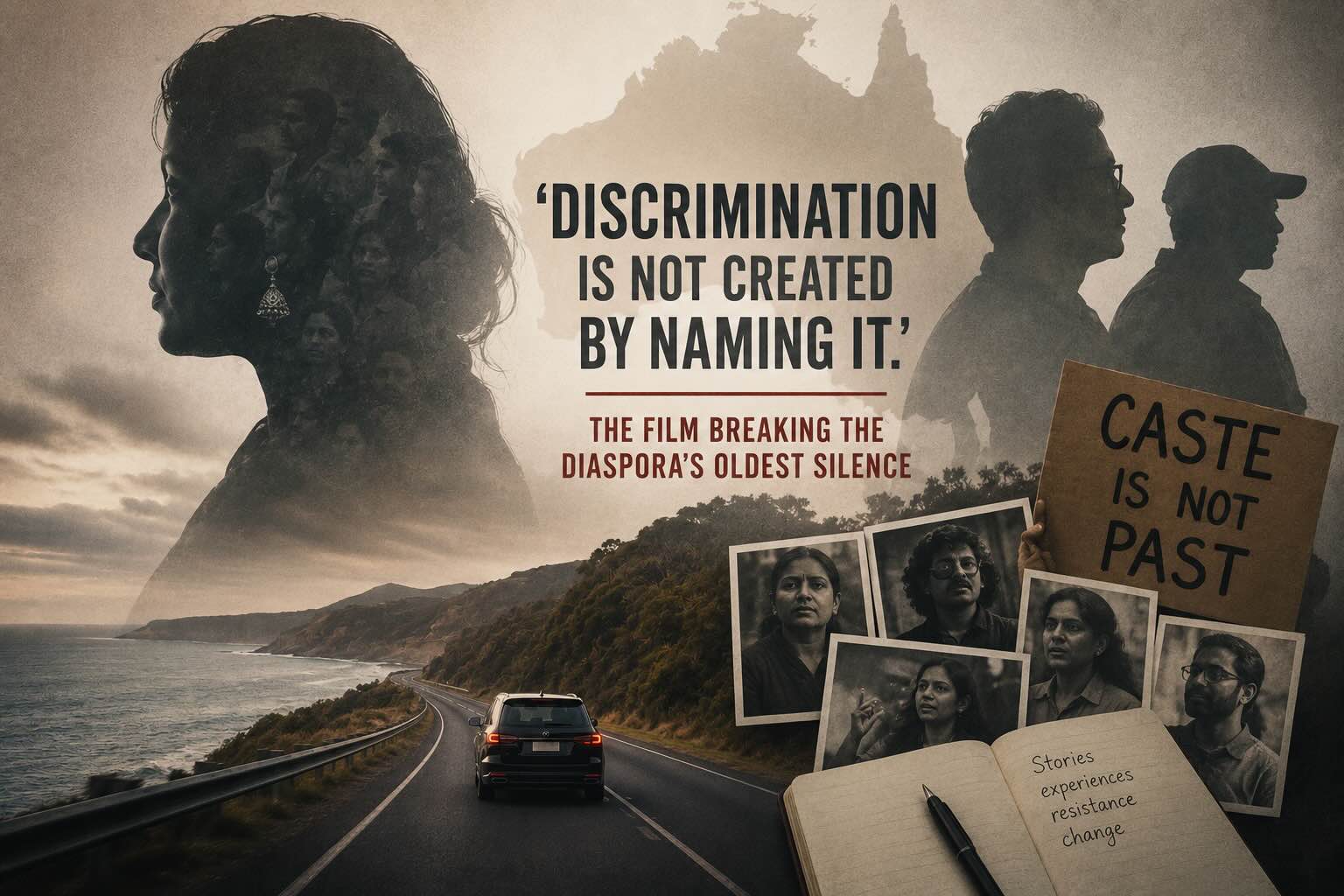
When Dr Vikrant Kishore set out on a five-day, 3,500-kilometre drive from Melbourne through Sydney, Newcastle and Coffs Harbour, he was not chasing landscapes. He was chasing silences.
The result is Resisting Casteism in Australia, a 61-minute personal road documentary that brings together academics, community leaders, activists, allies and members of the Indian-Australian community to speak about something many in the diaspora still deny exists here at all: caste discrimination.
“When I moved to Australia, I was struck by the assumption that caste would somehow disappear through migration,” Kishore says. “In reality, I began hearing stories that sounded familiar. People spoke about surnames, food, marriage, social networks, caste-based community groups, silences, and small acts of exclusion.”
Kishore, an Australian filmmaker, journalist and academic currently an associate professor at the University of Nottingham Ningbo, China, brings three decades of engagement to the subject. His first student documentary, Yathartha, co-directed in 1998 at Jamia Millia Islamia’s AJK Mass Communication Research Centre, examined caste discrimination in Indian universities. In the new film, he returns to Dr Ratan Lal, one of the people featured in Yathartha, to ask whether casteism has changed and how it continues to shape lives.
Speaking on NRI Affairs’ Pause with Nandini alongside Dr Haroon Kasim, vice president of the Periyar Ambedkar Thought Circle of Australia (PATCA), Kishore was blunt about why caste has been so hard to name in the diaspora.
“It is not a difficult-to-name issue. It is about who is actually empowered in a space,” he said. “The Indian diaspora has always been dominated by certain upper caste communities… when it comes to cultural practices, it was always about the good cultural practices, never about the bad cultural practices like caste discrimination.”
Invisible, but not absent
Drawing on author Isabel Wilkerson, Kishore explained the crucial difference between racism and casteism: race is often visible, while caste operates through inherited social identity, invisible to outsiders but instantly legible to South Asians. “We want to know what your surname is, where you come from, what your father worked as… These are the subtle forms of inclusion or exclusion.”
That invisibility does not blunt its harm. Kasim recounted an incident in Melbourne in which a five-year-old girl from a caste-oppressed community, attending dance lessons, was refused use of the toilet by a dominant-caste teacher and told to use it at home. “That’s going to scar her, and that is so perverse,” Kasim said. “It’s normalised because it’s systemic, and the only way you de-normalise it is confronting it, calling it out as barbaric and nothing else.”
Kishore described casteist microaggressions as rampant, from direct questions about caste to assumptions based on a surname, a car or the way someone dresses. One panellist at a Melbourne conference recalled colleagues refusing to share her lunch fifteen years ago, an incident that still stayed with her.
Getting people to speak on camera was the film’s hardest task. “Coming out, when we say in caste, it’s a huge thing, because you are making yourself vulnerable to people to judge you,” Kishore said. One participant dropped out entirely, unable to bear being publicly identified as Dalit. That difficulty reshaped the film itself. “I realised I’m trying to get a story which I should be telling, and that’s where I come into the film. Then the film becomes my story.”
From denial to listening
Kishore is clear about who the film is for, and who it is not. “I’m not making this film for the perpetrators. They understand how caste operates, and they do not acknowledge it. The film is for the wider community,” he said, pointing to an Indian and South Asian diaspora now more than a million strong. “How do we shape the culture of Australia? Do we be blind to this kind of cultural baggage and say racism is a problem, but what happens to our own baggage?”
To those who deny caste travels with migration, his answer is simple: “Discrimination is not created by naming it. Discrimination already exists when people experience it. Naming it is the first step towards dealing with it.”
The timing is significant. The Australian Human Rights Commission’s National Anti-Racism Framework has brought caste-based discrimination into policy discussion, recommending caste’s inclusion as a protected attribute, and Queensland’s Respect at Work and Other Matters Amendment Act 2024, in force since July 2025, now explicitly includes “descent, ancestry or caste” within the definition of race in the state’s anti-discrimination law. Speaking on the show, Kasim said the AHRC’s recommendation had been “seconded” in New South Wales and was making its way into the education stream. (In NSW, the Law Reform Commission’s ongoing review of the Anti-Discrimination Act 1977 is actively considering the inclusion of caste, a move supported in submissions including from the Law Society of NSW.) PATCA is advocating for caste-based data collection and a caste discrimination register.
“Annihilation starts with recognition,” Kasim said, noting the Greens Party of New South Wales had become likely the first party in the Western world to formally recognise caste as a form of racism. “I am a hundred per cent confident that we will have mechanisms of dealing with caste.”
The film is already resonating beyond Australia. Kasim revealed, live on the show, that an Ambedkarite group in Canada, instrumental in having caste recognised by the Toronto school board, has asked to screen it there. And when Kishore screened it for his overwhelmingly Chinese students in Ningbo, one stood up afterwards and offered a two-word review: “Jai Bhim.”
“Coming from a Chinese student who has never heard of caste, it just made my day,” Kishore said. “I hope the film helps move the conversation from denial to listening, from silence to recognition, and from recognition to change.”
Screening details
Resisting Casteism in Australia (61 min, English, E15+) screens in:
Sydney: Saturday 18 July 2026, 3:00 pm to 5:00 pm, The Regency, 18 George Young Street, Auburn. Bookings: eventbaba.com.au/events/Resisting-Casteism-in-Australia
Melbourne: Sunday 19 July 2026, 12:15 pm, Cinema Nova, as part of the Melbourne Documentary Film Festival. Bookings: cinemanova.com.au/films/mdff26-resisting-casteism-in-australia
Both screenings will be followed by a Q&A with filmmaker Dr Vikrant Kishore.
Film website: vikrantkishore.com/resistingcasteism