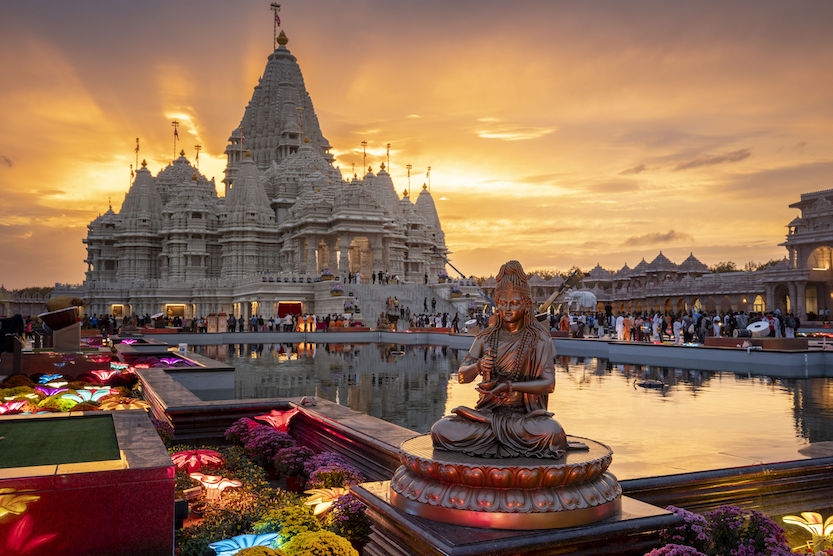
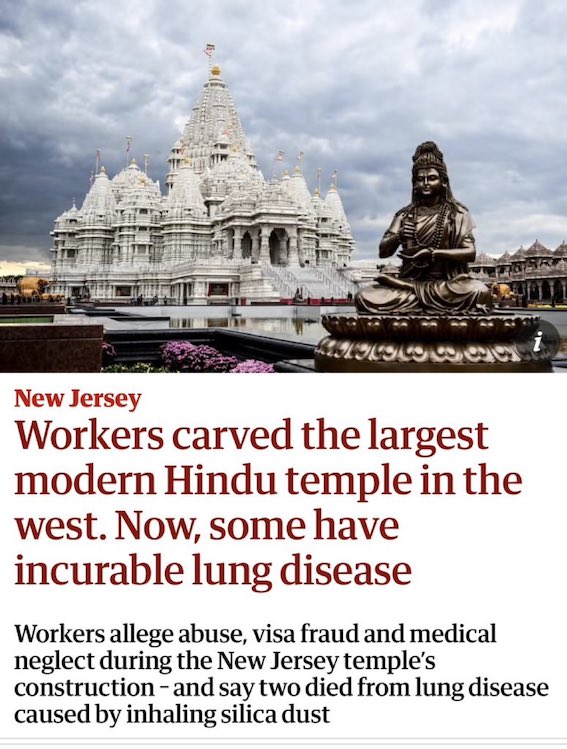
A major investigation into the construction of the BAPS Swaminarayan Akshardham temple in Robbinsville, New Jersey — the largest modern Hindu temple outside India — has revealed allegations that workers developed serious and incurable lung diseases due to unsafe working conditions, prompting renewed calls for accountability and reparations.
According to a report by The Guardian, more than 200 workers — many of them Dalit artisans brought from Rajasthan — were involved in building the sprawling temple complex between 2015 and 2023. While the site has drawn global admiration for its intricate craftsmanship, workers allege the project came at a devastating human cost.
Allegations of silicosis, deaths and unsafe conditions
Workers told The Guardian that at least two labourers, Ramesh Meena and Devi Lal, died from silicosis — an irreversible lung disease caused by inhaling fine silica dust generated during stone carving. Others reported developing respiratory illnesses including tuberculosis and chronic bronchitis.
Silicosis can cause severe breathing difficulties, chronic coughing and fatigue, often leading to disability or death. Workers alleged they were not provided adequate protective equipment, such as proper respirators, while working long hours in dust-heavy environments.
Many also described harsh labour conditions, including 80–90 hour work weeks, wages as low as $1.20 an hour, and restrictions on movement and communication with families.
Some workers said they were sent back to India once they showed symptoms of illness, without adequate treatment or support.
Legal battles and prior investigations
The allegations form part of an ongoing civil lawsuit against BAPS, following earlier claims of forced labour and visa misuse under the R-1 religious worker visa programme. In 2021, US federal agents removed around 90 workers from the site amid these concerns.
While the US Department of Justice closed its criminal investigation without charges in 2025, the civil case is continuing, with workers seeking compensation and damages for alleged exploitation and health impacts.
BAPS has strongly denied the allegations, stating that workers were volunteers engaged in religious “seva” (service), and that proper safety measures, medical care and accommodation were provided.
Hindus for Human Rights demands compensation and care
In response to the latest revelations, Hindus for Human Rights has issued a strong statement calling on BAPS to provide compensation and long-term medical support to affected workers and their families.
The organisation said “no sacred space should be built on disposable lives,” and emphasised that accountability is essential for justice.
Hindus for Human Rights highlighted that many workers were from historically marginalised Dalit communities and alleged they endured exploitative conditions, inadequate safety protections and medical neglect. It also pointed to broader systemic issues in India’s temple-stone industry, where silicosis has claimed thousands of lives.
The group urged BAPS to fully cooperate with ongoing legal proceedings and ensure dignity, protection and fair treatment for all workers involved in religious construction projects.
“People appreciate the art — but not the blood”
Workers quoted in the investigation described the emotional and physical toll of their experience, including years away from families and deteriorating health. One worker said: “People appreciate the art but they don’t know the blood.”
As the civil case progresses, the controversy has raised broader questions about labour practices, caste dynamics, and the ethics of large-scale religious construction projects — both in the United States and globally.
For rights advocates, the issue is no longer just about a single temple, but about ensuring that faith, devotion and cultural pride are not built at the expense of human dignity and worker safety.