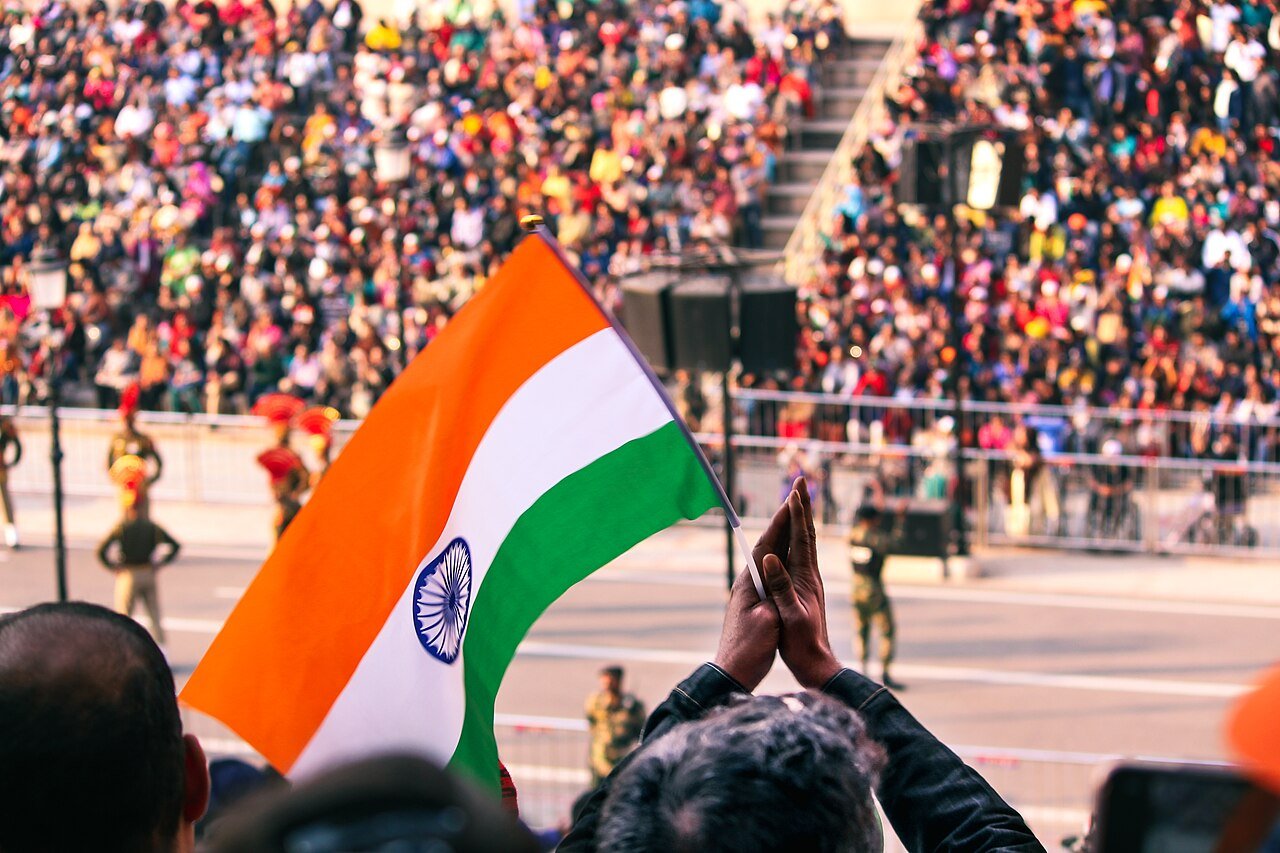
Public opinion of India is almost evenly divided internationally, according to a new Pew Research Center study, with the country receiving some of its strongest ratings in Sri Lanka, the United Kingdom and Kenya and its weakest in Pakistan, Turkey and the Palestinian territories surveyed.
Across the 36 countries surveyed between February 9 and May 13, 2026, a median of 45 per cent of adults held a favourable opinion of India, compared with 41 per cent who viewed it unfavourably.
But that median conceals enormous differences. Favourable opinion ranged from 79 per cent in Sri Lanka to just 7 per cent in Pakistan. Australia was among the countries where a majority viewed India negatively, while American opinion shifted further into unfavourable territory.
India’s image in Australia, the US and surveyed neighbours
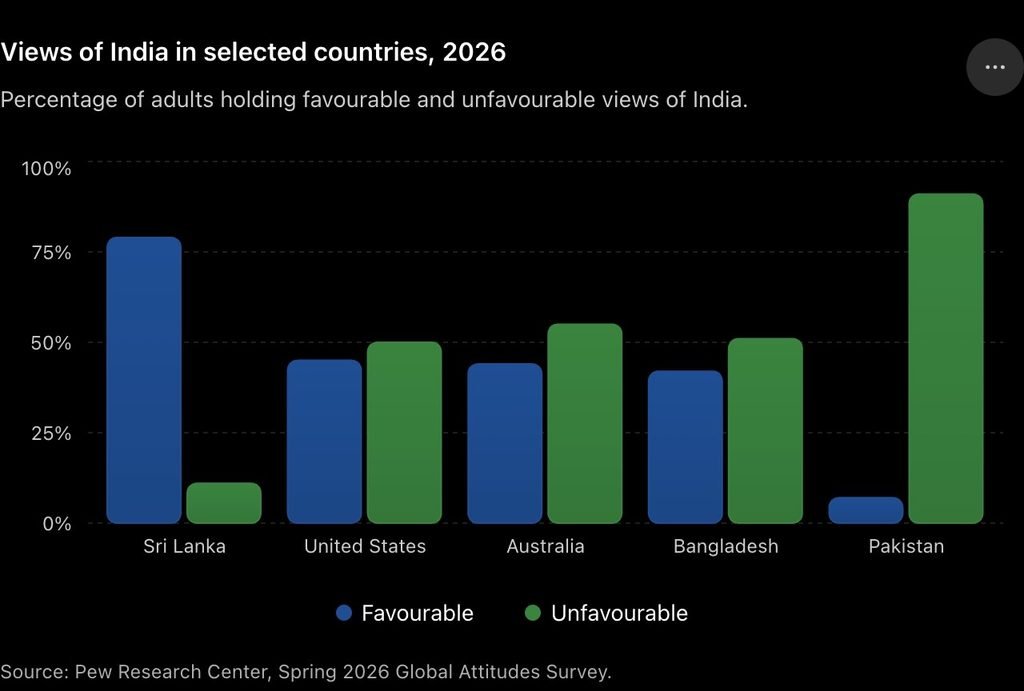
| Country | Favourable | Unfavourable | No opinion | Change in favourable rating |
|---|---|---|---|---|
| Sri Lanka | 79% | 11% | 10% | +14 points since 2024 |
| United States | 45% | 50% | 4% | −4 points since 2025 |
| Australia | 44% | 55% | 1% | −1 point since 2025 |
| Bangladesh | 42% | 51% | 7% | −15 points since 2024 |
| Pakistan | 7% | 91% | 2% | No comparable 2024–25 result |
Australia remains firmly sceptical
In Australia, 55 per cent of adults expressed an unfavourable opinion of India, compared with 44 per cent who viewed it favourably. Only 1 per cent did not offer an opinion.
Australia therefore recorded an 11-point gap between negative and positive sentiment. Among the Asia-Pacific publics surveyed, only Pakistan and Malaysia had larger unfavourable majorities.
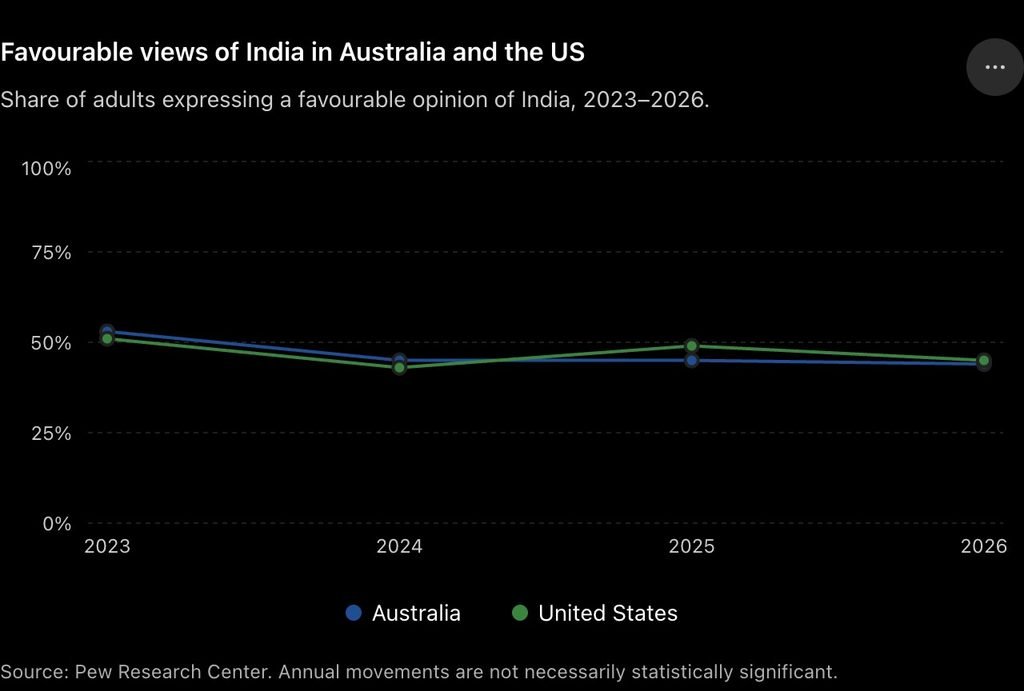
The result represents little change from 2025, when 45 per cent of Australians viewed India favourably and 54 per cent viewed it unfavourably. Pew described the movement between 2025 and 2026 as statistically insignificant.
The longer trend nevertheless shows that positive views are lower than in 2023. Favourability stood at 53 per cent that year before falling to 45 per cent in both 2024 and 2025 and 44 per cent in 2026.
Pew’s 2025 analysis also found important divisions within Australia. Older adults were significantly more likely than younger adults to view India positively, while Australians on the ideological right were more favourable towards India than those on the left. The latest short report does not provide comparable Australian subgroup figures for 2026. Pew’s 2025 study
US opinion falls to one of its lowest levels
The United States also moved into negative territory. Half of American adults now hold an unfavourable opinion of India, compared with 45 per cent who view the country favourably.
Pew said these were among India’s lowest American ratings since it began asking the question in 2008. The favourable share has generally declined since reaching 51 per cent in 2023.
Unlike the essentially unchanged result in Australia, the four-point fall in US favourability from 49 per cent in 2025 to 45 per cent in 2026 was statistically significant.
American opinion varied by both age and political affiliation.
| US group | Favourable | Unfavourable |
|---|---|---|
| All adults | 45% | 50% |
| Ages 18–29 | 42% | 56% |
| Ages 30–49 | 41% | 54% |
| Ages 50–64 | 50% | 46% |
| Ages 65 and older | 50% | 43% |
| Republican or Republican-leaning | 42% | 55% |
| Democrat or Democratic-leaning | 50% | 47% |
Half of Americans aged 65 and older viewed India favourably, compared with 42 per cent of those aged 18 to 29. Democrats and Democratic-leaning independents were eight points more favourable towards India than Republicans and Republican-leaning independents.
When asked about India’s international standing, 54 per cent of Americans said its global influence had remained about the same in recent years. Thirty per cent believed India was becoming stronger, while 13 per cent said its influence was weakening.
Neighbours hold dramatically different views
Among the South Asian neighbours included in Pew’s 2026 polling, Sri Lanka emerged as India’s strongest supporter.
Seventy-nine per cent of Sri Lankans viewed India favourably, compared with only 11 per cent who held an unfavourable opinion. Favourability has risen 14 percentage points since 2024, when it stood at 65 per cent.
India was also central to how Sri Lankans understood their country’s external relationships: 63 per cent named India as Sri Lanka’s most important ally. Seventy per cent expressed confidence in Prime Minister Narendra Modi’s handling of world affairs, although this was lower than the 79 per cent who viewed India itself favourably.
The picture in Bangladesh was almost the reverse. Forty-two per cent of Bangladeshis held a favourable view of India and 51 per cent an unfavourable one.
India’s favourable rating in Bangladesh has fallen by 15 points since 2024, from 57 per cent to 42 per cent. At the same time, the proportion declining to offer an opinion dropped from 24 per cent to 7 per cent. Pew therefore recorded both a decline in positive sentiment and a substantial increase in the number of Bangladeshis expressing a definite view.
Confidence in Modi among Bangladeshis was also 42 per cent, identical to the country’s overall favourable rating. Bangladeshis most often identified India as the greatest threat to their country. Pew’s South Asian findings
Pakistan produced by far the most negative assessment. Ninety-one per cent of Pakistanis viewed India unfavourably, including 73 per cent who described their opinion as “very unfavourable”. Just 7 per cent held a favourable view, and only 4 per cent expressed confidence in Modi.
The hostility was reciprocal, though slightly less overwhelming. Seventy-eight per cent of Indians viewed Pakistan unfavourably and only 8 per cent favourably. Fifty-four per cent of Indians named Pakistan as their country’s greatest geopolitical threat, while 43 per cent of Pakistanis identified India as theirs.
Pew also found religious differences within India: 21 per cent of Indian Muslims held a favourable view of Pakistan, compared with 6 per cent of Indian Hindus. Even among Indian Muslims, however, two-thirds viewed Pakistan negatively. Pew’s India–Pakistan report
The regional findings are not exhaustive. Pew’s country-rating data cover Bangladesh, Pakistan and Sri Lanka among India’s regional neighbours, but do not represent every neighbouring country.
Gains in Europe, declines elsewhere
India’s strongest ratings outside South Asia came from Kenya and the United Kingdom, where 71 per cent in each country held favourable views. Germany followed at 63 per cent, while Israel registered 60 per cent.
Pew found statistically significant improvements in the UK, where favourability rose 11 points since 2025, and Germany, where it increased six points. German favourability has risen from 47 per cent in 2023 to 63 per cent in 2026.
The sharpest recent declines occurred in Bangladesh, Turkey and Nigeria. Favourability fell 15 points in Bangladesh since 2024 and 10 points each in Turkey and Nigeria since 2025. Significant falls were also recorded in South Africa, Indonesia, Mexico and the United States.
The 2025 study reported a 24-country median of 47 per cent favourable and 38 per cent unfavourable, compared with 45 per cent and 41 per cent respectively in the new survey. These headline medians should not be treated as a direct measure of worldwide change because Pew expanded the survey from 24 to 36 countries. Its country-by-country comparisons provide the more reliable evidence of movement.
About the survey
Pew surveyed 42,092 adults across 36 countries between February 9 and May 13, 2026. The surveys were designed to represent the adult population of each participating country.
The linked South Asia report drew on interviews with 3,566 adults in India, 1,039 in Pakistan, 1,044 in Bangladesh and 2,513 in Sri Lanka, conducted between February 8 and May 7, 2026.