Three UN Special Rapporteurs have formally written to the Government of India expressing concern over the large-scale removal of names from electoral rolls during the Election Commission of India’s Special Intensive Revision exercise, saying the process disproportionately affected Muslim voters and other minority communities.
The communication, dated 1 May 2026 and referenced AL IND 8/2026, was signed by Nicolas Levrat, UN Special Rapporteur on minority issues; Irene Khan, Special Rapporteur on the promotion and protection of the right to freedom of opinion and expression; and Nazila Ghanea, Special Rapporteur on freedom of religion or belief. It was addressed to the Government of India under the UN Human Rights Council’s Special Procedures mechanism.
Under that mechanism, the Indian government has 60 days to respond to the communication. It had not issued a public response as of the date of publication. The Election Commission of India has maintained that the SIR was conducted to ensure the accuracy of electoral rolls and to remove names of ineligible voters, including those who have died, relocated or entered the country illegally.
What the UN communication says
The communication states that Muslim voters were reportedly disproportionately impacted by the SIR process. The rapporteurs cited data from specific locations to support that claim.
In West Bengal’s Nandigram constituency, the rapporteurs noted that an alleged 95% of deleted voters were Muslim, even though the community comprises only 25% of the local electorate.
West Bengal was particularly affected, with a reported 9.1 million names removed from the state’s voter registers. The deletions took place ahead of West Bengal’s two-phase Assembly elections, held on 23 and 29 April 2026.
Affected individuals reportedly included men, women and elderly Indian citizens with valid identity documents. Many of those excluded approached the Election Commission and the Supreme Court seeking relief. The Supreme Court declined to stay the SIR process on 6 April 2026.
On 16 April 2026, the Supreme Court invoked its powers under Article 142 of the Constitution to permit voters in West Bengal whose names had been removed to regain voting rights if their appeals were accepted before 21 and 27 April, ahead of the state’s two-phase Assembly elections.
The rapporteurs noted that the revision exercise generated more than 3.4 million appeals, placing extraordinary pressure on tribunals to decide cases within an extremely short period.
What is the Special Intensive Revision?
What is the Special Intensive Revision?
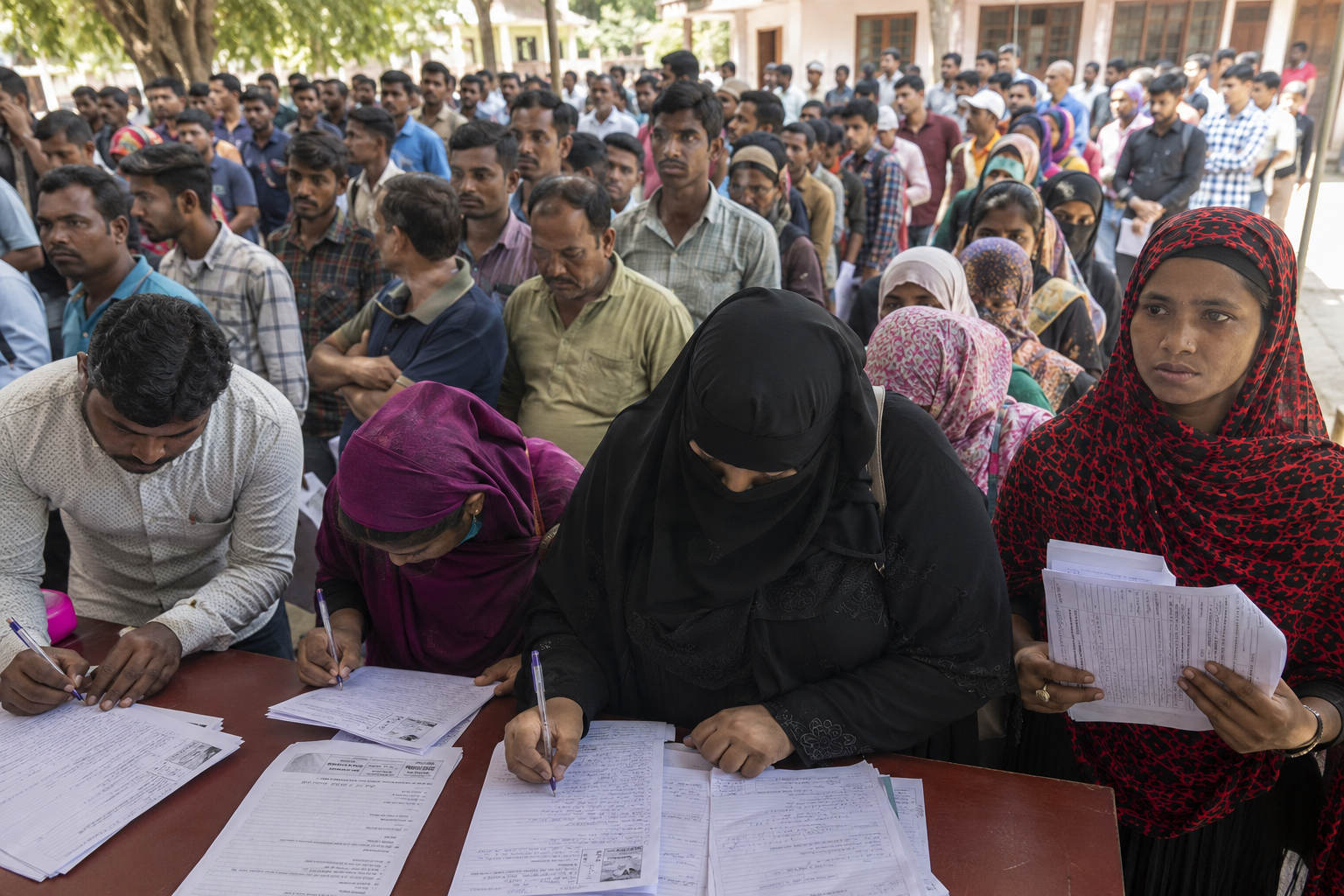
The Special Intensive Revision is a process conducted by the Election Commission of India to update and verify electoral rolls. It involves door-to-door verification of voter registrations and systematic review of existing entries to identify and remove names of voters who are deceased, have relocated, are duplicated, or are otherwise ineligible. The ECI has described the SIR as a standard administrative exercise conducted under the Representation of the People Act, 1950. The most recent SIR covered 12 states and union territories and began in Bihar before extending to West Bengal and other states. The ECI has said the exercise is necessary to maintain the integrity of the electoral process.
The AI system and the spelling inconsistency question
The letter pointed out the ECI’s use of an AI-based system to flag irregularities in voter data, warning that it raised concerns about transparency, errors and potential bias.
The experts also highlighted allegations that minor spelling inconsistencies in official documents, described as common administrative issues in India, were used as grounds for deleting names from electoral rolls.
The rapporteurs said the use of automated systems in this high-stakes context introduced serious issues related to transparency, errors and potential bias, which risked removing valid voters and undermining democratic fairness.
The political rhetoric the rapporteurs flagged
The UN communication connects the administrative actions to the broader political environment and public statements regarding minority communities. The Special Rapporteurs noted discriminatory rhetoric by politicians and senior public figures of the government in the context of the SIR exercise.
According to the letter, government officials, including the Union Home Minister, publicly framed the deletion of voter names as targeting illegal Bangladeshi immigrants. The experts said such rhetoric appeared to conflate Indian Muslim citizens with foreign nationals.
The communication also referred to repeated references to a policy of “Detect, Delete and Deport” in relation to the electoral process. The rapporteurs said such rhetoric could amount to advocacy of religious or national hatred prohibited under Article 20(2) of the International Covenant on Civil and Political Rights.
“We note with grave concern that the framing of a state-administered electoral process in terms of the removal of a religious community risks constituting, at minimum, an official endorsement of discriminatory attitudes toward Muslim citizens,” the rapporteurs wrote.
What the rapporteurs have asked India to provide
The communication poses seven questions to the Indian government. It asks for detailed data on the exact number of voters removed and the reasons cited for each deletion. It requests a religious and ethnic breakdown of those excluded from the rolls. It asks what safeguards were in place during the claims and objections period and what measures were taken to ensure access to effective remedies before the West Bengal elections.
The letter sought details on steps taken to ensure that the SIR process has not resulted in the exclusion of eligible voters from their participation in the public elections of 2026. It also sought information on measures undertaken to eliminate any discriminatory treatment of minorities, including Muslims and persons of Bengali descent, as well as other minorities, concerning the right to vote and to choose their representatives freely.
India’s international obligations cited by the rapporteurs
The rapporteurs cited several international legal instruments they said India had obligations under: the International Covenant on Civil and Political Rights, which India ratified in 1979; the 1992 UN Declaration on the Rights of Persons Belonging to National or Ethnic, Religious and Linguistic Minorities; and principles of non-discrimination and the right to political participation.
A similar communication was sent by UN Special Rapporteurs in December 2018 during the compilation of the National Register of Citizens in Assam, when concerns were raised about the potential exclusion of Bengali Muslims from the NRC.
The ECI’s position and India’s response
The Election Commission of India has described the SIR as a standard administrative exercise conducted under the Representation of the People Act, 1950, aimed at maintaining the accuracy and integrity of electoral rolls. The Commission has said the process is necessary to remove names of deceased voters, have relocated, have duplicate entries, or are otherwise ineligible to vote.
The Supreme Court of India, in its April 6 ruling declining to stay the SIR process, did not find grounds for an immediate intervention in the exercise. Its April 16 order under Article 142 allowed removed voters to seek restoration through the appeals process before the West Bengal election dates.
The Government of India has not issued a formal public response to the UN communication as of the date of publication. Under the Special Procedures mechanism, it has 60 days from 1 May 2026 to respond. Whether it responds, and what its response contains, will determine the next phase of this UN-level scrutiny.
What it means for the Indian diaspora
The UN communication on electoral roll deletions sits within a broader international conversation about minority rights and democratic processes in India that the global Indian diaspora follows closely.
For Indian-Australians, Indian-Americans and Indians in the UK, Canada, UAE and New Zealand, many of whom have family members in West Bengal, Bihar and other states affected by the SIR, the communication from UN Special Rapporteurs is a significant development. It elevates what had been a domestic political and legal dispute to an international human rights question, with formal UN scrutiny and a mandatory government response period.
The diaspora’s relationship with India’s domestic politics is complex. For Indian Muslims in the diaspora particularly, the SIR and its documented impact on Muslim voters is a matter of direct concern for family members who remain in India. For the broader diaspora, the UN communication raises questions about the integrity of India’s democratic institutions that touch on how India is perceived internationally.
The Indian government’s response to the UN communication, or its absence, will shape how the issue is reported and understood internationally in the months ahead.
What happened and what comes next
What is the UN Special Procedures mechanism and is India obliged to respond?
The UN Special Procedures mechanism allows independent human rights experts appointed by the UN Human Rights Council to communicate directly with governments about alleged human rights violations. Communications are sent as letters and governments are given 60 days to respond. The mechanism is not a court and cannot impose binding obligations. However, governments’ responses, or failures to respond, are made public and form part of the UN human rights record. India has received numerous Special Procedures communications over the years and has responded to some while not responding to others.
Did the Supreme Court rule in favour of the affected voters?
The Supreme Court declined to stay the SIR process in its April 6 ruling. On April 16, using its special powers under Article 142 of the Constitution, it allowed voters whose names had been removed to seek restoration through appellate tribunals before the West Bengal election dates of April 23 and April 29. The rapporteurs noted that the compressed timeline and 3.4 million appeals placed significant pressure on the system, and expressed concern that millions of eligible voters may still have been excluded.
How many names were removed nationally under the SIR?
The communication cites allegations that approximately 52 million names were removed from electoral rolls across 12 states and union territories. In West Bengal alone, 9.1 million names were reportedly removed. The ECI has not publicly released a full official breakdown of deletions by state, religion or reason.
Has the Indian government responded to the UN communication?
Not publicly as of the date of publication. The 60-day response window from the 1 May 2026 communication date has elapsed. Whether the government has responded confidentially to the UN or will make any public statement has not been confirmed.
Is this the first time UN Special Rapporteurs have written to India about electoral rolls and minority rights?
No. A similar communication was sent in December 2018 regarding the National Register of Citizens exercise in Assam, which raised concerns about the potential exclusion of Bengali Muslims. That communication also did not result in a formal public government response.