

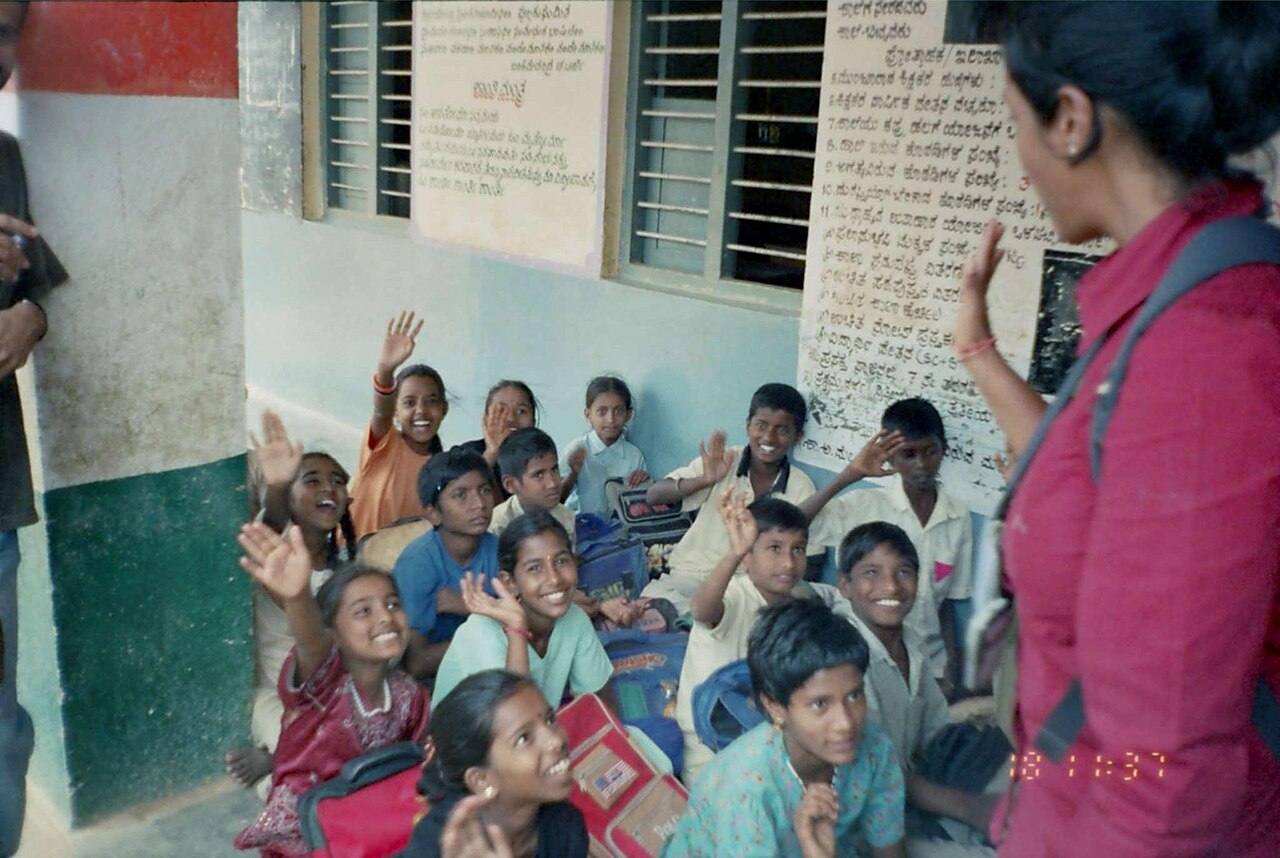
Indian families are increasingly spending on private coaching out of school to improve children’s learning outcomes. Nearly two in five students in secondary school are enrolled in some coaching classes, up from under a quarter in primary school, according to the Comprehensive Modular Survey on Education 2025, conducted across 52,085 households between April and June 2025.
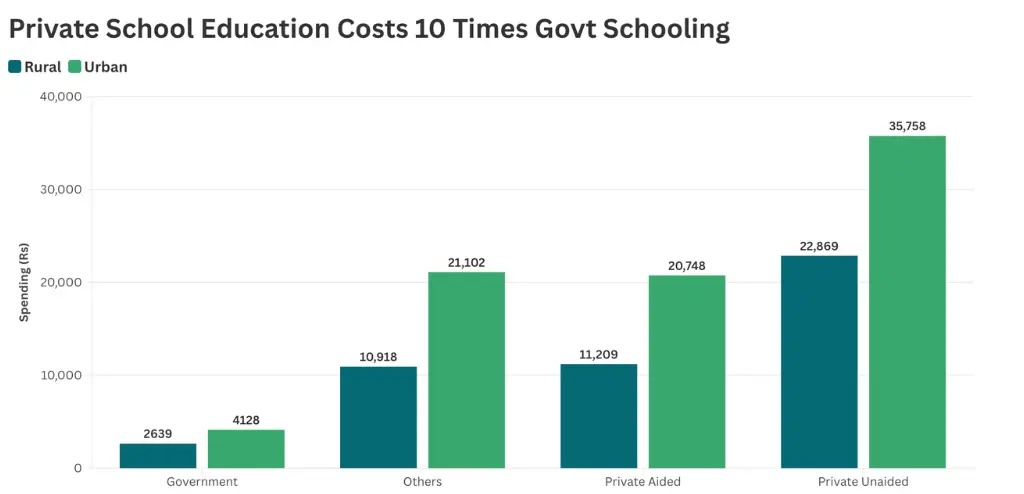
In addition, about 38% of students are enrolled in private schools, where overall household expenditure per student, on average, is 10 times that in government schools. Taken together, families with school-going children spend between 5% and 10% of their monthly expenditure on education and related costs, our analysis shows. Spending patterns vary across social groups.
“When we say that parents are not paying any fee under the Right to Education [RTE Act], we need to understand that there is a lot of ‘opportunity cost’ of education that parents pay,” said Kishore Darak, a senior educationist working in the sector for close to three decades. “For example, a child going to school may require her mother to stay at home as a caregiver to younger siblings. In that case, she loses her daily wages, adding to the opportunity cost the parents must bear.”
In six charts, we analyse household spending on school education.
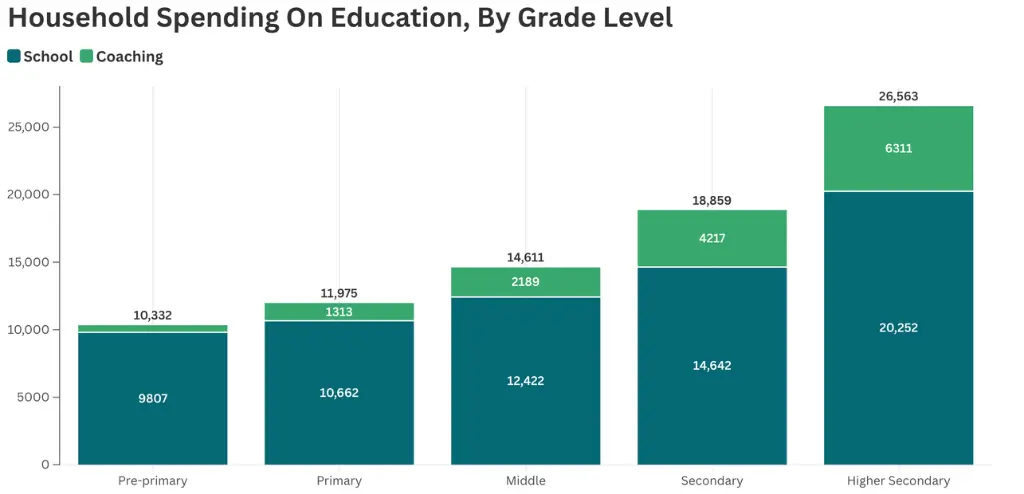
High pre-primary costs
The survey asked respondents for a breakdown of expenditure on education and found that, on average, households spent Rs 9,807 per year per student in pre-primary school. This is two-thirds the amount spent in secondary school.
“The pre-primary education sector in India is highly unregulated, we do not even know the number of nurseries and preschool centres in the country,” Darak said. “Lack of regulation leads to unchecked profiteering. Sending a child to an expensive preschool has become a symbol of prestige or class, a vehicle of upward mobility, so parents want to believe they should spend more.”
Similarly, private coaching expenditure rises nearly four times between primary and higher secondary school.
High costs in urban elementary schools
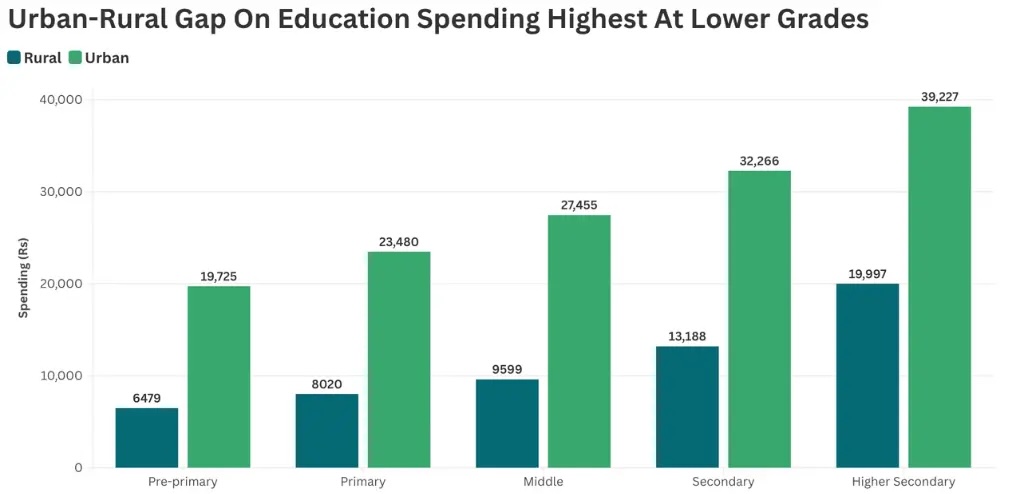
Families in Indian cities and towns spend more on education and related costs than their rural counterparts. Until middle school, spending in urban areas is nearly three times that in rural areas. By higher secondary levels, urban spending is about twice the rural spending.
Urban households are more likely to enroll children in private schools, while rural households depend more on government schools, a 2023 study noted.
The private bill
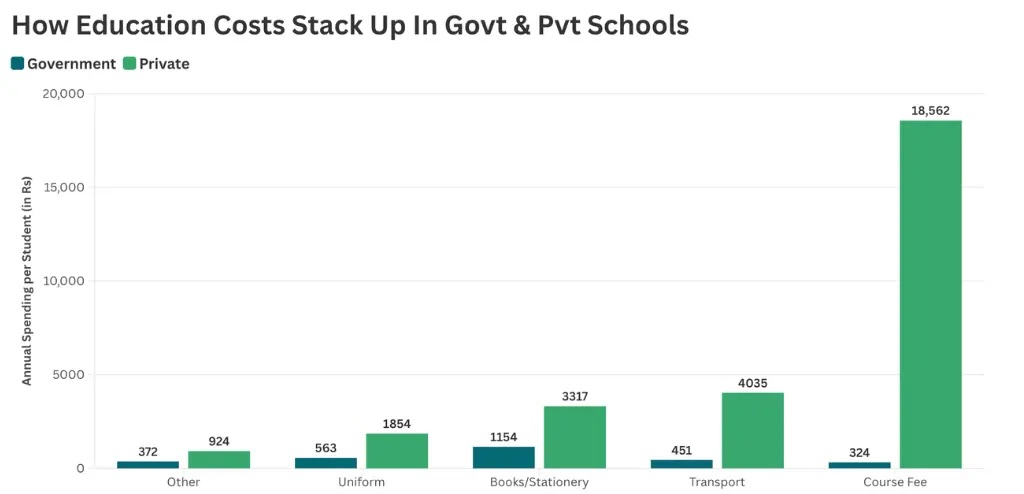
An average student in government school incurs Rs 2,863 per year in education-related costs, compared to Rs 28,693 in private schools. The difference is seen across both rural and urban areas.
Enrolment in government schools has declined in recent years, while private school enrolment has increased, with many parents citing better learning outcomes as a reason for choosing private schools, as IndiaSpend reported in August 2025.
“Parents are concerned about the quality of education. They want their children to have better education. The circumstances are forcing them to pay for quality education,” said Darak.
In government schools, books and stationery account for about 40% of total school expenditure. In private schools, course fees account for about 65%.
These figures capture reported spending, but may not include all expenses households incur. “There are a lot of hidden and allied costs of education and coaching. Parents often report only fees, but there are additional costs like transport for private coaching, which are not captured.” said Darak.
The coaching boom
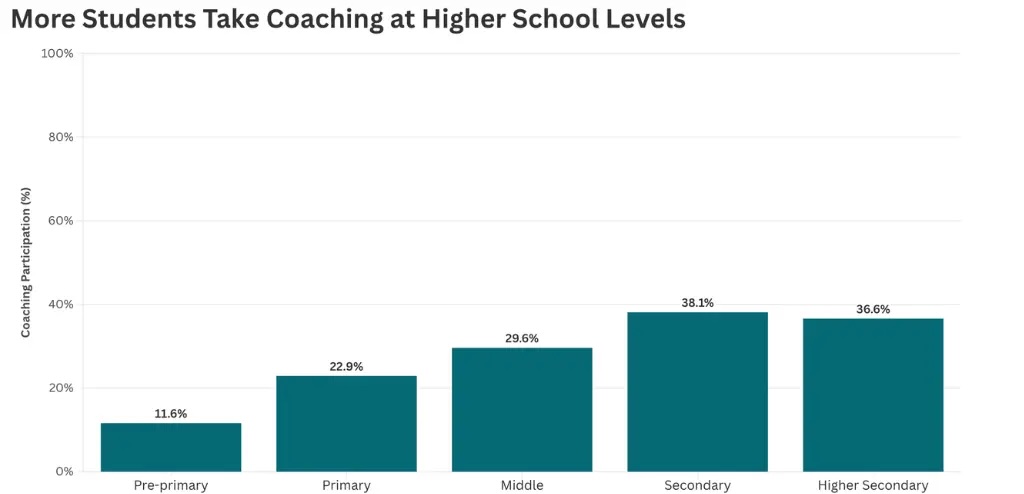
About one in ten students (11.6%) at the pre-primary level take coaching, rising to—as we said—almost four in 10 (38.1%) at the secondary level.
Average coaching expenditure rises from Rs 525 at the pre-primary level to Rs 6,311 at the higher secondary level. The increase is seen in both rural and urban areas, with urban spending higher at each stage.
“As children move to higher grades, the cost of education increases. Entry to higher education is now almost totally driven by the entrance examinations and the coaching industry is the gatekeeper there,” said Kishor Darak. “Coaching centres teach techniques of cracking exams. Almost any child cannot crack those exams without such coaching support that preaches ‘academic manipulations,” he added.
Research based on data from the Annual Status of Education Reports has found that private tutoring is linked to better learning outcomes, suggesting that households use coaching to support school learning. The findings also suggest that reliance on private tutoring may point to limitations in the school system.
Education spending across groups
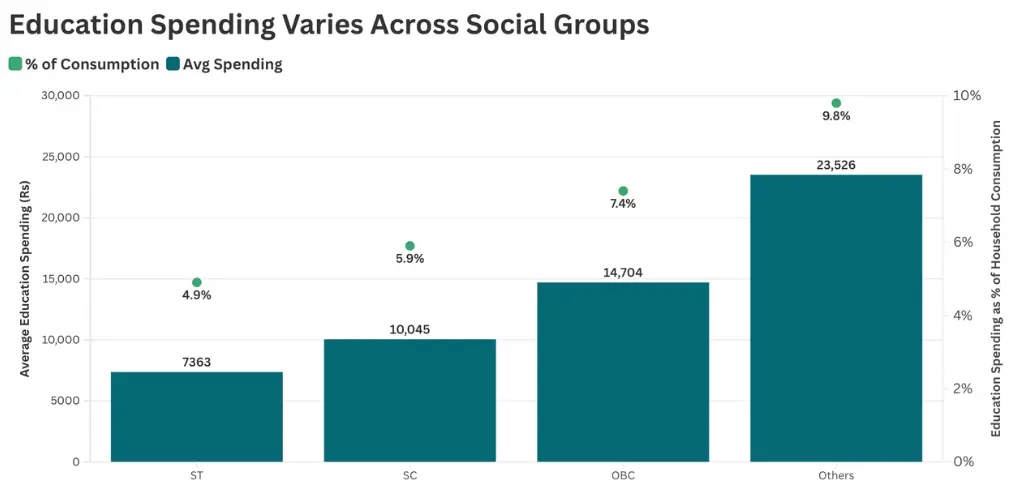
Household spending on education also varies across social groups. Scheduled Tribes households spend Rs 7,363 annually on education and related costs, amounting to about 5% of their consumption expenditure, while Other Backward Classes households spend about twice and ‘others’ spend nearly thrice that amount annually, amounting to about 10%.
A 2024 study on household expenditure in urban India found that spending on education varies across socioeconomic groups, caste and type of institutions, with households allocating a significant portion of their budgets to schooling despite the provision of free education.
Spending also increases across grades for all social groups, with the gap widening at higher grades. At the higher secondary level, households in the ‘others’ category spend Rs 40,348 per student, compared with Rs 15,303 among ST households.
Enrolment drops at higher grades, particularly among ST students, we had reported in 2025.
“If India wants to become a developed country, as is harped in the Viksit Bharat 2047 narrative, it should ensure free and high-quality mandatory education for all children,” said Darak. “Education is and should always be seen as a fundamental right, part of the Right to Life. The state cannot run away from its responsibility of providing equitable quality education to every child,” he added.
This article was originally published on IndiaSpend.
Vijay Jadhav is a journalist at IndiaSpend. He holds a postgraduate degree in journalism from the Department of Communication and Journalism, Savitribai Phule Pune University.
IndiaSpend is a nonprofit that utilises open data to analyse a range of issues with the broader objective of fostering better governance, transparency and accountability in the Indian government.