In over 30 years of being a journalist, Joe Sacco has traveled from Malta to Bosnia to Gaza reporting on stories about violence, poverty, and genocide for the most vivid journalistic medium: the graphic novel. Most well-known for his books “Palestine” and “Footnotes in Gaza,” the comic journalist’s latest book, “The Once and Future Riot,” explores the 2013 Muzaffarnagar riots in India and how people construct stories around the violence that they have experienced. Muzaffarnagar is a small city in the northern Indian state of Uttar Pradesh, where riots between Hindus of the Jat caste and Muslims broke out, killing more than 60 people and displacing more than 50,000.
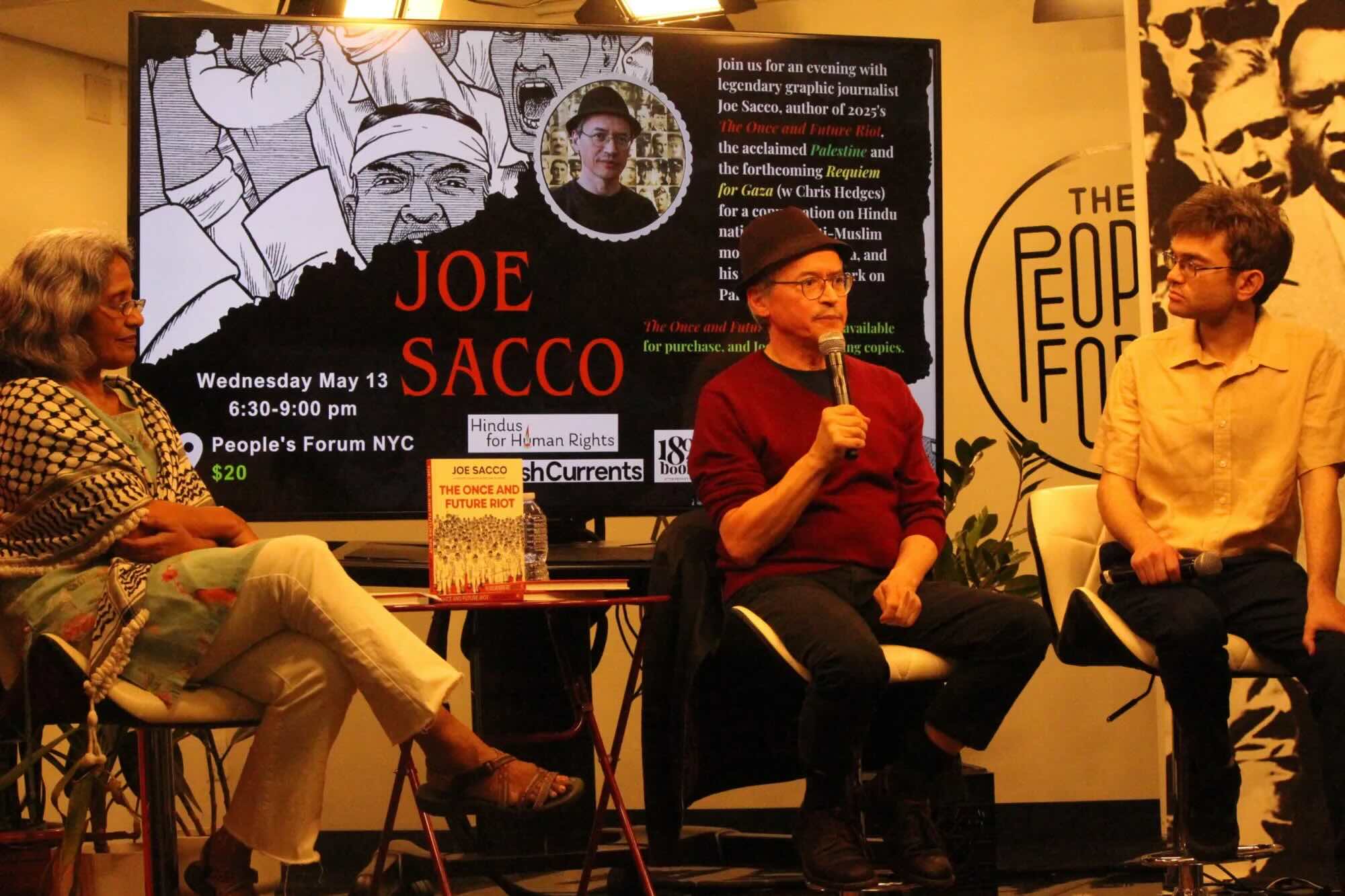
Speaking about the book, released late last year, on a May 13 panel co-organized by Hindus for Human Rights and Jewish Currents at People’s Forum in Manhattan, Sacco discussed how his curiosity about conflict is rooted in his intrigue about the human condition. He also discussed his upcoming book, “Requiem for Gaza,” co-authored with journalist Chris Hedges, which is about Palestinian refugees in Egypt who fled Israel’s ongoing genocide in Gaza. Describing his experience working on the book, Sacco said he was not prepared for the level of trauma he witnessed among the Palestinian refugees. “The baseline trauma is beyond anything I have ever been around,” he said during the panel discussion with organizer Sunita Viswanath and journalist Alex Kane. The book will be released on Oct. 6.
On the sidelines of the panel discussion, Sacco spoke to Prism about his work, his thoughts on what’s happening in India and in Palestine, and what he thinks of the current state of the Western media.
This interview has been edited for clarity and brevity.
Biplob Kumar Das: What made you go from working on the history of the Palestinian conflict and the genocide in Gaza, to a story about a riot in India that happened 13 years ago?
Joe Sacco: I did a shorter piece in India. I went to Uttar Pradesh some years before [the riot] and did a story about Dalits in Kushinagar district and about rural poverty. It was looking at a specific group of Dalits called Musahars. And these were, from all my experiences anywhere, probably the [toughest] group of people I’ve ever met. [The story] was about all these government schemes. When you read the scheme you think, OK, that’s actually a good thing, and this is the minimum wage, and they’re going to get this amount of food grain each. But everything is siphoned off. Poverty is sort of a money-making venture. A lot of village chiefs were siphoning off grain and selling it in the market. And these people didn’t know. They were so hungry, they were literally surviving. And the sad thing is that to survive, they would just take food out of ratholes. And it was very eye-opening to me.
With episodes of violence in Muzaffarnagar, [my contact in India] said, “Would you be interested in coming to have a look at this?” I started thinking, maybe it’s interesting to go after and find out what narratives people had about what happened. Then, of course, there are other themes that developed that I wouldn’t have anticipated. I always wanted to go back to India, and then the riot was just an excuse. But I had to find something to hang my head on. Sort of a security blanket of an idea. And then you begin to see it—oh, this is also about democracy and electoral politics. And how violence is used in electoral politics in India, and not just in India. I tried to write it in a way that it also applies to the West, certainly.
Das: There is so much organized violence in India. What about Muzaffarnagar riots stood out for you?
Sacco: I’ve always wanted to go to someplace that, from a Western standpoint, obscures the journalistic impulse. And go at something and learn about it. I mean every journalist should have the ability to figure it out. Of course you have to do your reading, but that matters only 10% of the time. When you get there, you have to do a study of what’s going on.
Das: You dedicated the book to rural journalists in India. Can you share why?
Sacco: I was always impressed by the journalists I met because a lot of them were Jats, for example. But they are journalists enough to not let that get in the way of—for lack of a better term—the truth. The willingness to interrogate their own people, not just Muslims. They are really trying to figure out what’s happening, and they will talk to me about it. Not all journalists are like that, but the ones I talked to were really good. And I just wanted to acknowledge those people who were local. Without them, I couldn’t do these sorts of stories.
Das: You wrote in your book about people lying to you while recounting their version of the riots. In your work, how do you identify and navigate lies?
Sacco: I just throw it back at the reader. There were the narratives that seemed really off base, but they were so clearly untruths.
The story of the world is the story of the narrative.
Joe Sacco
When people are telling you, “Little children wounded all these people,” you’ve just got to raise your suspicion. And as a journalist, you can’t just hear that and let it go. I was interested in that story. But then, to show that it was not true, you have to find some version of the facts. So it’s a question of looking at the lies and then presenting them as lies. I just want the reader to experience what it’s like to be lied to and then what a journalist should do. It’s not like “they said this and they said that.” “She said, he said” is not journalism. That’s just quoting people. In this case, it was possible to make an effort to find out what actually had happened.
A lot of people who were victims, whether Jats or Muslims, I definitely got the impression for the most part they were telling me what happened. If someone’s son died in the truck next to them, then the son died in the truck next to them. They’re not embellishing. They’re just heartbroken.
But I felt there were community lies, maybe for legal reasons and just to develop narratives. The story of the world is the story of the narrative. Were there weapons of mass destruction? Is Iran close to having a nuclear bomb? The Gulf of Tonkin incident which America used to go to war against Vietnam, which is a made-up incident. This is constant throughout history, it is competing narratives. And this [book] is showing this in a small way.
Das: What do you feel about how the mainstream Western media reported on the genocide in Gaza, or even the refusal to acknowledge it as such?
Sacco: Yeah, things like “Palestinians died because of a bomb,” but not saying who killed them. I would say it’s a certain ecosystem of journalism, they’ve completely failed. People are now suspicious of mainstream journalism. Average Americans, especially younger people, their viewpoint is changing on the issue. I would have never imagined. And it’s changing despite the media. In other words, they were able to circumvent the media by just seeing images on their phone. They might not even know the politics of why it was happening exactly. But it just revolted them, and that human emotion, no amount of mainstream journalism trying to finagle it around could stop the revulsion. What’s interesting is people are beginning to understand despite the mainstream media.
Das: What lessons do you derive from your work, particularly in the world we live in which is going through so much violence?
Sacco: Journalism is becoming a dangerous profession in the United States. It’s becoming difficult to speak. It’s harder to get a job because there are fewer outlets in the mainstream, and some of these outlets have been bought out by people with a specific agenda. There is always a corporate agenda, and now there is an ideological agenda. And it’s a dangerous space. Look at the journalists in Gaza; no journalists should have to go through that. To me, journalism is a calling. Ultimately, we’re trying to get to something about the human condition. Over time, I’ve learned a lot. As I get older, I’m kind of at that point where I don’t want to do this anymore. I’ve learned that I am never going to get to the bottom of all the things that I want to know. It’s like you keep opening doors, but there’s just more. It’s a calling.
Republished from Prism. Read the original article here.
Biplob Kumar Das is an investigative reporter based in New York City. His reporting focuses on politics and business. He graduated from Columbia Journalism School with a Master’s in Journalism in May 2025.