Australia passed a law of social media ban that no other country had attempted. India’s Prime Minister stood in Melbourne and said his country was learning from it.
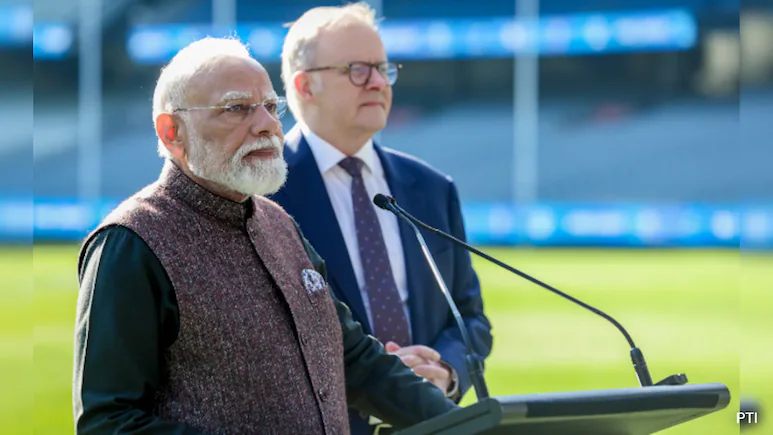
Speaking at the Australia-India Annual Leaders’ Summit on 9 July 2026, Prime Minister Narendra Modi praised Australia’s decision to prohibit children under 16 from holding accounts on major social media platforms, describing it as a model the rest of the world could draw from.
“The way you are bringing changes in laws related to information technology and social media, and working to protect society, is highly inspiring for the world. We are learning a lot from your efforts and taking many lessons from them,” Modi said in the presence of Australian Prime Minister Anthony Albanese and other leaders.
The remarks carry weight beyond diplomatic courtesy. India is the world’s largest social media market by user numbers. Karnataka has already moved to ban social media access for children under 16. Andhra Pradesh has signalled it may bring in similar rules. Modi’s public endorsement of the Australian model, on Australian soil, at a bilateral summit, adds momentum to what was already a live debate in New Delhi.
What Australia’s law actually does
Australia’s Online Safety Amendment (Social Media Minimum Age) Bill 2024 passed on 28 November 2024 and came into effect on 10 December 2025, making Australia the first country in the world to introduce a nationwide ban on under-16s holding social media accounts.
What is Australia’s social media ban?
The Online Safety Amendment (Social Media Minimum Age) Act prohibits Australians under 16 from creating or holding accounts on designated social media platforms. The law places the compliance burden entirely on the platforms, not on children or their parents. Platforms face fines of up to AUD 50 million for failing to take reasonable steps to prevent under-16s from accessing their services.Age verification methods include AI-based facial age estimation and government ID verification. The platforms covered are TikTok, X, Facebook, Instagram, YouTube, Snapchat, Reddit, Twitch, Threads and Kick. WhatsApp, Roblox and Pinterest are currently exempt. The eSafety Commissioner oversees compliance and enforcement.
The law’s implementation has not been without difficulty. Communications Minister Anika Wells said on the day the ban took effect that more than 200,000 TikTok accounts in Australia had already been deactivated. She also warned that children using VPNs to appear to be in another country would eventually be identified. Age verification technology has faced criticism for being unreliable, with some children reportedly fooling facial estimation tools by drawing on facial hair.
A YouGov survey conducted before the law passed found 77% of Australians supported the ban. UNICEF Australia has argued the real fix should be improving social media safety rather than delaying access, saying the ban alone would not resolve the harms young people face online. Dr Brittany Ferdinands, Digital Content Creation Lecturer, said: “Preventing under-16s from having social media accounts won’t necessarily stop them using them. In fact, it may push their activity underground.”
Despite the criticism, the law has drawn intense international attention. Jonathan Haidt, social psychologist and author of The Anxious Generation, praised Australian policymakers for “freeing kids under 16 from the social media trap.” The European Parliament passed a non-binding resolution in November 2025 advocating a minimum age of 16 for social media access across the EU. Denmark, Malaysia, New Zealand, Canada, Brazil, Indonesia and several US states are all exploring or advancing similar restrictions.
Where India stands
India has not enacted a national social media age restriction. The central government has directed Instagram and Meta to remove child abuse and exploitation content, but no age-based account ban exists at the national level.
At the state level, Karnataka has moved to ban social media for children under 16, making it the first Indian state to attempt such a restriction. Andhra Pradesh has signalled it may bring in similar rules. The existence of state-level action without a national framework creates a patchwork that advocates say is insufficient for a country with hundreds of millions of young social media users.
Modi’s remarks in Melbourne are the most senior public signal yet that the central government is watching the Australian model closely. He stopped short of announcing a policy. India’s Ministry of Electronics and Information Technology has not announced any legislation following the summit.
What it means for Indian families in Australia
For Indian-Australian families, the two angles of this story converge. Australian law already applies to their children: any child under 16 in Australia, regardless of nationality or background, is covered by the social media ban. Indian-Australian parents of children under 16 are operating under the world’s strictest social media age restriction, a policy their own Prime Minister has now praised as a global model.
The compliance questions that Australian parents broadly face whether age verification works, whether children are finding workarounds, and whether the platforms are enforcing the rules consistently apply equally to Indian-Australian households. The eSafety Commissioner’s March 2026 compliance report found mixed results from the 10 designated platforms three months after the law took effect, with investigations ongoing.
For Indian families in the UK, Canada, the UAE, the US and New Zealand, the story has a different dimension. All five countries are actively debating or advancing their own under-16 social media restrictions. Modi’s praise for the Australian model, and the signal it sends about India’s direction, adds context to a debate that is already live in every country where the Indian diaspora is concentrated.
What parents and families wants to know
Does Australia’s social media ban apply to Indian-Australian children?
Yes. The law applies to all residents of Australia under the age of 16, regardless of nationality or background. Indian-Australian children under 16 cannot hold accounts on the designated platforms. The platforms, not the children or their families, bear the compliance burden and face the fines.
What happens if a child under 16 already has an account?
The law requires platforms to take reasonable steps to remove accounts held by under-16s in Australia, not just prevent new ones from being created. If a child’s account is identified as belonging to an under-16 user, the platform is required to deactivate it. Children are not penalised individually.
Has India announced a national social media ban following Modi’s remarks?
No. Modi’s comments at the 9 July summit were an endorsement of Australia’s approach and a signal that India is studying the model. No legislation has been announced by the central government. Karnataka’s state-level restriction is a separate, pre-existing development.
Which platforms are exempt from Australia’s social media ban?
WhatsApp, Roblox and Pinterest are currently exempt. The government has said the exemption list remains under review and may be updated. The current designated platforms subject to the ban are TikTok, X, Facebook, Instagram, YouTube, Snapchat, Reddit, Twitch, Threads and Kick.
Can a child use a VPN to get around the ban?
Technically possible, but Communications Minister Anika Wells said children using VPNs to appear to be located in another country would eventually be identified, for example through content that geolocates them in Australia. The eSafety Commissioner is monitoring circumvention methods as part of its ongoing compliance investigations.