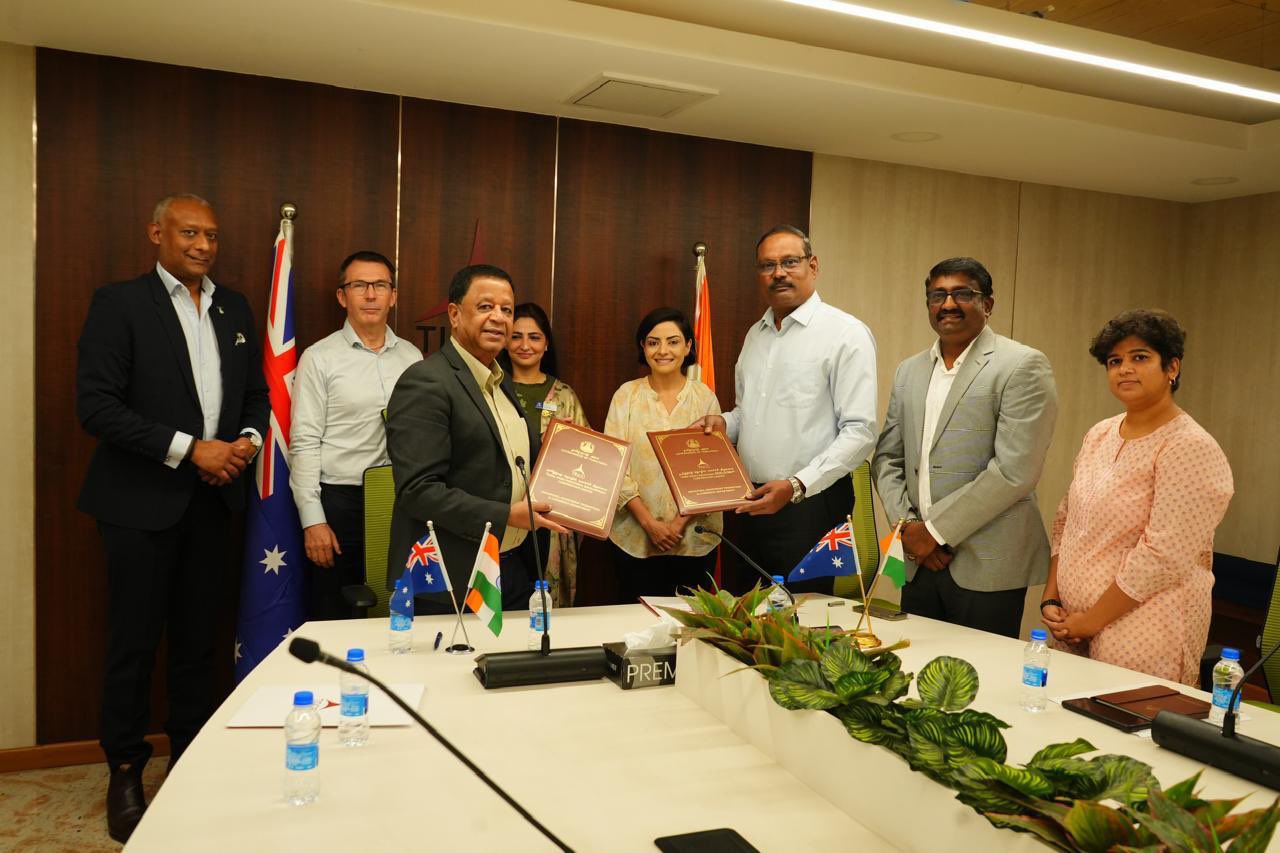
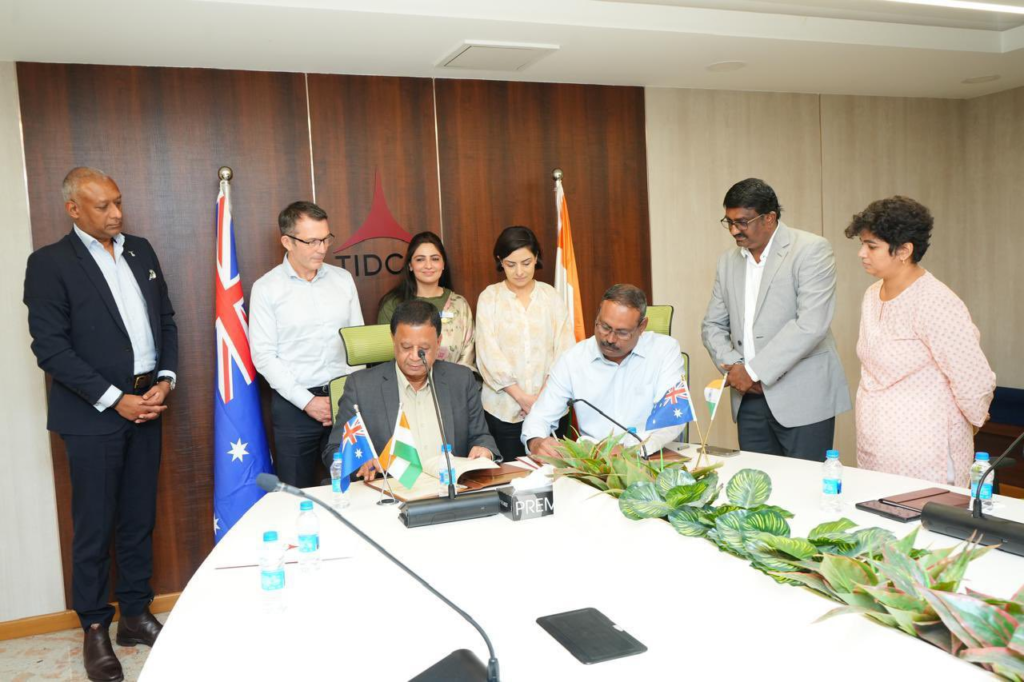
A 20,000-square-foot research and teaching facility in Tiruvallur, Tamil Nadu. That is what the University of Melbourne is committing to under a Memorandum of Understanding signed with the Tamil Nadu Industrial Development Corporation on 5 July 2026, days before Prime Minister Narendra Modi’s arrival in Melbourne for the Australia-India Annual Leaders‘ Summit.
The centre, to be established at Tamil Nadu Knowledge City’s plug-and-play knowledge tower, will focus on quantum computing and agri-tech, two fields where both Australia and Tamil Nadu have identified strategic gaps. It will bring together researchers, students and industry partners across both countries for basic, applied and translational research.
The MoU builds on a Letter of Intent signed by both parties earlier in 2026. No funding figures have been announced. The agreement is a framework for collaboration, not a funded project commitment.
What the centre will actually do
The scope of the partnership extends well beyond a research facility. The University of Melbourne Centre for Emerging Technologies will deliver industry-aligned curriculum development, workforce skilling programmes, certification courses, joint research and development projects, prototyping and pilot testing, technical workshops, exchange programmes and dual-certification courses linking Australian and Indian qualifications.
For Indian students and professionals, the dual-certification pathway is the most immediately practical element. A qualification jointly certified by the University of Melbourne and a Tamil Nadu institution carries weight in both countries, potentially strengthening employability in Australia without the cost of a full Australian degree.
Professor Michael Wesley, Deputy Vice-Chancellor (Global, Culture and Engagement) at the University of Melbourne, said the partnership reflected a shared commitment to research, skills development and innovation for both societies. “By collaborating in quantum computing and agri-tech within Tamil Nadu’s vibrant industrial ecosystem, we hope to contribute to practical solutions, create new opportunities and help build a stronger future for people in India and Australia,” he said.
Dr D. Karthikeyan, IAS, Chairman and Managing Director of TIDCO, described the agreement as a transformative moment for Tamil Nadu’s research profile. “By partnering with the University of Melbourne, we are positioning Tamil Nadu as a preferred global destination for quantum computing and agri-tech research and development. Together, we will nurture talent, generate cutting-edge solutions and create meaningful economic opportunities for our region,” he said.
What is quantum computing?
What is quantum computing? Quantum computing uses principles of quantum mechanics to process information in ways that classical computers cannot. Where a conventional computer processes data in binary bits, a quantum computer uses qubits, which can exist in multiple states simultaneously. This allows quantum systems to solve certain complex problems, in areas such as drug discovery, financial modelling, materials science and cryptography, exponentially faster than existing computers. India and Australia have both identified quantum computing as a strategic research priority. The University of Melbourne hosts the Melbourne Quantum Institute, one of Australia’s leading quantum research centres.
Source: Australia consultate in Chennai (X)
Why Tamil Nadu, and why now
Tamil Nadu is already one of India’s most significant technology and manufacturing states, home to Chennai’s software industry, Coimbatore’s engineering sector and a growing semiconductor supply chain. Tiruvallur, where Tamil Nadu Knowledge City is located, sits within the Chennai metropolitan region and is part of the state government’s push to attract global research institutions.
The timing of the announcement, days before Modi’s bilateral meeting with Australian Prime Minister Anthony Albanese, is not incidental. Australia-India research cooperation has been a stated priority under the Comprehensive Strategic Partnership and the Australia-India Research and Education Linkages programme. The Melbourne-TIDCO MoU is one of several Australia-India institutional partnerships that have accelerated in the lead-up to the 2026 Leaders’ Summit.
For the Indian-Australian community, the announcement also carries a practical resonance. Tamil Nadu is the home state of a significant share of Indian-Australians, particularly in Melbourne and Sydney, many of whom retain family and professional connections to Chennai and the surrounding region.
What is confirmed and what is not yet
Element
Status
MoU signed
Confirmed, 5 July 2026
Location: Tamil Nadu Knowledge City, Tiruvallur
Confirmed
Facility size: 20,000 sq ft
Confirmed
Research focus: quantum computing and agri-tech
Confirmed
Dual-certification courses
Confirmed as part of scope
Funding amount
Not announced
Opening date for the centre
Not announced
Specific industry partners
Not announced
Student intake numbers
Not announced
The MoU is a framework agreement. What has been committed to is the structure of the partnership and the scope of activities. The funding, timeline and operational details are subject to further negotiation and will be confirmed as the partnership progresses.
What it means for Indian students in Australia and India
For Indian students currently studying at the University of Melbourne, the centre creates a future pathway for research exchanges and collaborative projects in India, particularly in quantum computing and agri-tech. Exchange programmes are explicitly included in the MoU scope.
For students in Tamil Nadu considering Australian university education, the dual-certification courses offer a lower-cost entry point to Australian qualifications than a full degree programme abroad. The specifics of those courses, including cost, eligibility and delivery format, have not yet been announced.
For Indian professionals in Australia working in technology, agriculture or research, the centre represents a new institutional bridge between the two countries’ research communities, one that could eventually support industry placements, collaborative grants and joint publications.
The University of Melbourne has not announced an application or enrolment process for any programme connected to the centre. Students and researchers interested in the initiative should monitor the University of Melbourne’s India engagement page and TIDCO’s official communications for updates as the partnership develops.
What students and researchers need to know before applying
Is this centre open for student applications now? No. The MoU was signed on 5 July 2026 and establishes the framework for the partnership. No courses, research programmes or exchange opportunities have been announced yet. Monitor unimelb.edu.au and TIDCO’s official channels for updates.
What is TIDCO and what does it do? The Tamil Nadu Industrial Development Corporation is a state government body responsible for promoting industrial investment in Tamil Nadu. It develops industrial parks, knowledge cities and special economic zones, and facilitates partnerships between Tamil Nadu institutions and global organisations. Tamil Nadu Knowledge City in Tiruvallur is one of its flagship infrastructure projects.
Will the dual-certification courses count towards Australian qualifications? The MoU includes dual-certification courses as part of its scope. The specific qualifications, their recognition status in Australia and India, and any fees or eligibility requirements have not been announced. These details will need to be confirmed once the centre’s programmes are formally launched.
Does this affect the University of Melbourne’s existing India partnerships? This MoU is a new agreement with TIDCO and is separate from the University of Melbourne’s existing partnerships with Indian institutions. The university has existing research links with IITs, IIMs and other institutions across India. The Tamil Nadu centre adds a dedicated physical facility to that network.
Is the University of Melbourne ranked highly enough for this to matter? The University of Melbourne is ranked 13th globally in the 2025 QS World University Rankings and is Australia’s highest-ranked university. Its Melbourne Quantum Institute is a recognised research centre in quantum computing. The institutional credibility behind the MoU is substantive.