Education does not stop after school, college, or university studies. Rather, it continues. Pursuing knowledge in the fields already studied, along with new interests of learning, is part of lifelong schooling.
As formal education ends early in life, the journey to explore and gain knowledge continues. At the same time, knowledge itself continues to expand. Once the learning drive starts, there is no stopping on the knowledge track.
However, knowledge must be pursued intelligently and with an open mind.
Its credibility and perception are based on truth and rationale. As our continuing education advances, it generates new studies, thoughts, theories, meanings and interpretations. With that growth, knowledge becomes enriched.
We are the seekers of knowledge as well as its creators, developers and distributors.
It is at this helm that we can discern its traditional outlets — books and libraries, newspapers and magazines, radio and television. However, these sources are increasingly being outpaced by the surge of the internet and social media.
And this is where we must alert ourselves to establish the authenticity and credibility of knowledge attained from online sources. Information circulated through various internet channels can prove to be wrong and deceptive.
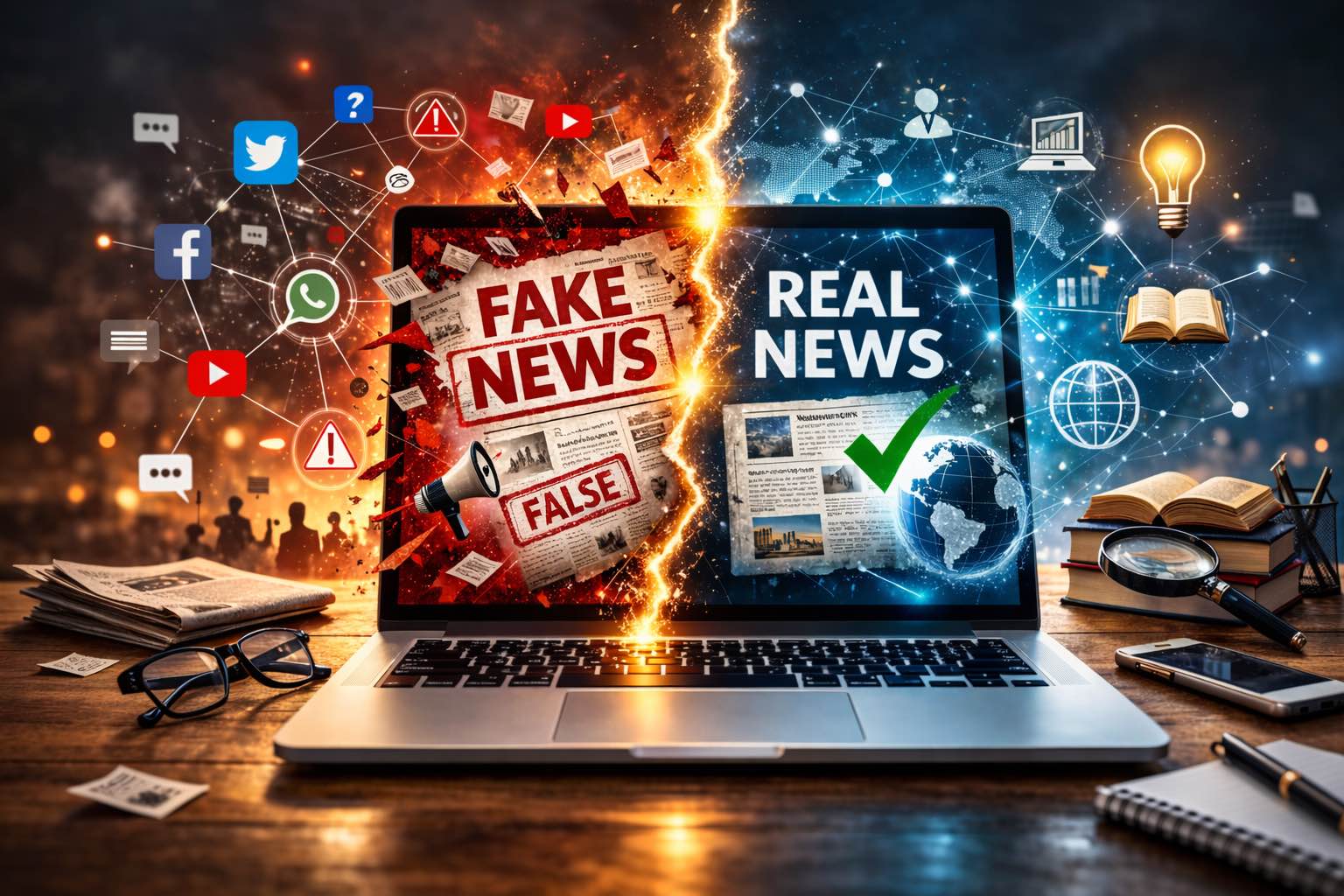
The buzzword of our times is the generation and circulation of fake news and misinformation.
Google, WhatsApp, Twitter, Facebook and countless websites are vehicles operated at our fingertips for the mass distribution of news, views and learning — along with fake stories and misinformation. In many cases, such material is so professionally produced that the unreal is cast as reality. Believability is established, and mass circulation quickly follows.
Since the blight of fake news has become part of knowledge gathering, the acceptance or rejection of pseudo or genuine information depends on our sensitivity, perception, empathy — or apathy. Our personal preferences also play a determining role in whether we remain informed or misinformed in our quest for knowledge.
Usually, we select information that aligns with our interests, mindset biases and beliefs.
The production of fake or false news, or the creation of a thought, ideology or campaign — and its spread — covers almost every subject: politics, religion and culture, science and medicine, economics and statistics.
Fabricated information supporting a concept, cult or crusade driven by morally questionable motives not only contaminates true knowledge but can be misleading and sinister. As a consequence, information literacy becomes corrupted.
Professional “gatekeepers” such as editors of newspapers and magazines — who traditionally reject, edit or verify incoming material — are largely absent in the receiving and delivery systems of modern information technology.
Today, our temperaments, beliefs and personal motives have become the new gatekeepers in the selection and sharing of information.
When these attitudes are repeatedly exposed to false narratives, fanaticism can take root. Convictions harden. Extreme beliefs keep the doors of truth and rationality closed.
Democratic Platform
Despite this inevitable abuse, the internet remains a democratic platform that was once monopolised by traditional print and electronic media.
Social media platforms are open, free and readily available. Websites provide space for disseminating information — true or false — and viewpoints, rational or irrational.
This phenomenon has led to an explosion in the creation, presentation and sharing of knowledge. It is no longer the exclusive domain of professional writers, intellectuals, publishers or editors.
The internet offers space to express oneself in a few words or in lengthy essays — often without editing, cuts or censorship. A submission rejected by conventional publishers or editors can easily find alternative outlets through online platforms, frequently reaching even wider audiences.
Unlike traditional sources of knowledge, the internet, in its relatively brief history, has expanded into a vast landscape overflowing with information.
Personally speaking, I wrote Hinduism Beyond Rituals, Customs, and Traditions by extensively using internet sources, which provided a wealth of relevant articles, research papers, manuscripts, scriptures and stories.
Numerous reputable and credible websites — including Wikipedia — offer extensive material for research, study and writing on virtually any subject of interest.
The internet has undeniably liberated knowledge through accessibility and reach.
But in this endeavour, Nobel laureate George Bernard Shaw offered a timeless caution:
“Beware of false knowledge; it is more dangerous than ignorance.”

Promod Puri
Promod Puri resides in Vancouver, Canada. He is the former editor, publisher and founder of The South Asian Canadian newspaper The Link, published from Surrey, Canada. Puri is the author of ‘Hinduism beyond rituals, customs and traditions’. Websites: promodpuri.com, progressivehindudialogue.com
More stories by Promod Puri