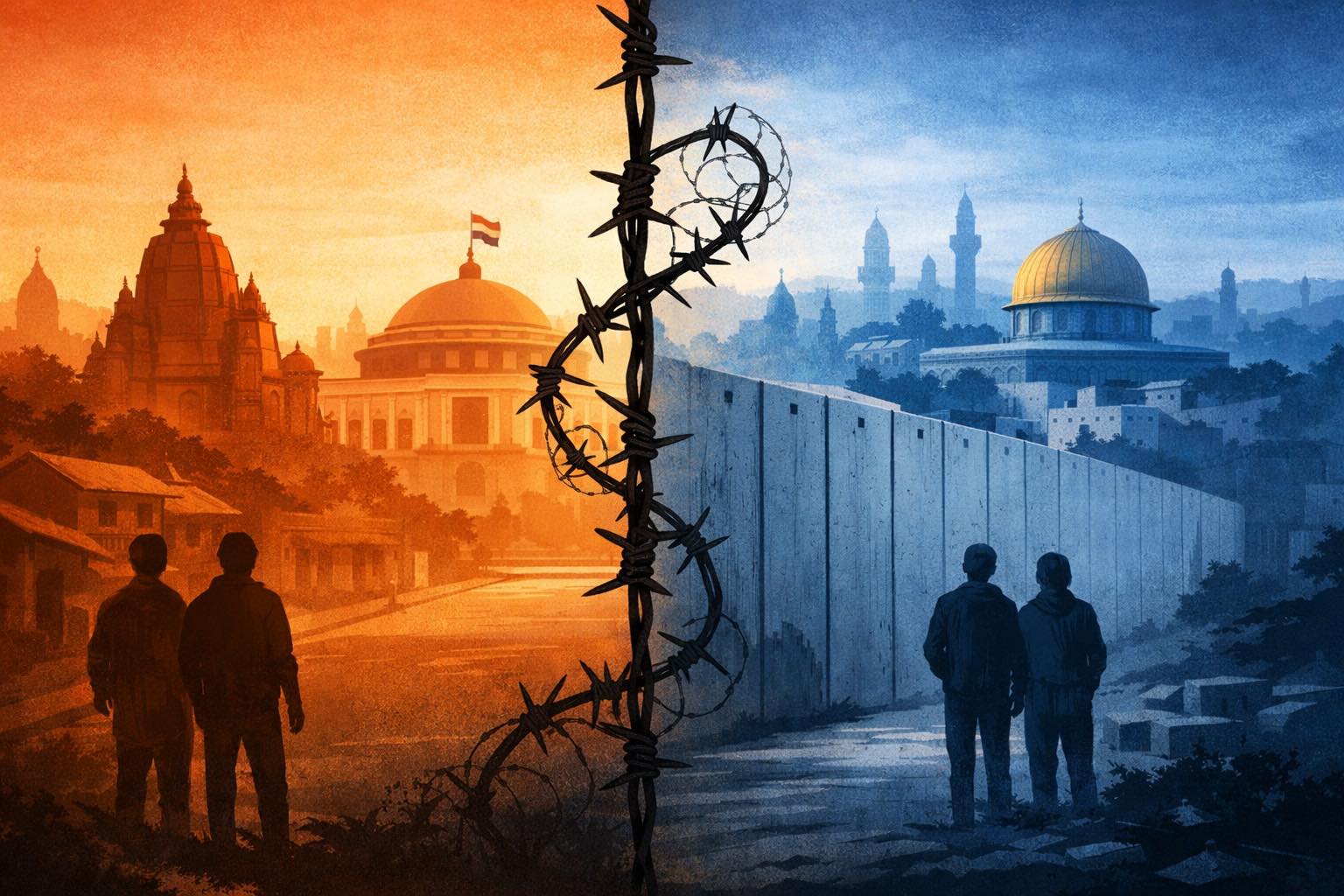
A newly released report by the international organisation Genocide Watch draws controversial parallels between Hindutva in India and Zionism in Israel, arguing that both ideological frameworks shape national identity, governance and citizenship in ways that marginalise minority communities.
Titled Hindutva and Zionism – A Comparative Study of Identity, Governance, and Exclusion, the February 2026 report examines the historical origins, political evolution and social impact of the two movements.
The report itself cautions that it is “advocacy-oriented and intentionally critical”, focusing on systemic injustice and the experiences of communities it says have been marginalised under these ideological frameworks.
Origins of two nationalist ideologies
The report traces the origins of Hindutva to early 20th-century India, particularly the writings of Vinayak Damodar Savarkar, who argued that Indian nationhood should be defined by shared ancestry, culture and civilisational identity centred on Hindu traditions.
According to the report, this conception of identity distinguished Hindus as the core of the nation while viewing Muslims and Christians as communities whose sacred lands lay outside India.
The study argues that Hindutva has moved from ideological discourse into state policy in recent decades, particularly since the rise of the Bharatiya Janata Party (BJP) to national power.
In parallel, the report examines the development of Zionism, a political movement that emerged in late-19th-century Europe as Jewish communities faced persecution, pogroms and exclusion.
When ideology becomes state policy
A central theme of the report is how ideological visions become embedded in laws, institutions and governance systems once they align with state power.
In India, the report highlights legislation such as the Citizenship Amendment Act (CAA) of 2019, which offers fast-tracked citizenship to certain religious minorities from neighbouring countries but excludes Muslims.
The report also refers to the National Register of Citizens (NRC) process in Assam, which critics say risked rendering large numbers of Muslims stateless if they could not prove citizenship through documentation.
In Israel, the report cites the 2018 Nation-State Law, which formally defines Israel as the nation-state of the Jewish people and affirms that the right to national self-determination in the country is unique to Jews.
According to the authors, such policies reflect attempts to codify national identity through law.
This report is written to document and analyze the systematic injustices endured by communities under the two ideologies. It seeks to show how laws, state policies, and social structures produce exclusion, displace populations, and erase memory. My aim is neither neutral nor detached: it is to bear witness, to make visible what is too often ignored, and to provide a critical framework for understanding how power and ideology shape who belongs and who does not.
~ Areeka Khan, Genocide Watch
Security narratives and the “enemy”
The report also examines how narratives of security and historical grievance shape political discourse.
It argues that Hindutva politics often portrays Muslims as historical outsiders or internal threats tied to memories of past invasions, while Israeli political narratives frequently frame Palestinians primarily through a security lens.
These narratives, the authors argue, help justify policies ranging from surveillance and citizenship restrictions to military control and territorial expansion.
Culture, memory and identity
Beyond laws and politics, the report argues that struggles over culture and historical memory play a crucial role.
It cites controversies in India over history textbooks, temple-mosque disputes and interpretations of the Mughal period.
In Israel and the Palestinian territories, the report highlights disputes over land, historical narratives and the remembrance of the Nakba, the displacement of Palestinians during the creation of Israel.
According to the authors, these cultural conflicts shape how communities understand belonging and national identity.
Resistance movements
The report concludes by highlighting movements that challenge identity-based nationalism in both contexts.
In India, it refers to the 2019–2020 protests against the Citizenship Amendment Act, including demonstrations led by Muslim women at Shaheen Bagh.
In Palestine, it points to forms of cultural and political resistance that seek recognition of Palestinian identity and rights.
According to the authors, these movements represent attempts to defend pluralism and inclusive citizenship against majoritarian political projects.
A debate likely to intensify
The comparison between Hindutva and Zionism is likely to provoke debate across political and academic circles.
Supporters of both movements argue they represent legitimate national aspirations and responses to historical persecution.
However, the Genocide Watch report positions them as parallel ideological frameworks that transform cultural identity into state power, raising difficult questions about democracy, minority rights and the future of pluralism in both regions.