India in the World
- On the 9th of March, while addressing the Parliament, External Affairs Minister S. Jaishankar stated that the Indian government had tried reaching out to the Iranian leadership after the U-S.-Israel combine attack on Tehran on February 28th but India could not establish contact. Iran had sought permission for three ships to use India’s ports before the U.S. torpedoed the ship IRIS DENA off Sri Laka. Permission was granted on the 1st of March with the crew resigning in Indian naval facilities, a call which External affairs Minister named “the right thing to do.” Jaishankar informed the MP’s that more than 52,000 Indian nationals have returned from the conflict zone since and that the Ministry has been closely engaged with governments to facilitate all those in need of assistance.
- On the 16th of March, the International Day to Combat Islamophobia, India critiqued Pakistan in the United Nations General Assembly (UNGA) over “fabricating imaginative tales of Islamophobia” in its neighboring countries. India’s Permanent Representative Ambassador Parvathaneni Harish did not directly name Pakistan but instead referred to “India’s Western Neighbor.” He accused the country of hypocrisy, stating “one wonders what would brutal repression of Ahmadiyyas in this country be termed, or the large-scale refoulement of the helpless Afghans or air-bombing campaigns in this Holy Month of Ramadan?” Harish further requested the UN to focus on the alleged rising trend of “weaponizing religious identity” “to serve narrow political ends”. He underlined how all communities in India enjoy a multicultural and peaceful coexistence, including over 200 million Muslims, and that respect for all religions has been entrenched in “the secular ethos of the Indian Constitution”.
- On the 17th of March, India released a statement condemning Pakistan’s airstrike on the drug rehabilitation center in Kabul, Afghanistan, on the night of the 16th of March, killing over 400 people and injuring more than 250, according to Afghanistan. In the press release, spokesperson for the Indian Ministry of External Affairs, Randhir Jaiswal, called the attack on the Omid Addiction Treatment Hospital “barbaric” and “cowardly”, and accused Pakistan of “trying to dress up a massacre as a military operation”, stating that there is no justification for the deliberate targeting of a hospital and its patients. According to India, the attack is “a blatant assault on Afghanistan’s sovereignty and a direct threat to regional peace and stability” as they underline their “unwavering support for the sovereignty and territorial integrity of Afghanistan”. The statement further claims that the airstrike reflects “Pakistan’s persistent pattern of reckless behaviour” in an attempt to “externalize internal failures.” India called for the International Community to hold the perpetrators accountable and to ensure a halt to the targeting of Afghanistan by Pakistan.
- On the 24th of March, U.S. President Trump called up PM Modi to discuss the situation in West Asia, Modi shared on X. This was their first call since the start of the war on the 28th of February when the US and Israel launched attacks on Iran. Modi described the conversation as a “useful exchange of views on the situation in West Asia”. He further stated that “India supports de-escalation and restoration of peace at the earliest.” Both parties acknowledged the importance of opening the Strait of Hormuz, as described by the US ambassador to India on X, signaling their concern over disruption in global energy chains. On the same day, the US Under Secretary of War spoke at the Aanta Aspen Centre in New Delhi, he argued that the US and India did not need to agree on everything to cooperate effectively, describing their partnership as “embedded in lasting strategic mutual self-interest”. “Both of our countries benefit from an Indo-Pacific in which no power can dominate the region. Both benefit from open trade and national autonomy.” He further stated that US- India defence ties “have never been stronger” due to both parties acknowledging “the strategic centrality of military power for a stable balance in the region”.
Civil society, human rights defenders, and journalists
- On the 10th of March, the Campaign Against State Repression (CASR), a collective of at least 37 rights groups, have asked for the release of E. Abubacker , the 72-year-old man who has reportedly been in critical condition. Abubacker is the founding chairman of the Popular Front of India (PFI), an Islamist political organisation in India, which the government has banned due to alleged “unlawful activities” which are said to be “prejudicial to the integrity, sovereignty and security of the country”. Abubacker was arrested by the National Investigation Agency in September 2022 in connection to the Unlawful Activities (Prevention) Act. CASR stated in their press release that they do not want “another political prisoner murdered by the Indian state”, as Abubacker is affected by serious health conditions and the situation, which has worsened significantly, poses serious humanitarian concerns. Given his health complications, the authorities have allowed him to the Deen Dayal Upadhyay Hospital located in New Delhi to receive treatment, regardless the CASR maintains that still keeping him in custody despite his age and health is a “shocking negligence of authorities towards the health and dignity of political prisoners”, and that his condition should give grounds for constant medical assistance and supervision daily. The organisation cited other instances in which prisoners did not receive adequate and necessary medical care which resulted in their death.
- On the 15th of March, the Delhi High Court heard multiple habeas corpus petitions concerning the alleged illegal detention of ten students and activists by Special Cell officials. The petitions were filed after the Campaign Against State Repression (CASR) claimed that the individuals had been picked up by plainclothes officers from different locations in Delhi and had remained untraceable, with no contact with family or lawyers. The petitioner’ council called the police actions ‘alarming’ as the activists were allegedly taken to unmarked “safe houses” instead of designated police stations and kept overnight without being produced before a magistrate. The counsel further alleged that the detainees were forced to sign false statements and were subjected to torture, with students describing the interrogation as “painful”, “humiliating” and “highly sexualised”, some even claiming they were forced to undertake sexual acts with fellow detainees. The police denied these statements, arguing that all activists received a formal notice to join the investigation which they complied with voluntarily. During the hearing, the Delhi Police told the court that all ten individuals had been released. However, counsel for the petitioners disputed this claim, stating that one activist was still missing. The court directed the police to trace him and report back. A division bench of Justices Navin Chawla and Ravinder Dudeja asked the police to explain the circumstances under which the detentions took place and ordered them to preserve CCTV footage from locations where the individuals were allegedly picked up. The police’s counsel declined to share a copy of the FIR, stating that it was confidential.
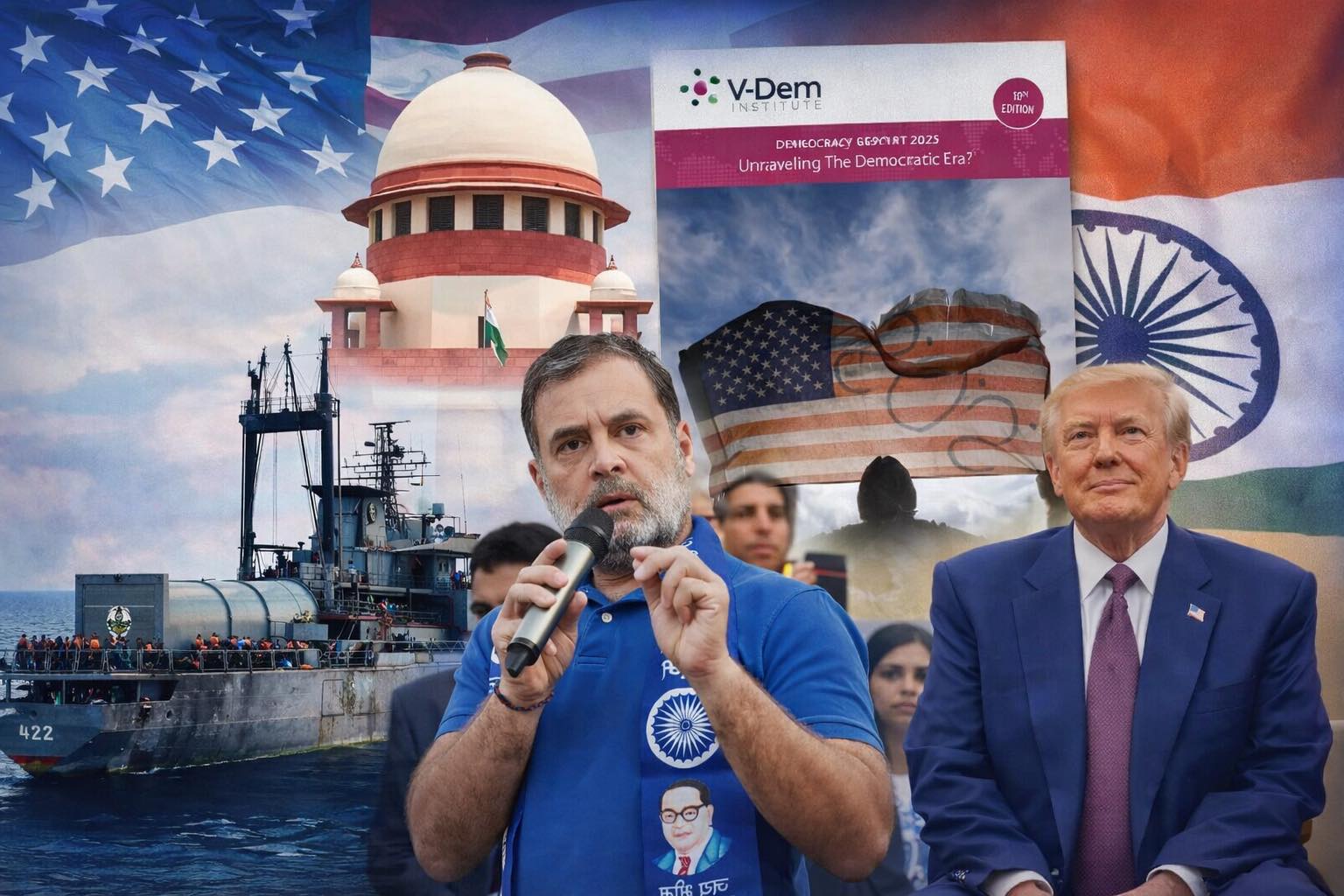
- On the 17th of March, the V-Dem institute published their annual report in which India ranked 105 out of 179 countries on the liberal democracy Index. Titled ‘Democracy Report 2026: Unraveling the Democratic Era’, the report notes that India remains an ‘electoral autocracy’, a zone it entered in 2017. According to the report, “India’s autocratisation is a slow but systematic dismantling of democratic institutions. The ruling BJP and PM Modi’s derailing of democracy include “deteriorations in freedom of expression and independence of the media, harassments of journalists critical of the government, and attacks on civil society and the opposition.” They further report that gains made in the “third wave of democratization” are almost eradicated as autocratisation scores fall back to the same level as in 1975.
- On the 19th of March, a Delhi Court acquitted Jamsheed Zahoor Paul and Parvaiz Rashid, arrested at the age of nineteen under the Arms Act, 1959 and subsequently under terrorism-related provisions of the Unlawful Activities (Prevention) Act. Since their arrest, Paul and Rashid have been repeatedly portrayed as “ISIS terrorists”, and declared guilty long before any trial concluded. Based largely on police claims and without judicial findings, several prominent outlets used definitive language that ignored the principle of innocence until proven guilty, shaping public perception and hardening stigma against the two young men from the moment of their arrest. After spending more than seven years in prison, the Delhi court acquitted both of them, citing serious doubts and failures in the prosecution’s case.
- On the 23rd of March, the Election Commission of India (ECI) released its first supplementary list for the upcoming West Bengal assembly elections which shows that women are being deleted at significantly higher rates than men. Across the state, over 30 lakh citizens remain in the ‘Under Adjudication’ (UA) category, a legal status where someone is legally barred from voting, awaiting an opaque review process. According to the Wire, who manually downloaded and verified the booth-level data, women are being deleted at significantly higher rates, with Malatipur showing the most excessive case of gendered exclusion with women accounting for 67.4% of deletions. The UA process exploits the documentation vulnerabilities inherent to rural women, specifically those related to marriage-based migration and the resulting changes in surnames or addresses. The UA tag leaves millions deprived of their constitutional voting rights without a finalised adjudication or a reason for removal, making it virtually impossible to file a meaningful appeal. The electoral rolls will be finalised between the 6th and 9th of April, leaving a window of two weeks to resolve 30 lakh cases.
Hate Crimes and Hate Speech against Minorities
- On the 15th of March, while addressing a rally of the BJP’s youth wing the Bharatiya Janata Yuva Morcha, Union Home Minister Amit Shah claimed he “will search out and remove infiltrators” in Assam. He expressed confidence that the BJP would win a large majority in the upcoming Assam elections and serve a third of them, as he claimed improvements in law and order, culture and traditions and development projects. Shah was visiting Assam to inaugurate the construction of hospitals and medical facilities, where he stated that the BJP had brought the state’s healthcare system on par with developed states. At the rally, he claimed that the BJP would continue to free Assam and the country of “infiltrators” if the people of Assam would give the BJP a third mandate. He referred to districts with significant Bengali-origin Muslim populations and declared that they “will inspect every house, and the coming government will do the work of removing them.” He further accused the Congress party of “legalising, formalising and normalising” infiltrators, claiming that Rahul Ghandi, leader of the Congress party, opposes the Special Intensive Revision (SIR) as infiltrators are being cut of the electoral lists. He asserted that only the BJP can make Assam “infiltrator-free”, that they “will not stop cutting names” of the electoral lists and that “each one will have to leave the country”.
- On the 26th of March, the Catholic Bishops’ Conference of India (CBCI) expressed “grave concern” over the proposed amendments to the Foreign Contribution Regulation Act (FCRA), calling it “undemocratic” and “unconstitutional”. The Bill proposes the creation of a “designated authority” to take provisional or permanent control of assets of NGOs whose FCRA licences are cancelled, surrendered or lapse. In a press statement, the CBCI described the Bill as ‘dangerous’ and ‘alarming’, alleging that the proposed changes could enable ‘executive overreach’ into constitutional freedoms under the pretext of administrative concerns. They further raise concerns about the fairness, transparency and accountability of such licencing authority, alleging that the amendment is an attempt to place minority institutions under an “excessively stringent regulatory framework”. The CBCI urged the government to reconsider the proposed amendments, “remove all contentious provisions” and ensure that constitutional rights and freedoms, particularly of minorities, are protected. On the 29th of March, Kerala chief Minister Pinarayi Vijayan published a letter on X demanding Prime Minister Modi to withdraw the Bill and calling the provisions a “a tool for arbitrary control and intimidation” and “a direct assault on the autonomy of civil society and minority communities”. The amendment has become a major topic of debate in the upcoming Kerala assembly elections, with both the ruling and oppositional parties asking the Union government to reconsider the bill.
Religious Freedoms and Minority Rights
- On the 4th of March, the day of the Hindu festival Holi, a dispute broke out in the Uttar Pradesh’s Shahjahanpur district over the alleged forceful throwing of Holi colours on members of the Muslim community. The police registered a case against 108 unidentified people and eight Muslims in Mau Rasulpur village. According to the First Information Report (FIR), the ensuing argument escalated into violence with some Muslim community members reportedly sustaining injuries. “As the dispute escalated, stone pelting occurred between the two groups, in which around 11 people sustained injuries,” Superintendent of Police Rajesh Dwivedi stated. The Police detained 20 people from both communities, 10 Hindus and 10 Muslims, as a precautionary measure, who were later released. Authorities stated that the situation in the village is currently peaceful, but security has been tightened as a precaution.
- On the 7th of March, Amit Shah, the Union Home and Cooperation Minister stated that “intruders” will be driven out from Kedarnath to Kanyakumari. Shah further claimed that the names of those who are not Indian citizens must be removed from the voter list, in relation to the Special Intensive Revision (SIR) of electoral rolls and the opposition parties protecting against the SIR, saying that a clean electoral roll is crucial to safeguard democracy. Moreover, according to Shah, the government is working so in the coming years all infiltrators will be ousted from India: “they will not be allowed to stay here” while saying that non-Muslim refugees have the right for the citizenship similarly as to any other Indian. He stated that no matter how much he opposes such initiatives, the Modi government will make those people Indian citizens. The Union Minister praised the introduction of the Uniform Civil Code (UCC) as well, as according to him, citizens, regardless of their religion, will be subject to the same law under the UCC and “the UCC will help stop unnatural increases in demographics”. The committee assigned to carry out the implementation of the order soon, and he finished by saying that the “opposition leaders can protest as much as they want”, since in his view, the amendments to the criminal laws shall streamline the delivery system of justice.
- On the 9th of March, Odisha Chief Minister Mohan Charan Majhi informed the state assembly that 54 incidents of communal riots and seven cases of mob lynching were reported in the state since June 2024. He stated that nearly 300 people have been arrested for their alleged involvement in the riots, however, chargesheets have been filed in less than half of the cases. According to the CM, changes have been made to prevent future incidents, such as the formation of peace committees and the strengthening of intelligence gathering to act against people attempting to disturb the public order. The Indian Express pointed out that Majhi did not mention the communal attacks reported in Cuttack last year during Durga Puja festivities, which prompted a three-day long curfew in the state and suspended internet services. Members of the Vishva Hindu Parishad, a right-wing Hindu nationalist organisation, clashed with police and indulged in vandalism and arson. In the past 20 months, six towns in Odisha have experienced curfews and Internet suspension over communal incidents, including the lynching of Bengali-speaking Muslims. Most of the accused have been members of right-wing organisations, according to critics, the Mohan Majhi government has been struggling to control militant Hindu organisations accused of attacking minority community members, particularly Muslims.
- On the 10th of March, the Communist Party of India (CPI) State Council passed a resolution condemning the government for including two non-Muslims in the newly constituted Puducherry Waqf board. The Waqf Act of 1995 governs the management of Islamic religious donations (Waqfs), specifically properties, and mandates the formation of state-level boards. The new Waqf Amendment act 2025, introduced by the BJP ruling party, substantially increases the government’s involvement in managing Waqf assets. It further mandates that every Waqf board must include at least two non-Muslim members, a requirement that does not exist for Hindu or Christian religious thrusts and which Muslim leaders have called “unconstitutional”. The Union government has argued that the provisions aim to improve transparency, administrative efficiency and secular oversight in management without interfering in religious matters. However, the amendment faces opposition from several Muslim organisations and political parties that argue it infringes on religious autonomy and minority rights. Particularly controversial is the amendment that Waqf boards must provide valid documents to claim a property as waqf, while many properties have been donated through oral declarations or community customs. In case of disputes, particularly over land deemed government-owned, the final decision will rest with the government. Multiple petitions challenging the amendment have been filed in the Supreme Court in 2025, with the court imposing limits on the number of non-Muslim members allowed on the board. In their resolution, the CPI stated that the inclusion of non-Muslim members was against the interest of the Muslim community, especially as one of the non-Muslim members is “a staunch RSS man”, the RSS being a right-wing Hindu paramilitary organisation. “The State Council meeting of the party demands immediate cancellation of the Waqf Board and constitution of a new board as per the Act prior to the amendment,” the resolution stated.
Internet and Technology
- The Union Government is using Article 69A of the Information Technology Act 2000 to block social media posts containing satire and criticism against Prime Minister Modi and his policies, actively censoring his critics online. The legal provision was applied to block all content on social media that mocks, lampoons, or in any other way is critical of Prime Minister Modi, or his policies and actions. Because takedown orders are issued secretly under Section 69A of the IT Act, the main “proof” comes from users posting the legal notices they receive from platforms like X (Twitter), showing their content has been blocked in India. These notices cover a wide range of posts: political cartoons, memes, satirical videos, critical commentary about Modi’s foreign policy, and posts questioning India’s alignment with the US. A research examining the data from Meta between January to June 2025 and observed that Instagram and Facebook deleted content due to governmental orders rose by three times compared to 2 years prior, in the same period from 2023. Among them whose post have been removed, cartoonist Satish Acharya came forward on the 10th of March 2026 denouncing that X have been withholding two of his works which were depicting India-Iran relations as well as the United States of America. The notices that X have sent out to users whose content has been removed from the platform stated that even though the platform has legal obligations to withhold the content in the country, if affected users wish to appeal the decision they can contact MeitY via their email address. Other censored material includes images of Modi saluting Trump, posts referring to the mistranscription of Sanskrit subhashita by Modi, as well as Shabnam Hashmi’s post on the protest at the AI Summit. Pranesh Prakash, the co-founder of the Centre for Internet and Society has stated that such orders and actions on X are “unconstitutional” as well as they fail to give meaningful opportunity to the user to be heard, as well as lacking a “public, reasoned order”. Prakash assessed the legal framework of these directives in a paper in 2024 and concluded that the requirements imposed by international human rights law in terms of legality, legitimate aims and proportionality all fail in present situation.
Political Parties
- On the 8th of March, Jairam Ramesh, a member of the Lok Sabha, politician of the Indian National Congress party urges for the strengthening of action against air pollution. He said that the National Clean Air Programme needs to have a sharp focus on PM2.5, essentially showing significant concern over the rising pollution levels and asked for a review and upgrade of the National Ambient Air Quality Standards of 2009. His demand included enforcement of the Standards as well as monitoring the effectiveness of it. A study found that approximately 17.2 lakh Indians die annually from exposure to PM2.5, which has increased by 38% since 2010, posing a huge issue. However, despite the data, the Ministry of Environment, Forests and Climate Change has claimed that mortality “cannot be conclusively established” in relation to air pollution.
- On the 10th of March, Oppositional parties staged a walk out in the upper house after Chairman Radhakrishnan declined their demand for a new debate on the Special Intensive Revision (SIR) of electoral rolls in West Bengal. Mr. Radhakrishnan rejected the plea raised by Trinamool Congress leader Deker O’Brien, stating that adequate time had already been given during the Winter Session’s discussions on electoral reforms. Leader of the House J.P. Nadda accused the Opposition of avoiding substantive debate, undermining democratic norms and “bringing about anarchy”. TMC MP Sukhendu Sekhar Ray used a brief preface to question the Centre’s “coercive measures” in West Bengal under the SIR, naming it a threat to the fundamental rights of millions and calling for an investigation. In turn Mr. Nadda accused the West Bengal government of ignoring the rules and regulations.
- On the 24th of March, Rahul Gandhi – Leader of Opposition in the Lok Sabha – called Narendra Modi Prime Ministers way of handling foreign policy a “personal” approach which turned into a “universal joke”. The setting of the interaction was as Modi have addressed the Parliament on the situation in West Asia as the government organised an all-party meeting discussing the implications of the situation for India and the deepening crisis. Modi addressed the Rajya Sabha in the face of the ongoing conflicts in West Asia and warned of long-lasting effects urging citizens to prepare. According to Gandhi, if Modi is compromised then so is the foreign policy of the country, and alleged that Modi’s “inconsistent and swinging diplomatic posture” changed the strategic autonomy-balance of the country.
Police and authorities
- On the 18th of March, the security forces as well as the police have intensified the vigil around the Mata Vaishno Devi shrine in the Jammu’s Reasi district, ahead of Navratras. The Security forces deployed searches because of reports of movements of suspected terrorist nature in parts of the province of Jammu. The official authorities stated that the base camp to which pilgrims arrive from across the country were reviewed based on security arrangements on the 17th of March. Deputy Inspector General of Police, Udhampur-Reasi range, Sarah Rizvi have called for an enhanced foot patrol at the high points, as well as activation of VDGs – village defence guards, while continuing area domination practices focusing on the management of crowds to anticipate incidents such as sabotage, according to the official statements. The advanced security measures – among others – include AI-enabled cameras, as well as drones and security personals in the area. Allegedly, over 500-600 CCTV cameras that are equipped with advanced AI functions have been installed in the route of pilgrims according to officials. Rizvi also requested a strict background checks on migrants, construction workers as well as porters and ponywalas who enter Katra to seek employment.
- On the 24th of March, The Home Ministry provided data in Parliament showing a rise of deaths of people in police custody with 170 individuals dying in 2025-6. The figures stood highest in 2021-22 (176), and lowest in 2024-5 (140), before rising again to 170 in the current year so far. Despite these numbers, only one case of disciplinary action has been reported over this 5-year period. Bihar recorded the highest number (19), almost double the figure in the previous year (10). Responding to a Written question in the Lower house, Minister of State for Home Affairs Nityanand Rai said that all custodial deaths, whether in police or judicial custody, must be reported to the NHRC within 24 hours. The Ministry of Home Affairs and the NHRC issue advisories to ensure protection of human rights such as video recordings of post-mortems and model autopsy procedures. In cases where negligence is found, the NHRC recommends action to the concerned authorities, while disciplinary proceedings are carried out by the respective state governments.
Judiciary
- On the 10th of March, the Supreme Court agreed to consider the plea against the deletion of the electors from the electoral rolls. The Supreme Court have allegedly consented to the consideration of a fresh plea which was filled out by the persons whose names have been deleted from the electoral rolls ongoing in West Bengal by the Special Intensive Revision (SIR) by the Election Commission. The plea relating to the deletion of voters from the rolls were considered by a Bench, and they were said to have a hearing on the issue the very next day. Previously, on the 24th of February, deployment of West Bengal civil judges was allowed to requisition judicial officers from both Odisha and Jharkhand to handle the objections and claims of those affected by the deletion from the electoral roll in the ongoing SIR proceedings. It was also noted that the process shall take up to 80 days to map the situation of the effected individuals.
- On the 24th of March, the Supreme Court ruled that only Hindus, Sikhs and Buddhists can hold scheduled caste status, meaning that those who have converted to Christianity cannot, making impossible to benefit from affirmative action policies or to file a case for discrimination under the SC/ST (Prevention of Atrocities) Act. The Court said that the immediate consequence of conversion to any religion that is not the three previously mentioned is the loss of the SC (scheduled caste) status. The reasoning was that in the Constitution (Scheduled Caste) Order of 1950, it allegedly mandates that “no person who professes a religion different from Hinduism shall be deemed to be a member of the Scheduled Caste”. According to the Court, this clause is absolute and “admits no exception”. The bench made its judgement while hearing the case of C. A., who alleged caste-based abuse and discrimination as he turned to the Supreme Court following the 2025 judgement of the Andhra Pradesh High Court.
Business & economy
- On the 17th of March, the Research Collective published their investigation on how the BJP government in Assam pledged to pay the Adani group for surplus electricity that may not consume. Conservative calculations based on documents from the Assam government and Central Electricity Authority show that the state could end up paying more than Rs 12,500 crore over five years. Assam has committed to buying 3,200 MW from the Adani group starting in a phased manner from 2030. However, according to the Resource Adequacy Plan from the Central Electricity Authority, Assam requires only 2,829 MW of additional coal power by 2035-36 to meet all its energy needs, even if the state sees high economic growth. The Coordination Committee of Electricity Employees, Engineers and Pensioners demanded the immediate suspension of all proceedings related to the project in a formal letter to the state’s power distribution agency and Assam Chief Minister, stating that decision-makers took this step without adequate transparency, public awareness, or consultation with stakeholders. They further requested the authorities to explain the need for an additional 3200 MW as excess power generation could create financial risks, a burden that would ultimately be paid by consumers through higher tariffs.
Compilation by: Diaspora in Action for Human Rights and Democracy.