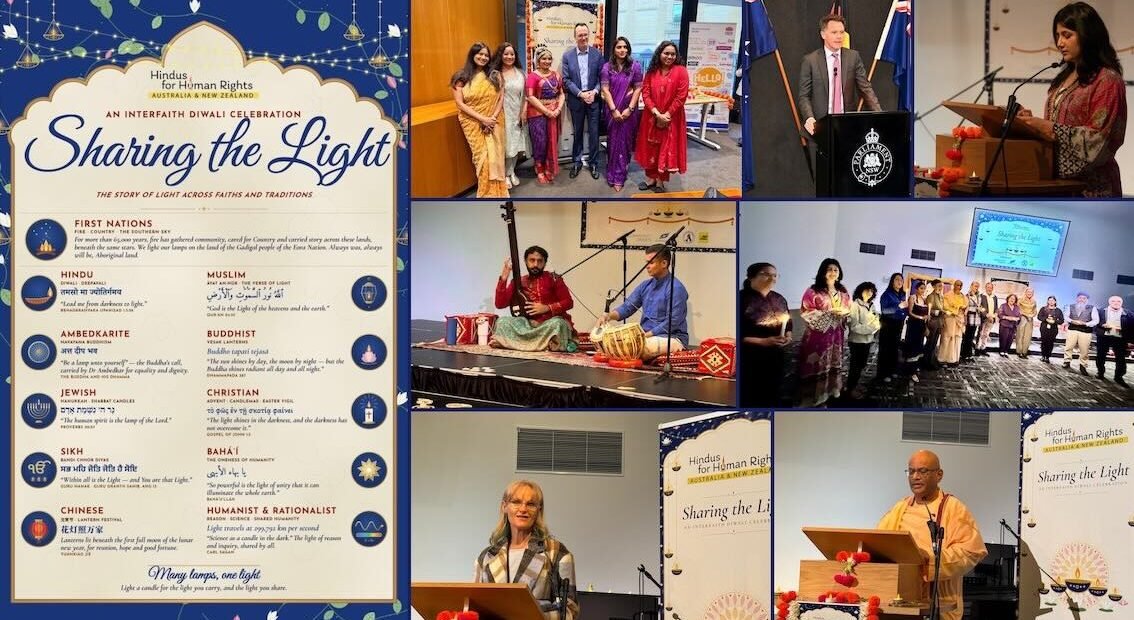
First Nations, Palestinian, Jewish, Tibetan, Chinese, Christian, Muslim, Hindu, Ambedkarite, Sikh, Jain, Buddhist, Greek and Bahá’í voices stood side by side this Diwali season to share what light means in their traditions, at Sharing the Light, an inaugural series of interfaith celebrations held in Sydney and Melbourne.
Hosted by Hindus for Human Rights Australia & New Zealand (HfHR ANZ), the events drew more than 200 guests across the two cities. The Sydney event, held at NSW Parliament House, was co-hosted with the Indian Crescent Society of Australia (ICSOA) and was arguably the first time a Hindu and a Muslim cultural organisation have come together to host an event at the building.
HfHR ANZ said it is taking the lead in moving the conversation beyond tolerance towards genuine intercultural belonging and solidarity, where communities celebrate their differences and meet each other with respect and curiosity.
“Through events such as Sharing the Light, we aim to bring communities together in joyous intercultural celebrations that showcase our unity in our glorious diversity,” said Dr Shanti Raman, Chair of HfHR ANZ. “I thank each one of our leaders, guests and volunteers who made these events in Sydney and Melbourne possible.”
Sydney: the Premier joins the celebration at NSW Parliament
The Sydney event was held on Wednesday 21 October in the Preston Stanley Room at NSW Parliament House. Supported by Multicultural NSW, it also marked ten years of ICSOA’s service. ICSOA is led by Mr Abbas Raza Alvi.
NSW Premier Chris Minns, Leader of the Opposition Kellie Sloane MP and Leader of Australian Greens Senator David Shoebridge joined the gathering and shared their thoughts, which HfHR ANZ described as a sign that building a cohesive society is a responsibility shared across political and community lines.
Guests included the Hon. Warren Kirby MP, Cate Faehrmann MLC, Anthony D’Adam MLC, Mark Coure MP, Jenny Leong MP and Simon Chan, Chair of the Multicultural NSW Advisory Board, alongside mayors, councillors and community leaders, who joined faith representatives in a ceremonial lighting of the lamp.
Ms Binowee Bayles, a Koori woman with deep roots in the Gadigal Country of Redfern, delivered the Welcome to Country and spoke of the connection to light for First Nations peoples, the custodians of the world’s oldest continuous living culture. Speakers then shared Hindu, Islamic, Ambedkarite and Navayana Buddhist, Jewish, Christian, Buddhist, Sikh and Bahá’í perspectives on light. Paul Power, Co-CEO of the Refugee Council of Australia, spoke about creating welcoming spaces for people who have sought safety in a new country.
A Buddhist reflection recalled the Buddha’s final teaching to be a lamp unto yourselves, and the idea that a single flame can light countless others without ever growing dimmer. Theatre practitioner Jyotsna Sharma called for a return to the essence of Diwali, light and celebration with community, rather than firecrackers that pollute the air and distress birds and animals.
The program featured Kuchipudi classical dance by Ramasa Venpati and music by John Napier and Sumati Krishnan, and closed with Sydney Bollywood dancers.
“Tolerance asks us to make room for one another. Acceptance asks us to see one another. Celebration invites us to grow because of one another,” said Mr Alvi.
Melbourne: twelve voices, one story of light
In Melbourne, more than a hundred guests gathered at Manningham Uniting Church & Community Centre in Templestowe on Sunday 25 October, with the support of Manningham City Council’s Community Grants program, NRI Affairs and The Humanism Project. Hindu, Ambedkarite, Sikh, Muslim, Jain, Jewish, Christian, Palestinian, Tibetan, Greek, Chinese and Bahá’í voices took part.
Fayez Othman spoke of the olive oil lamps of Palestine and of how, in the Holy Quran, Allah is referred to as the light of the heavens and the earth. Lital Weizman brought a Hanukkah menorah and spoke of the Jewish rituals of light that mark the arrival of Shabbat. Tenzin Norzin spoke of the butter lamps of Tibetan daily life and of light as wisdom, and Jia Hu spoke of the Chinese celebrations of light, including the Lantern Festival.
Konstandina Dounis noted that, just as at Diwali, the ancient Greeks saw the flame as the triumph of light over darkness, while Siamak Naimi explained that the name Bahá’í means a follower of the light. Priyanka Jain shared the symbolism of light in Jain days of ritual and prayer, and Swami Sunishtananda spoke of light in Hindu philosophy as the wisdom within and the connection between people.
Gurvinder Singh Atwal recalled Bandi Chhor Divas, the day of liberation that coincides with Diwali, when Guru Hargobind ji, the sixth Sikh Guru, refused to leave prison without his fellow inmates.
Cr Carli Lange, speaking on behalf of the Mayor and Manningham City Council, said that at interfaith events such as Sharing the Light, “we come together as different faiths, different cultures and different backgrounds to celebrate, connect and learn from one another.”
“Light is God’s gift. It shows a path to our souls and ignites hope in the heart of the hopeless,” said Maneeza Rahmany, speaking of the Islamic connection to light.
The program featured a semi-classical Kathak dance by Sanditi and a classical vocal performance by Bimal of a song by the mystic Kabir, with Jigar on tabla. It closed with a Garba dance led by Krishna and her team.
Building belonging, not just coexistence
Across both cities, speakers reflected on the shared meanings of light: as wisdom, as hope, as liberation and as the connection between people.
“Sharing the Light was a way to truly bring communities together, not as witnesses but as active participants, each sharing their own traditions of light,” said Nandini Sen Mehra, Regional Communications and Policy Director at HfHR ANZ. “We are alike and we are different, and that is our strength. Even in such divisive times, it is possible to bring diverse voices together in a shared space of warmth that reflects the reality and promise of multicultural Australia.”
About Hindus for Human Rights Australia & New Zealand
HfHR ANZ is an award-winning community and cultural organisation working in three areas: building interfaith and inter-community respect and resilience through inclusive intercultural events; delivering anti-racism and media literacy initiatives, working with allies across social justice issues such as First Nations justice, climate justice and family violence; and building social cohesion by advocating against hate, polarisation, racism and extremist ideologies. Its allies include communities of all faiths and no faith, and varied ethnicities and cultures. More at hindusforhumanrights.org/anz.