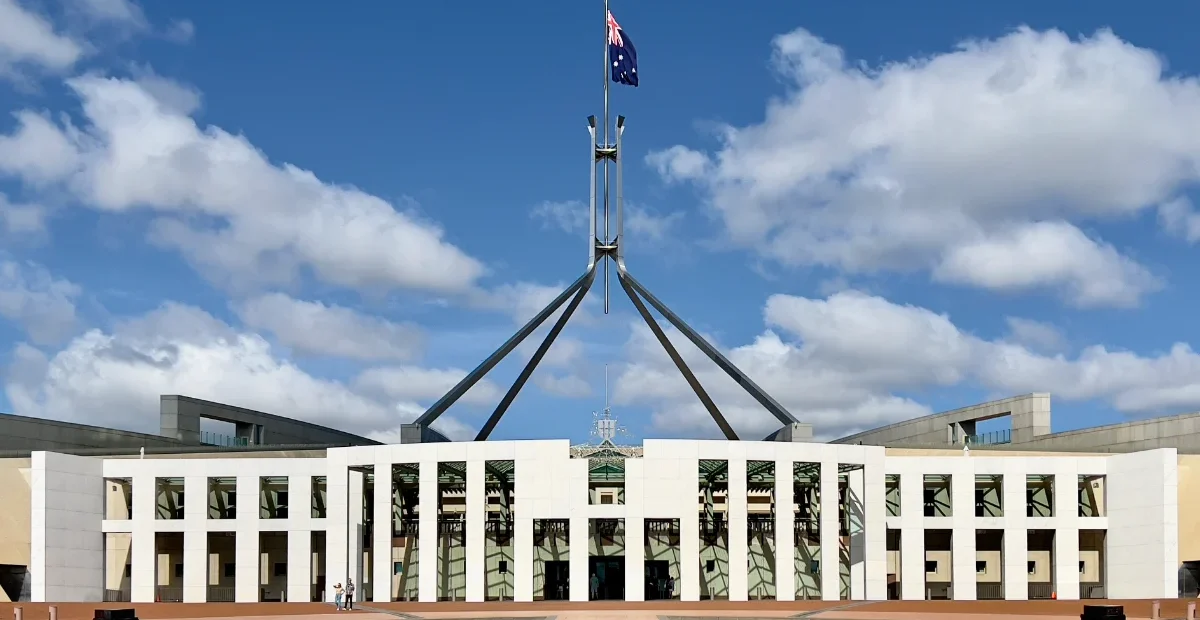
The visa that more Indian graduates in Australia hold than any other nationality would disappear under the immigration plan Australia’s opposition unveiled this week. The Liberal-National Coalition says it would abolish the temporary graduate visa, cap international student enrolments at 240,000 and cut temporary visa numbers by 650,000 over four years.
Opposition Leader Angus Taylor announced the Coalition migration plan on Tuesday 6 October. It would bring annual net overseas migration down to 100,000 for two years, around a third of its current level, before letting it rise to 160,000 in the fourth year.
“What we are proposing today is the biggest cut to immigration in the history of this country,” Taylor told a press conference. “It will be putting Australia first and it will be putting our national interest first.”
The plan is a pledge, not law. Australia’s next federal election is not due until 2028, and the Labor government is pursuing its own, smaller reduction. For the hundreds of thousands of Indian students, graduates and recent migrants in Australia, the announcement nonetheless sets out the sharpest alternative now on offer from a party that could form government.
What is in the Coalition migration plan?
The Coalition migration plan targets temporary migration hardest. Alongside the 650,000 cut to temporary visas, it would halve humanitarian visa places to 10,000 a year, cap international student enrolments at 240,000 and abolish the temporary graduate visa, which lets international students stay on and work after they finish their studies.
It is not a cut across the board. The Coalition says it would add 100,000 temporary skilled visas and clear a backlog of applications from construction workers. “We’ve also seen under Labor a shift away from skilled migration to mass migration. We will reverse that shift,” Taylor said.
Taylor argued that lower numbers would ease the strain on services and housing. “The net overseas migration numbers will be 100,000 year one, 100,000 year two, going to 160,000 in year four,” he said. “That will take pressure off roads, off schools, off infrastructure, off houses, and that will ensure that our country has the breathing space it needs.”
The Coalition’s plan and the government’s own approach differ on almost every lever.
| Measure | Coalition plan (6 October 2026) | Labor government plan (17 September 2026) |
|---|---|---|
| Net overseas migration | 100,000 a year for two years, 160,000 by year four | 225,000 by 2028 |
| Temporary visas | Cut by 650,000 over four years | Tighter rules on switching visas and extending stays |
| International students | Enrolments capped at 240,000 | Student visa numbers unchanged; most dependant visas restricted |
| Temporary graduate visa | Abolished | No abolition announced |
| Humanitarian places | Halved to 10,000 | No cut announced |
| Temporary skilled visas | Increased by 100,000 | Processing priority for construction, healthcare and agriculture |
Why would Indian students and graduates feel it most?
Indians are the largest single group on both of the visas the Coalition is targeting hardest. According to the Department of Home Affairs, there were 592,342 student visa holders in Australia at 30 June 2025, and 107,038 of them, roughly 18 per cent, were Indian citizens, more than any other nationality. Student visa holder numbers overall were down 2.6 per cent on a year earlier. Indian citizens also received 48,536 student visas in 2024-25, about 13 per cent of all grants.

The picture is starker for the temporary graduate visa. Of the 228,909 people holding one at 30 June 2025, India was the largest source country, ahead of Nepal and China. The temporary graduate visa population had grown 5.7 per cent in a year, even as student numbers fell, which means the visa the Coalition would abolish is the one still expanding. In the 2024-25 programme year, Indian citizens received 39,822 temporary graduate visa grants, more than Nepal’s 17,095 and China’s 15,032 combined.
Education department figures measure the same population slightly differently. In the year to February 2026 there were 655,204 international student enrolments, with India accounting for 16 per cent, second to China on 24 per cent. Nepal, Vietnam and Bangladesh made up the rest of the top five, and together those five countries accounted for 58 per cent of all international students. The two sets of figures are not in conflict: the education data counts course enrolments, which can include students holding other visas and students enrolled in more than one course, while the Home Affairs data counts people holding a student visa. On either measure, Indian students make up one of the two largest groups in the country.
India is also the largest source of new arrivals overall. The Australian Bureau of Statistics reported that 74,540 India-born migrants arrived in Australia in 2024-25, more than from any other country of birth, ahead of China, the United Kingdom, Australia and New Zealand, although that was down from a peak of 111,000 in the year to September 2023. The bureau noted that Indian-born arrivals had since fallen below their pre-COVID level.
What is the temporary graduate visa?
The temporary graduate visa, subclass 485, is a temporary visa that allows international students to live, study and work in Australia after they have finished their studies. It gives recent graduates time to work in Australia once their course ends, and Indian citizens hold more of these visas than any other nationality. Abolishing it would remove that option for future graduates unless another pathway were created in its place.
Does the plan clash with Australia’s trade deal with India?
The graduate visa commitment has a history the Coalition is closely tied to. Under the Australia-India Economic Cooperation and Trade Agreement, Australia set out post-study work rights for Indian graduates in a side letter signed on 2 April 2022 by Dan Tehan, then trade minister in the Coalition government of Scott Morrison.
That letter provides for stays of up to 18 months for Indian graduates with diploma or trade qualifications, up to two years after a bachelor’s degree, three years for bachelor’s graduates with first-class honours in science, technology, engineering, mathematics or information and communications technology, up to three years after a master’s degree and up to four years after a doctorate. The letter says these understandings form an integral part of the agreement. It was written to India’s commerce minister, Piyush Goyal, and took effect as part of the agreement once India confirmed matching understandings in reply.
In the coverage of Tuesday’s announcement reviewed for this report, the Coalition did not say how abolishing the temporary graduate visa would be reconciled with those commitments to India, or whether Indian graduates would be offered a different route.
It is not the first time the Coalition has targeted the graduate visa. During the campaign before the May 2025 federal election, which Labor won with a majority, the then opposition promised to review the visa and proposed a similar cap of 240,000 new international students, along with a $5,000 visa fee for applicants to the country’s top universities.
Phil Honeywood, chief executive of the International Education Association of Australia, said at the time that his organisation was “sceptical” about the motivation for that review. Andrew Norton, a higher education policy expert at Monash Business School, argued then that Australia runs a transactional international student industry and should uphold its side of the bargain when it entices students with post-study work rights.
Why is the Coalition proposing this now?
The announcement comes amid rising anti-immigration sentiment driven by high living costs and housing shortages, and under pressure from the right. The anti-immigration One Nation party has outpolled the Coalition in recent surveys and has pledged to cut temporary migration by 750,000 over three years.

Migration surged after Australia reopened its borders in February 2022, driven largely by international students, backpackers and temporary workers, but it has been falling for two years. The Australian Bureau of Statistics reported net overseas migration of 306,000 in 2024-25, down from 429,000 the year before. Its most recent figure, released on 17 September 2026, put net overseas migration at 292,100 in the year to 31 March 2026, a fall of 17,400, or 5.6 per cent, on the previous year. Even so, that is nearly three times the 100,000 the Coalition is promising for its first two years.
The government’s own plan, announced by Home Affairs Minister Tony Burke at the National Press Club on 17 September, aims to bring net overseas migration down to 225,000 by 2028. Burke said the government had looked at the pace of new housing and where immigration stood, and concluded it needed ways to bring the numbers down. His measures include restrictions on most visas for family members joining international students, a ballot for second- and third-year working holiday visas and tougher action on an estimated 77,000 people who have overstayed their visas.
Burke acknowledged that his measures did not go as far as he wanted, saying talks with the Coalition on legislation for extra powers had collapsed, and the government also extended its “No Further Stay” condition to all visitor visas. The dependant restrictions matter to Indian families: in the last financial year, 337,427 student visas were granted, including 45,991 to dependants.
Government minister Tanya Plibersek defended the government’s middle course at the time. “We want to have a sensible policy as a government that recognises that some immigration is still very important to this country,” she said. One Nation leader Pauline Hanson attacked Labor’s plan from the other side, saying the government “would rather destroy industries in regional Australia than face the problem of unskilled arrivals and students head on.”
What do supporters and critics say?
Taylor presented the plan as a reset that would give Australia breathing space, ease pressure on housing and services, and restore skilled migration as the priority.
The government attacked it on economic grounds. Burke said the plan would be bad for businesses and would push up prices for consumers.
“What we need to have is a reset, breathing space, get the economy moving,” Taylor said when pressed on the impact. He conceded that some aged care workers would be affected by the changes, before saying transition arrangements would protect them, and acknowledged he did not have an exact figure for how many would be hit. The independent economist Saul Eslake said it was difficult to judge the Coalition’s claims about the budget without its costings.
The education sector, for which India is one of the two largest student markets, was critical. Phil Honeywood warned that international education is Australia’s biggest service industry and that jobs depend on it. Luke Sheehy, chief executive of Universities Australia, said the cuts risked making Australia less competitive for talented graduates.
What does the Coalition migration plan mean for Indian students now?
For now, nothing changes. The Coalition migration plan is an opposition policy, and it would only take effect if the Coalition won the next federal election and then passed or implemented the measures. Indian students currently in Australia, and those applying for courses that begin before then, remain under the existing rules, including access to the temporary graduate visa.
The changes that are taking effect sooner come from the government. Indian students planning to bring a partner or children to Australia should check how the government’s new restrictions on student dependant visas apply to them before committing to a course or a move.
Visa rules and processing priorities can change quickly. The Department of Home Affairs publishes the current requirements for each visa, and a registered migration agent can advise on an individual case. Figures in this report were accurate at the time of publication and should be checked against official sources before any decision is made.
What happens next?
The Coalition has released its targets but not detailed costings. With the next federal election not due until 2028, the plan is likely to be tested against the government’s own measures, which are being introduced through regulation and ministerial direction rather than new legislation, and against One Nation’s rival pledge.
The question for Indian graduates is whether the temporary graduate visa, and the trade commitments built around it, survive whichever plan prevails.