
Victoria’s political leaders have delivered a strikingly united rejection of the idea that Australia was once a monocultural society, using the Premier’s Multicultural Gala Dinner to declare cultural diversity an intrinsic part of Victoria’s past, present and future.
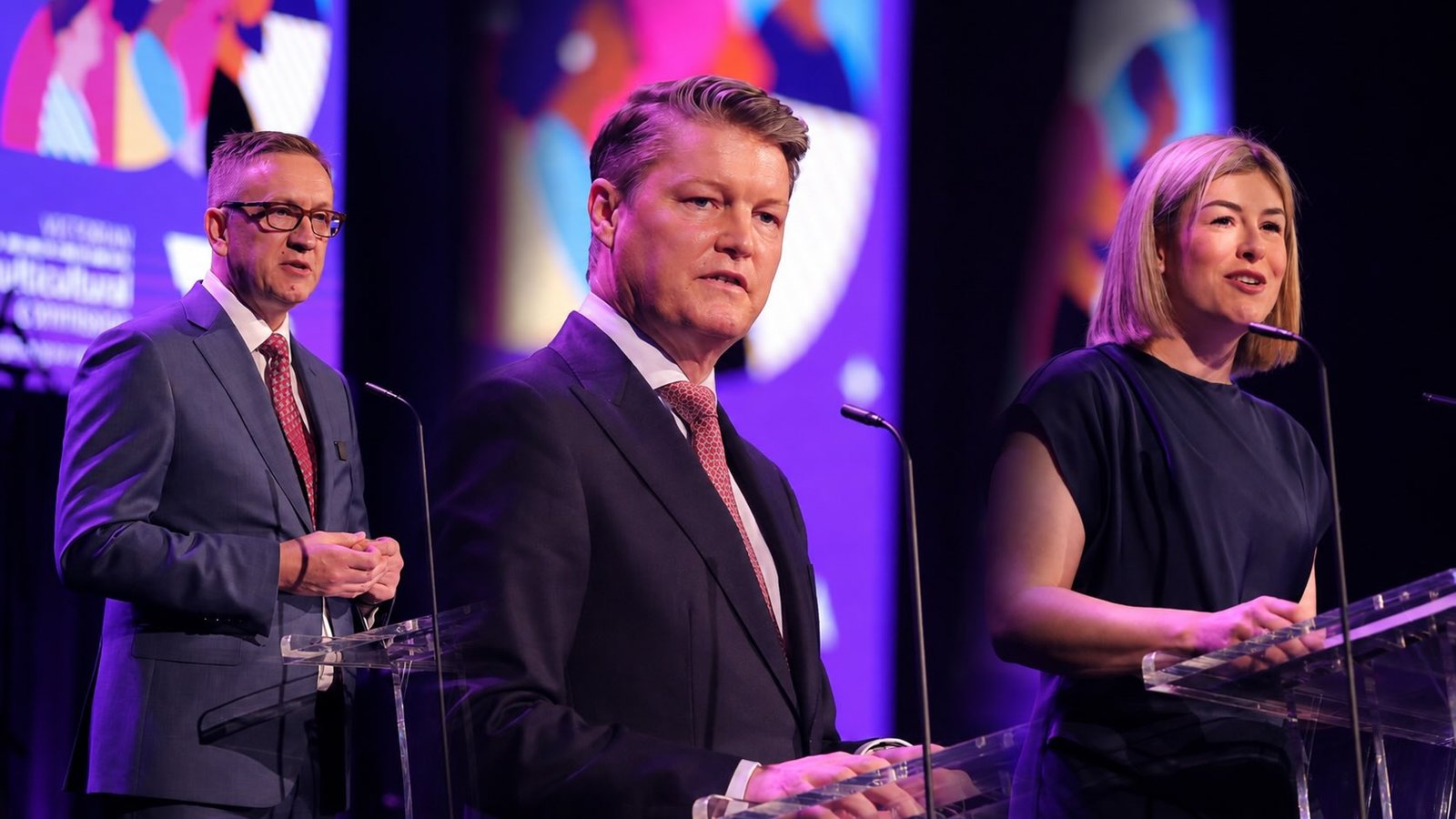
Premier Ben Carroll, federal Assistant Minister for Citizenship, Customs and Multicultural Affairs Julian Hill MP and Victorian Opposition Leader Jess Wilson each placed multiculturalism at the centre of their addresses at Saturday night’s gala, held under the theme “Stories of Us”.
Carroll also used the event to promote his government’s newly announced commitment to provide free dental care to Victorians and revealed that his first major multicultural affairs policy announcement as Premier would focus on languages.
“Free dental clinics will fix that problem for working people,” Carroll said, describing the dental commitment as “structural cost-of-living relief that will save Victorians real pain and also real money”.
But it was the question of what it means to be Victorian — and whether there ever was a monocultural Australia to which the country could return — that emerged as a central theme of the evening.
Carroll: ‘That is a lie’
Carroll directly rejected the idea of an earlier, culturally uniform Victoria.
“Some people would have you believe that there was a mythic time when Australia, and therefore Victoria, was monocultural. A time when everyone thought, spoke and looked the same. That is a lie.”
“Victoria, as a place and a people, has always been diverse,” he said, declaring that “Victoria’s secret sauce is our diversity”.
Carroll pointed to Victoria’s First Peoples and the diversity among those who fought at the Eureka Stockade before invoking his own family’s migration story.
“Everyone is multicultural in Victoria. Everyone has a multicultural backstory. Even me,” he said.
Carroll spoke of his mother arriving in Australia from the United States as a young girl, eventually becoming a permanent resident and citizen.
“It doesn’t matter what kind of Australian you are,” he said. “All that matters is that you love this place as much as my mum does.”
The Premier described multiculturalism as “a source of societal strength, cultural enrichment and economic growth”.
He also foreshadowed a significant policy announcement on community languages, drawing on his experience as a former education minister.
“I’m passionate about languages because I’ve seen the transformational power they have in schools,” Carroll said, adding that language was also critical to cultural connection.
“My first major policy commitment in the multicultural affairs portfolio will involve languages,” he said.
Hill: ‘We are not a monoculture. We never have been’
Hill’s address made the most explicit connection between contemporary attacks on multiculturalism, racism and what he called the false historical idea of a monocultural Australia.
“There is no single story of Australia or Victoria,” Hill said. “We are not a monoculture. We never have been.”
Reflecting on the gala’s “Stories of Us” theme, Hill said Australia’s national story was made up of millions of individual stories rather than a single cultural narrative.
“Diversity is core to who we are as a society and as a people. As Australians, we seek unity, not uniformity.”
Hill described the “elephant in the room” as an attack on multiculturalism by a “loud minority” and an accompanying “shameful, shocking spike in racism”.
He stressed that those attitudes did not represent the majority of Australians, but said they were nevertheless “deeply hurtful, and indeed scary, for many”.
Hill said such attacks rested on “a giant lie — the myth of the monoculture”.
“The question isn’t whether we’ll be diverse or whether we’re multicultural. Of course we are,” he said.
“The question is whether we’ll remain successful. Whether our diversity will remain a national asset, a source of strength, wealth and prosperity.”
Hill also issued a pointed warning to political leaders who embrace multicultural communities ceremonially but fail to defend them when they are targeted.
“It is not right to tell multicultural communities you value them on a Saturday night, and spend Monday flirting with political movements whose business model depends on making those same Australians feel that they don’t belong.”
He argued that diversity itself did not cause racism or violence.
“It is social distance, misinformation and polarisation that create a lack of empathy,” Hill said, urging leaders to build stronger relationships across cultural and religious communities.
Wilson: ‘They are Victoria’s story’
Wilson similarly presented multiculturalism not as an addition to an established Victorian identity but as part of the state’s foundations.
“Victoria’s history isn’t written in a single script,” she said.
“It’s written in dozens of languages, shared across kitchen tables, built through quiet sacrifice, and carried across oceans.”
“These stories are not a footnote. They are Victoria’s story. This state was built together, business by business, congregation by congregation, generation by generation.”
Wilson said multiculturalism went much deeper than “food and festivals”, pointing to her meetings with African, Iranian, Chinese, Vietnamese, Sikh, Hindu and Jewish communities during a tour of Victoria.
“You are not at the margins of this state’s history or story,” she told the audience. “You are the authors of it.”
“Loving this state is loving the multicultural fabric of our society.”
‘Stories of Us’
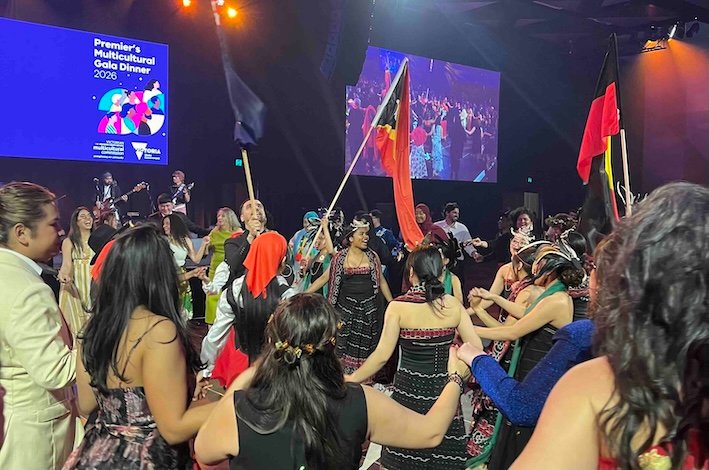
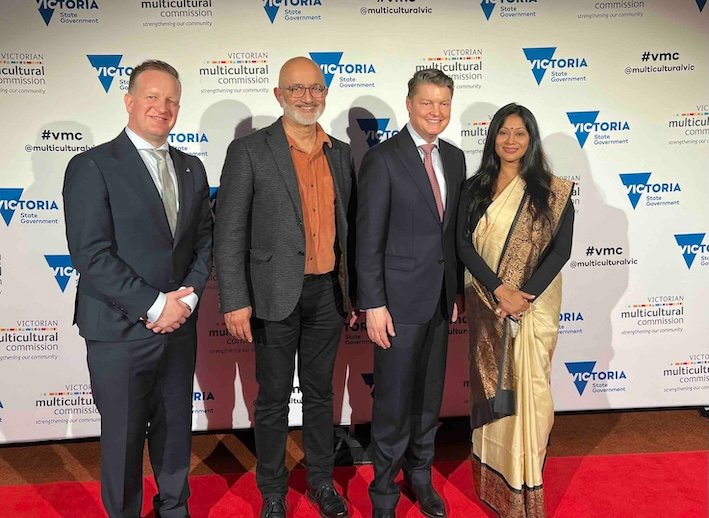
The sold-out gala brought together community leaders, politicians, diplomats and representatives of Victoria’s multicultural and multifaith communities.
Minister for Multicultural Affairs Paul Edbrooke MP; Wurundjeri Elder Aunty Annette Xiberras; Victorian Multicultural Commission Chair Louise Perry; and master of ceremonies Sista Zai Zanda also spoke during the event.
The Victorian Multicultural Commission said this year’s “Stories of Us” theme celebrated the individual journeys, ancestry and migration stories that collectively form Victoria’s shared identity.
For all the political differences on display ahead of November’s state election, the message from the major political leaders on Saturday night was unusually consistent: Victoria’s diversity is not a departure from its history but part of the history itself — and the monocultural past invoked in some contemporary political debates never existed.