
India in the World
- On the 11th of July, PM Modi returned to India after concluding his three-nation visit to Indonesia, Australia and New Zealand, during which he reaffirmed India’s commitment to strengthening Indonesia Comprehensive Strategic Partnership, expanded cooperation with Australia on clean energy, trade, investment and critical minerals, and India and New Zealand elevated their strategic partnership.
- On the 21st of July, India summoned a Russian diplomat regarding the killing of four Indian nationals on board of a vessel, off the coast of Ukraine. The commercial vessel came under attack as departing the port of Odesa in Ukraine, as four citizens were killed and one person remains in critical condition. India strongly condemned the strike, and further stated that targeting commercial vessels and endangering civilians was deplorable and should be avoided.
Civil society, human rights defenders, and journalists
- On the 4th of July, Delhi High Court has denied bail to Umar Khalid and Sharjeel Imam, after they had filed new bail applications, arguing that their continued detention without trial or formal charges violates their fundamental right to personal liberty. The two activists were arrested due to alleged links to the 2020 Delhi riots under the Unlawful Activities Prevention Act, and they have since spent nearly six years in custody without trial.
- On the 6th of July, a delegation of NDA leaders submitted a complaint alleging “mass irregularities” in the state of Karnataka on the Special Intensive Revision (SIR) exercise of the electoral rolls. The delegation demanded thorough inquiry and strict legal action amongst others, and alleged “undermining the very spirit of democracy”. Karnataka chief minister Shivakumar rejected the allegations and said the government wouldn’t interfere in the SIR exercise.
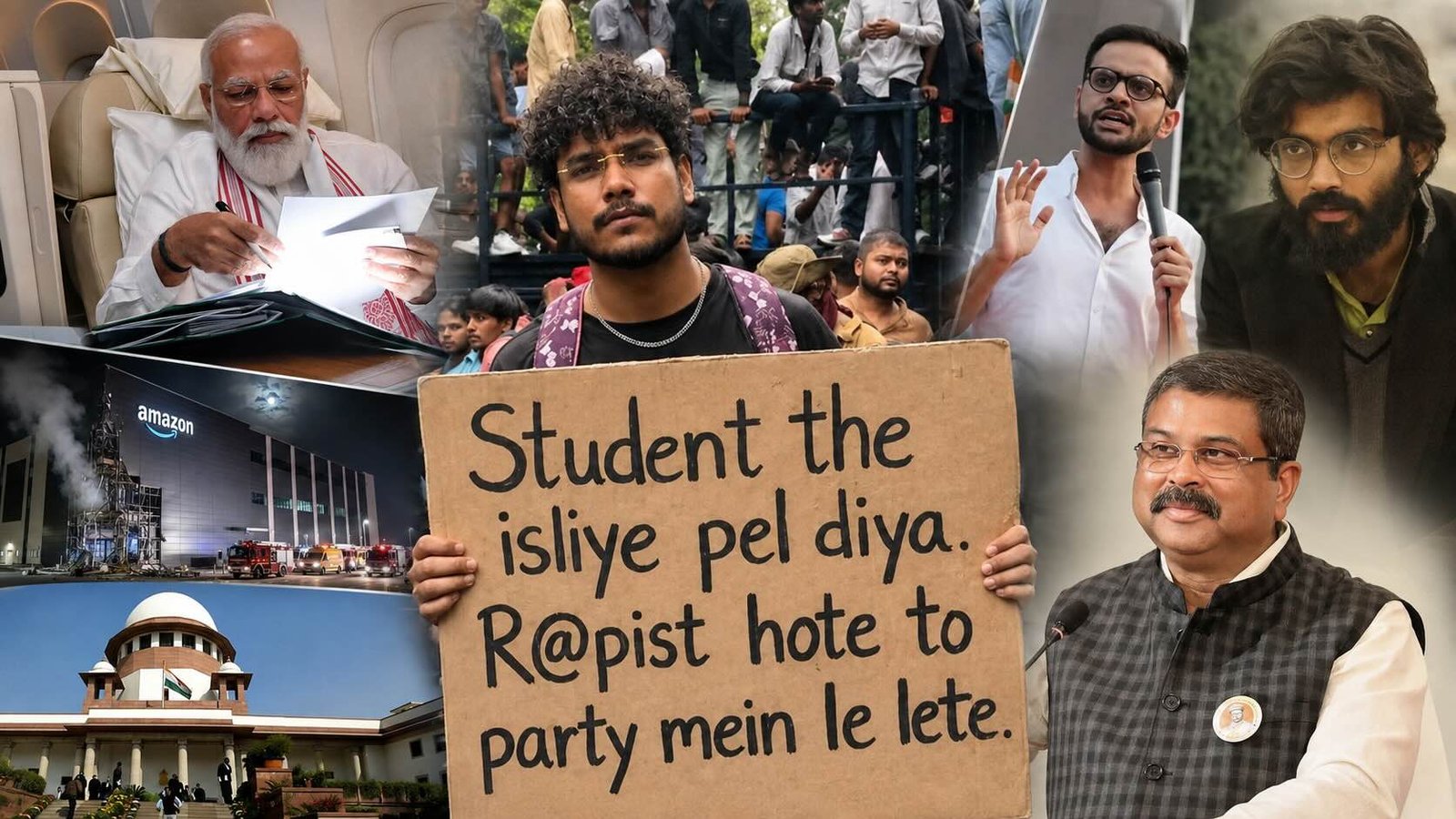
- On the 21st of July, a day after Delhi Police unleashed violence on protesters, thousands gathered to continue protesting despite the heavy rain. More than 70 students injured, with the number possibly being higher. The protest began as CJP accused the government of failing to ensure fair NEET examinations following allegations of paper leaks, demanding resignation of Pradhan Union Education Minster. Congress leader Gandhi points out the 154 paper leaks yet no convictions and called on Modi to apologize to the students.
- On the 25th of July, in Panaji, the police detained two youths for allegedly expressing support for Umar Khalid and Sharjeel Imam during celebrations over the resignation of Union Education Minster Pradhan. Police said a First Information Report (FIR) will be registered against both detainees and removed posters that supported Khalid
- On the 26th of July, Jantar Mantar celebrated after Pradhan’s resignation. The demands of the CJP were accepted by the government according to Union minister Nadda, but protesters say they still await change that can’t happen until Modi takes accountability.
Hate Crimes and Hate Speech against Minorities
- On the 12th of July, after convicting 14 men for lynching a man to death in a cow vigilantes’ case, an Muslim judge faces online death threats. The online campaign of abuse began after many protested the judgement, with one warning of “bloodshed” across the country if the convicted aren’t freed.
- On the 16th of July, a Dalit migrant worker was lynched to death after being labelled as “Bangladeshi”. His family and Kerala have urged the government to ensure fair investigation. The family claimed that the chargesheet filed by the police had deficiencies showing repeated lapses in the investigation and urged exemplary punishment for the accused. The police arrested five people, including four BJP workers in connection to his death.
- On the 21st of July, following a brutal gang rape and murder of an 11-year-old girl, Muslim neighbourhoods in West Bengal allege selective policing. Residents describe the events as a campaign of fear and arbitrary arrests targeting a specific community. Police conducted midnight raids, and detained dozens, with “blatant disregard of basic legal safeguards”.
- On the 28th of July, a 29-year-old Muslim man died following alleged custodial torture in Kerela. His family claimed that he was brutally assaulted by the police before being taken to custody, and suffered fractured ribs leading to severe lung infection. Police denied custodial assault allegations.
Religious Freedoms and Minority Rights
- On the 19th of July, Chhattisgarh Deputy Chief Minister Vijay Sharma announced that, following the completion of the necessary procedural formalities, the Chhattisgarh Freedom of Religion Bill 2026, will be implemented as law in the state. Sharma stated that the bill is intended to address what he described as the issue of forced religious conversions in Chhattisgarh, which he argued has contributed to social tensions and conflicts.
- On the 22nd of July, the Supreme Court agreed to gear the Kamal Maula Mosque case after Muslim petitioners missed two Friday prayers due to the Court barring Friday namaz. The complex is claimed both by Hindus as a temple dedicated to Goddess Saraswati and by Muslims as the Kamal Maula Mosque. Petitioners argued that the Madhya Pradesh High Court overlooked disputed factual issues and urged the Supreme Court to restore order.
- On the 27th of July, an Indian Muslim woman with voter ID, PAN and birth certificate was detained after the police branded has ‘Bangladeshi’. She was allegedly stopped by the police on her way to the market, taken by force and detained for nearly 90 hours.
Internet and Technology
- On the 2nd of July, the Internet Freedom Foundation criticised the Ministry of Electronics and Information Technology’s notice to WhatsApp over its proposed “usernames” feature, calling it an executive overreach and lacking clear basis in law. IFF called for the notice to be withdrawn and urged the Ministry to specify legal provision used to direct WhatsApp to halt the feature.
- On the 21st of July, the partial internet shutdown imposed by the government in Delhi has been confirmed by Telecom companies, even though no copy of the suspension order was placed in public domain. The Supreme Court directed that such order, imposed on the account of the Cockroach Janta Party’s ‘Chalo Sansad’, must be published and recorded in writing.
Political Parties
- On the 22nd of July, India’s opposition parties have shut down the parliament in solidarity with the protesters. Opposition politicians stood outside the parliament calling on Minister of Education Dharmendra Pradhan to quit. Proceedings were suspended inside the parliament, as politicians demanded the government to address police violence against protesters. Congress accused BJP of refusing to address the issues alleged police brutality on students. On the same day, opposition parties rallied behind students protesting, and called the government “insensitive” and “authoritarian” slamming police use of force against protesters. Leader of the Congress, Rahul Gandhi, Congress president Kharge, Karnataka Chief Minister Shivakumar, Congress leader and MP Priyanka Gandhi were among those who got detained by the police.
- On the 25th of July, the Cockroach Janta Party (CJP) said to follow up on five-point education reform charter after four weeks. Government representatives are to examine the proposals and discuss them with CJP. According to government representative, all demands were accepted, while CJP said agitation will be withdrawn in good faith, trusting in the agreed-upon. CJP’s demands include resignation of Pradhan, compensation to families of deceases students and scrapping cases against protestors. Later that day, Dharmendra Pradhan resigned following weeks of protests by the youth-led Cockroach Janta Party (CJP).
Police and authorities
- On the 22nd of July, Outlook magazine reported that one of its reporters was injured by “pellet-like projectiles” while covering CJP protests in Delhi. Injuries described by the journalist resembled wounds that were previously documented in the case of Shaikh Irshad Mansoori, a 25-year-old man who alleged that a member of the Rapid Action Force fired at him during a police crackdown on 20th of July.
- On the 22nd of July, hundreds marched to Lok Bhavan against “Modi government’s war on students” and Bihar Police cracked down on activists of the All India Students’ Association (AISA) protesting over the NEET paper leak. Demonstrators marched despite heavy deployment of security personnel and police using water cannons, tear gas and baton-charge on protesters. Despite police action, the march reached the vicinity of Lok Bhavan, and many sustained injuries from the police forces.
- On the 22nd of July, the police have beaten up students protesting. People were detained by the police, even before reaching the protest site. Police took names, phone numbers, addresses, and showed up at homes without warrants or summons. 1,400 people were taken into custody and hundreds detained.
- On the 23rd of July, the Delhi High Court sought to assess alleged police brutalities against protestors. The Supreme Court Bar Association condemned the attacks, urged conducting inquiries and act accordingly to the law while expressing solidarity to the people seeing human dignity, law and the constitution.
Judiciary
- On the 1st of July, a collective of Supreme Court advocates condemned the threatening of Madya Pradesh Judge, who came under communal attack after delivering a verdict convicting 7 men to life imprisonment in a cow vigilantes case. The abuse focuses on religious identity and accused the judge of ruling with religious bias.
- On the 2nd of July, the Gujarat High Court ruled the demolition drive in Surat of the 30th of May which left 100 families homeless, illegal. Allegedly, the demolition took place during the intended demarcation exercise and was entirely unauthorized. The Court ordered the Surat Municipal Corporation to rehabilitate 100 displaced families and directed the Gujarat government to file an affidavit on its stand on the incident.
- On the 2nd of July, a Bombay high court ruled that a citizen has right to protest, and the police are public servants not “servants of the chief minister or prime minister”. Slogans like “BJP government murdabad and “Amit Shah murdabad” is allowed to say by protestors according to the judgement.
- On the 24th of July, the Supreme Court proposed setting up dedicated courts to hear cases regarding the 2023 Manipur violence. The idea is to run trials on a continuous basis instead of a sporadic one. The bench noted difficulty in tracing and questioning witnesses, and other factors slowing the process, such as suspension of internet services, and proposed order trials taken up on a day-to-day basis considering the delays.
Business & economy
- On the 6th of July, protesting farmers in Gujarat called for a written government resolution and demanded four times the market value for their land, highlighting that installed power transmission lines and poles are leaving their land practically uncultivable. Protestors continued their fast even after budget and raised compensation for land loss was decided. The land loss occurred as the Adani Energy Solutions Ltd installed power lines and towers on agricultural land.
- On the 19th of July, Shiv Sena MP from Thane Naresh Mhaske wrote to the Thane Municipal Corporation, raising attention to the project against proposed Amazon data centre given environmental concerns. Hundreds of locals joined the protest in Maharashtra’s Thane district on the 18th of July. The area is densely populated, and MP Mhaske asked for review of the permits to granting the project.
Compiled by Diaspora in Action for Human Rights and Democracy.