

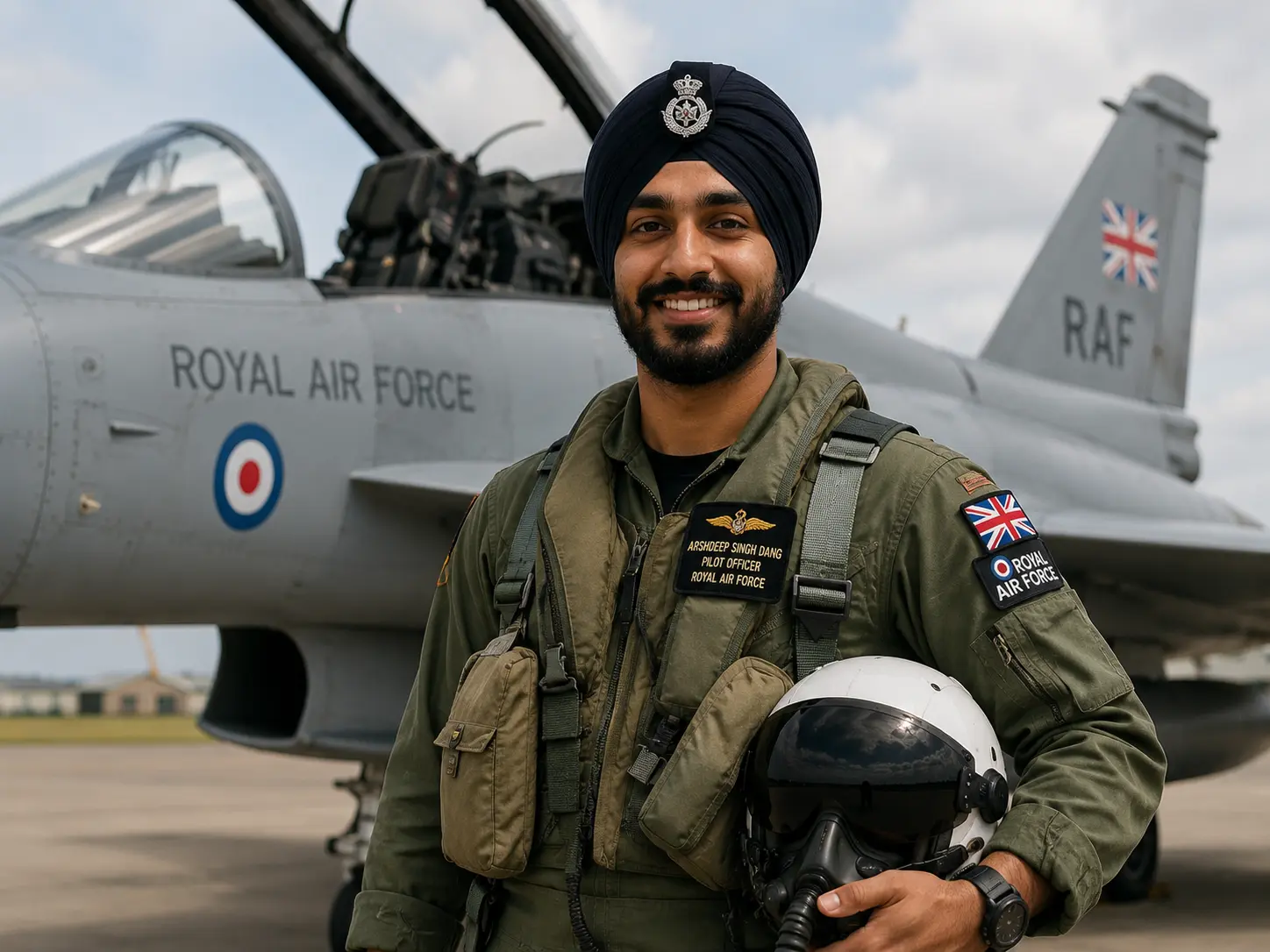
Sardar Santokh Singh Dang wanted his son to become a pilot. He died when his son, Jagdeep Singh Dang, was only six years old, and the family lacked the resources to pursue the dream. Decades later, at RAF Valley in North Wales, that unrealised ambition finally found its way into a cockpit, carried by Jagdeep’s own son instead.
Flight Lieutenant Arshdeep Singh Dang, 28, graduated as a fighter pilot in a ceremony at RAF Valley on Friday, 14 August 2026, becoming the first Sikh to earn fighter wings in Britain’s Royal Air Force since the Second World War. The Royal Air Force confirmed he was the first Sikh trainee to graduate on the Texan aircraft at its 4 Flying Training School under the UK Military Flying Training System.
“It was my paternal grandfather Sardar Santokh Singh Dang’s dream that my father should be a pilot,” Dang told The Indian Express, explaining the origin of an ambition his parents encouraged him to believe was still possible, a generation later, for their own son.
Arshdeep Singh Dang: From Chandigarh to the cockpit
Dang was born in Chandigarh in 1998 to a Punjabi Sikh family with roots in Ludhiana and Amritsar, his father, Jagdeep Singh Dang, from Ludhiana and his mother, Gagandeep Kaur, from Amritsar. He moved to the UK with his family when he was six years old, settling in Southall, west London, and attended a school in Mohali for roughly two years before the move, a period he has said he does not remember in much detail.
He studied Mathematics and Philosophy at the University of Bristol, graduating with a BSc (Hons), before entering RAF officer training in February 2022. His path into the cockpit followed a demanding, multi-year pipeline: elementary flying training in 2023, a posting to Cyprus, selection for the RAF’s fast-jet stream in 2024, fast-jet lead-in training beginning in March 2025, a move to basic fast-jet training in July that year, and a solo posting to Texas that October for advanced training. He passed his wings test in July 2026, ahead of the formal graduation ceremony the following month.
Dang’s training is not complete. He will now undergo a further year of intensive training before progressing to frontline fighter aircraft.
What is 4 Flying Training School and the UK Military Flying Training System?
What is the UK Military Flying Training System?
The UK Military Flying Training System is the structured pipeline through which the Royal Air Force, alongside the other UK armed services, trains pilots from initial selection through to operational readiness on frontline aircraft. It progresses candidates through elementary flying training, basic fast-jet training on aircraft such as the Texan, and advanced fast-jet training, before final assignment to a specific frontline aircraft type. 4 Flying Training School, based at RAF Valley in North Wales, is the RAF unit responsible for delivering the fast-jet phase of this pipeline, where trainee pilots earn their wings before moving on to operational conversion training on the specific fighter aircraft they will ultimately fly.
A historical gap the achievement closes
Dang’s graduation carries weight beyond his individual accomplishment. Sikhs served with distinction in the British Indian Army during both World Wars, earning multiple Victoria Crosses for extraordinary battlefield courage. Yet in the decades that followed, Sikh representation at the sharp end of British fast-jet aviation remained almost non-existent, a gap that persisted even as Sikh communities became firmly established across the UK.
Dang’s wings close that specific gap. He is not simply the most recent Sikh officer to serve in the RAF, a role Sikhs have held continuously, but specifically the first to reach fighter pilot status since the Second World War, restoring a form of representation that had quietly disappeared from Britain’s most demanding and selective military aviation role for roughly eight decades.
What carried him through training
Dang has spoken openly about drawing on his Sikh faith and upbringing during the most difficult stages of his training. He credited the Sikh principle of chardi kalan, a philosophy of relentless optimism and resilience regardless of circumstance, as a source of strength through the demanding, high-attrition pathway that fast-jet pilot training represents. He also credited his mother, Gagandeep Kaur, as a key source of support throughout the process.
The personal weight of his grandfather’s unfulfilled dream for his father appears to have shaped how Dang understood his own path from the beginning, transforming a family aspiration interrupted by circumstance into an achievement realised two generations later, in a different country, in a role his grandfather likely could never have imagined for a grandson.
Why this resonates across the diaspora
For Sikh and Indian-origin communities across the UK, Australia, Canada, the US and beyond, Dang’s story lands as more than a single officer’s career milestone. It is a story about a family’s multi-generational aspiration to survive displacement and reform across continents, and about a specific, historically significant gap in institutional representation finally closing after nearly eighty years.
His journey from a brief, barely remembered stint at a school in Mohali to earning RAF fighter wings in North Wales traces a distinctly diaspora arc: rooted in a specific place and a specific unresolved family story, carried forward through migration, and completed in an institution his grandfather would have had no direct connection to at all.
What readers following this story are asking
Was Arshdeep Singh Dang the first Sikh ever to serve in the Royal Air Force?
No. Sikhs have served in various roles within the RAF and its predecessor forces for decades, including as officers in non-fast-jet roles. Dang’s specific distinction is being the first Sikh to earn fighter pilot wings, the RAF’s most demanding and selective aviation qualification, since the end of the Second World War.
What happens next in Dang’s career?
Dang will undergo a further year of intensive training before progressing to frontline fighter aircraft. His specific eventual aircraft assignment has not been publicly confirmed as of the date of publication.
Where in the UK did Dang grow up after moving from India?
He moved to the UK at age six and grew up in Southall, west London, an area with one of the largest Sikh and Punjabi communities in Britain.
What did Dang study before joining the RAF?
He studied Mathematics and Philosophy at the University of Bristol, graduating with a BSc (Hons), before entering RAF officer training in February 2022.
Why does the “since World War II” distinction matter specifically?
Sikhs served with significant distinction in the British Indian Army during both World Wars, including multiple Victoria Cross recipients. Despite that historical record of frontline military service, Sikh representation in the RAF’s fast-jet fighter pilot ranks had effectively disappeared in the decades following the Second World War, making Dang’s graduation the closing of an approximately eight-decade gap rather than a first-ever milestone.






Comments 1