
Apurba Chatterjee, University of Reading
In 1825, English artist George Chinnery left Calcutta for Macau, chased away by his disgruntled wife Marianne and his creditors. He’d been based in India for the past 23 years, having previously lived in Hyderabad and Dacca.
Besides running a debt of around 30,000 rupees (£232 today), Chinnery was, according to one Dictionary of National Biography, a “penniless fornicator” and “begetter of an uncertain number of illegitimate Chinnerys white, brown and yellow”.
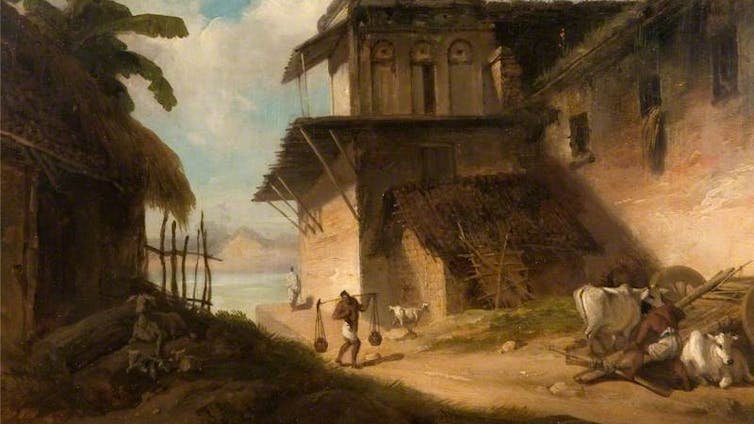
While he became famous as a portraitist, Indian landscapes also take pride of place in Chinnery’s legacy. His vision of an early morning in the Bengal countryside projects an image of peace and harmony far removed from the realities of colonial India under the British Empire.
From the 1760s, a number of British artists arrived in India. These men were motivated both by the economic prospects of catering to expatriate communities and portraying unique subject matter for those back home. In so doing, these artists presented India not as it was, but remade it into an exotic land ripe for colonial rule.
In their artistic representations, India was dangerous but also a place of opportunities. Travelling across provinces, artists’ visual documentation helped claim and appropriate Indian landscapes. As these spaces were endowed with new meanings, in turn, the question of imperial authority’s legitimacy became entangled with art.
Indian picturesque: a blot on the landscape
Besides just a few unkempt and passive human figures, the foregrounding of decayed buildings in Chinnery’s painting speaks directly to the picturesque aesthetic that rose to prominence in the late 18th century. This style focuses on asymmetrical compositions, dramatic chiaroscuro (light and shadow), rugged textures and landscapes with classical ruins and rustic life. In this, picturesque artists turned rural England into a national ideal.
The picturesque style occurred in a time when the process of enclosure was increasing. This involved taking commonly used land and dividing it into privately owned fields to the benefit of wealthy landowners, while limiting poorer people’s access to land. The picturesque helped justify social inequalities by presenting wealthy landowners and their estates as natural and idyllic parts of the landscape.
In a similar way, as wealthy imperial officers returned to Britain and invested their money in land, the picturesque also helped present Britain’s colonial power as taming and improving foreign lands.
In India, artists were using the picturesque to reshape colonial landscapes according to British ideas of progress and civilisation and to tell stories that celebrated colonial power.
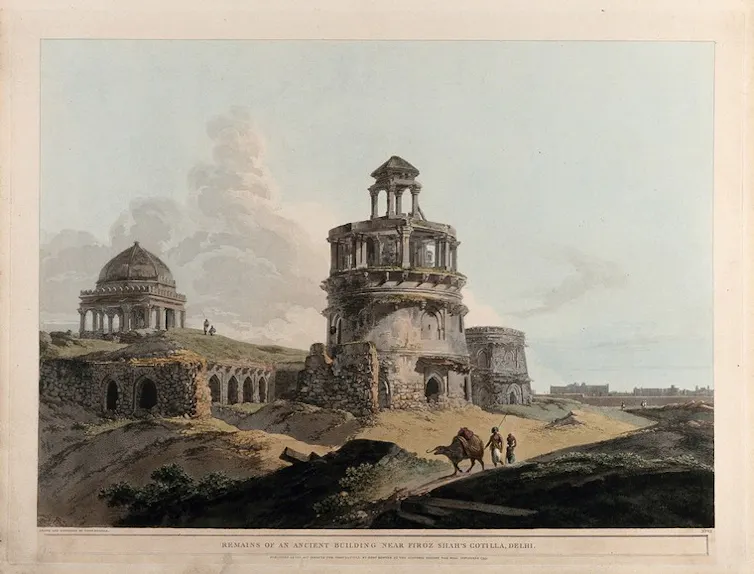
In their painting of India, the British fascination with ruins became a visual trope to signify Indians’ political decadence and loss of connection with their histories and heritage. Take Thomas Daniell’s 1795 depiction of an ancient building near Feroz Shah Kotla in Delhi (above). This image fed into wider commentary on the gradual decline of Delhi as the seat of the Mughal empire.
The building is reduced to a shadow of its former eminence, the limited life in its surroundings generating an impression of neglect that might be solved by British intervention. The new colonial masters were celebrated as harbingers of modernity. Through depictions like this, travelling artists, though attracted for mercenary reasons, became a mouthpiece for burgeoning imperial power.
How a monument became a cliché
Such picturesque visions enabled Britons to understand India on their terms and it was ultimately a process of objectification. Pre-colonial cultural and religious references came to be relegated to the background.
Take the Taj Mahal in Charles Ramus Forrest’s 1824 painting (below), which is divested of political metaphors central to how the Mughal Empire presented its identity and power.
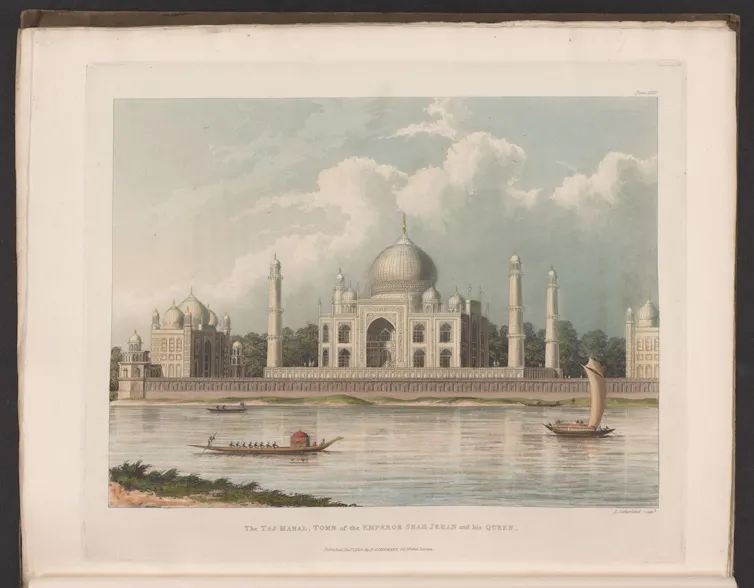
The garden complex of the Taj is based on a quadrilateral plan, in the Mughal Charbagh style, replicating the four gardens of paradise mentioned in the Quran, symbolising divine grace and approbation. The architecture drew on Timurid traditions (1370 to 1507), as Shah Jahan, the fifth Mughal emperor, was proud of his lineage and sought to actively revive the legacy of his ancestor, Timur (Tamerlane). The building is believed by certain scholars to be a replica of the throne of God on the Day of Judgement in Islam, which consists of Allah’s throne (the Arsh) and the gardens of Paradise.
Simplifying these architectural complexities, however, Forrest reduces the Taj to an ornamental delight to be enjoyed by a European audience during their boat rides along the river Yamuna, pictured in the foreground.
Memorialisation of conquest
While visual imagery of travel made it possible for the British to control the interpretation of India’s past and insert themselves, it also facilitated the creation of imperial mythologies.
Commemorating sites of war played an important role. During the Third Anglo-Mysore war (1790 to 1792), successes against the ruler of Mysore, Tipu Sultan, led the British to envision themselves as the incumbent power. Destruction cleared the path for occupation as territories were laid bare for takeover, as evident in Robert Home’s 1794 depiction of Tipu’s gardens in Bangalore (below).
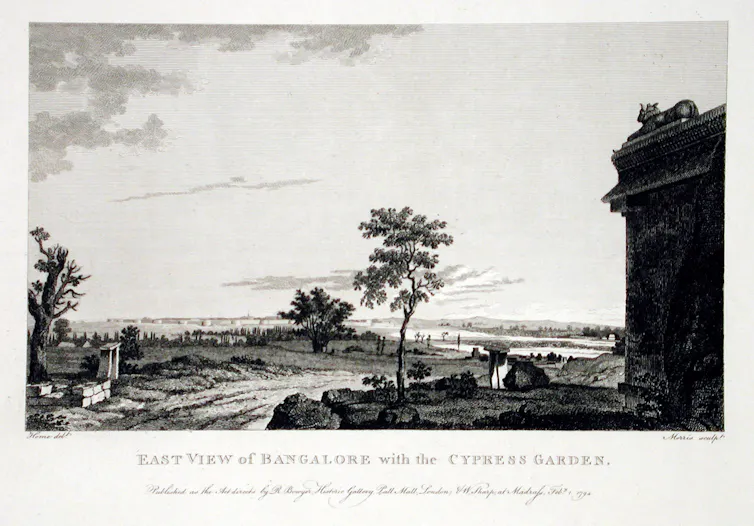
Devoid of its vegetation and former grandeur in wartime, the once beautifully ordered landscape is turned into a picturesque scene. This ruggedness is romanticised as the remnant of a bygone era, to be discarded in favour of a new beginning.
Mysore soon evolved into a site of British personal and collective memories, embedding sacrifices for imperial cause as a matter of national pride. Previously, more tragic sites had served this memorial purpose. For instance, The Black Hole of Calcutta, a small, cramped dungeon at Fort William, where supposedly more than a hundred imprisoned Britons suffocated in 1756.
It is telling that, by the 19th century, British tourism was built around and reinforced the idea that Britain’s empire and territorial conquests were things to be proud of.
Tourists often fail to appreciate the experience of ordinary Indian people, which has influenced how destinations are marketed. These 18th-century western artists wandering across South Asia, their fortunes and, above all, their art, can tell us how this perspective surfaced.
As a place bereft of its own political identity by conquest, India was ripe for romantic projections of western might. In our age of travel, we must question these ways of seeing.
Apurba Chatterjee, Visiting Research Fellow Department of History, University of Reading
This article is republished from The Conversation under a Creative Commons license. Read the original article.