
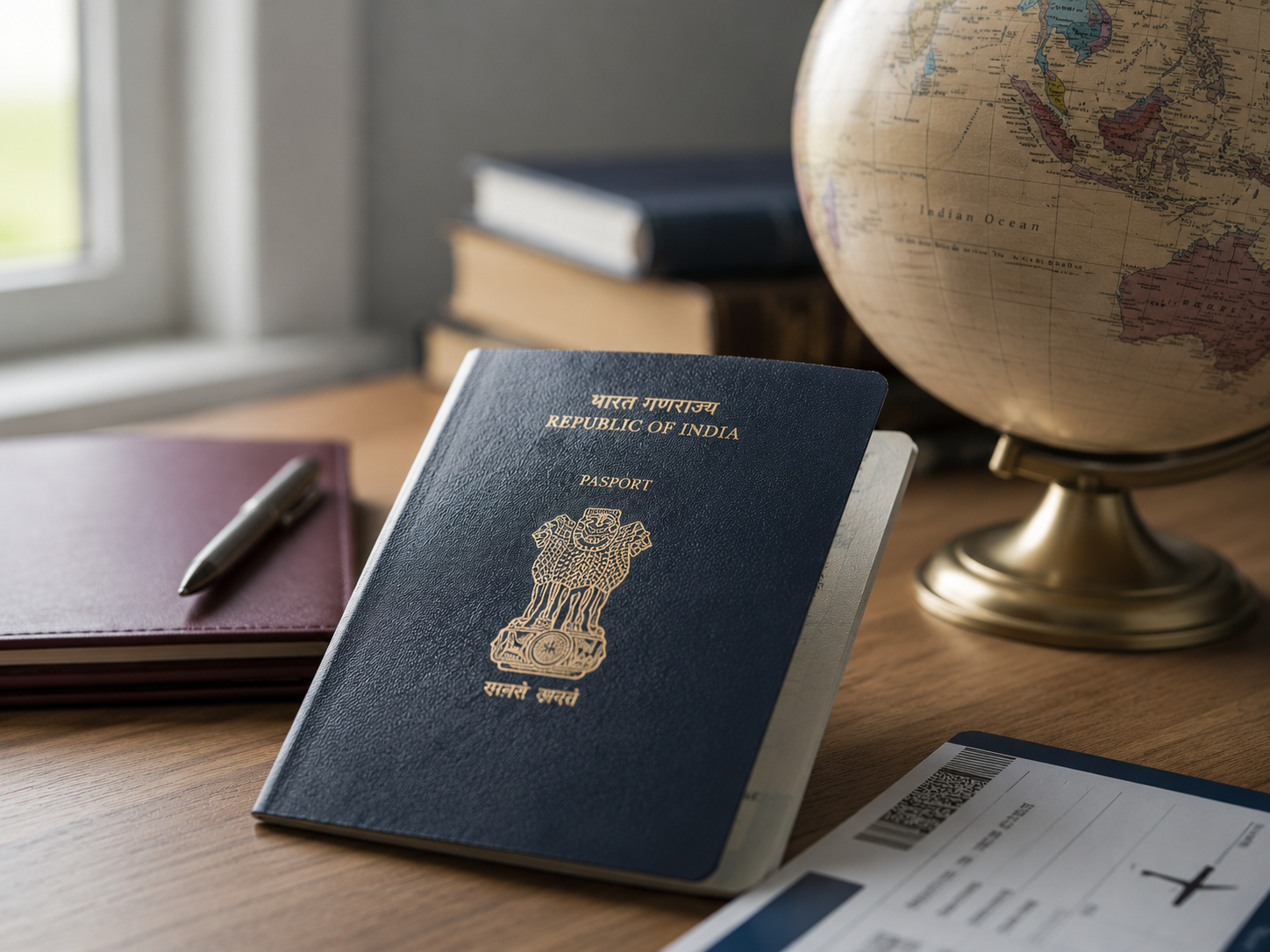
Three separate global indices placed India’s passport in three different positions this year: 80th, 125th and a tied 126th. All three figures are accurate. They measure different things, and the gap between them explains why conflicting headlines about India’s passport strength have circulated within days of each other this week.
The figure making headlines, 125th out of 197 countries, comes from the Global Passport Index (GPI), published on 5 July 2026 by residency and citizenship advisory firm Global Citizen Solutions (GCS), now in its fifth edition. It marks a slip of one place from 124th in 2025, though India’s overall composite score of 45.1 is its highest in five years, up from 127th in 2021.
Unlike the more widely cited Henley Passport Index, the GPI does not rank passports on visa-free travel alone. It scores each one across three weighted categories: Enhanced Mobility (50% of the total), Investment Potential (25%) and Quality of Living (25%). India’s weakest score was on mobility, where it placed 136th. It fared better elsewhere, climbing 11 places to 118th on Quality of Living and rising to 94th from 97th on the Investment Index.
According to the GCS report, Indian passport holders currently have visa-free or simplified entry to 26 destinations, among them Bhutan, Nepal, Jamaica, Macau, Palestine, Tunisia, Angola and Barbados. Advance visas are still required for the United States, the United Kingdom, Germany, France, China and the United Arab Emirates, a detail with direct consequences for NRI families arranging visits between those host countries and India.
What is the Global Passport Index?
The GPI was built by Global Citizen Solutions to measure a passport’s overall value rather than travel access alone, weighing how useful the document is for relocation, business and long-term living standards. Sweden topped the 2026 edition with 96.05 points out of 100, followed by Switzerland and Finland. Nine of the top ten passports belong to European countries, with Singapore the only exception.
Why the numbers diverge and what it means for India’s passport
The Henley Passport Index, published by Henley & Partners using International Air Transport Association data, placed India 80th in its July 2026 update, with visa-free, visa-on-arrival or electronic travel authorisation access to 56 destinations. Arton Capital’s Passport Power Rank, built on its own mobility-score methodology, placed India in a tied 126th position, crediting it with a mobility score of 72, made up of 30 visa-free and 42 visa-on-arrival destinations.
| Index | Publisher | India’s 2026 rank | Accessible destinations |
|---|---|---|---|
| Global Passport Index | Global Citizen Solutions | 125th of 197 | 26 |
| Henley Passport Index | Henley & Partners | 80th | 56 |
| Passport Power Rank | Arton Capital | 126th (tied) | 72 mobility score (30 visa-free + 42 visa-on-arrival) |
None of the three numbers is wrong. Henley and Arton Capital both measure travel access but apply different definitions of “visa-free” and count destinations differently. The GPI folds mobility together with investment and living-standard measures, which pulls India’s overall placement down even though its underlying travel access has held broadly steady year on year.
What this means for NRIs
For the diaspora in Australia, the UK, the US, Canada, New Zealand and the UAE, little changes in practical terms regardless of which index gets quoted. Family visits into and out of those six countries still require a visa on an Indian passport in almost every case, a position set by bilateral agreements rather than by any single ranking. What has moved, per the GPI report, is India’s underlying score on quality of living and investment attractiveness, both trending upward over five years even as the mobility component lags.
Where all three indices agree is on the size of the gap still to close, and on the pace of change. Henley’s own data shows India’s rank recovering to roughly its 2024 level after a dip in 2025, driven by incremental bilateral negotiations with individual governments rather than a single policy shift. The GPI report frames India’s trajectory the same way: gradual, uneven across its three categories, and unlikely to move sharply in any one edition.
For NRIs weighing a second passport, OCI renewal or long-term residency options as a way to close the travel gap, related coverage sits in NRI Affairs’ visa and business sections. The next data point to watch is Henley’s October 2026 quarterly update, which will show whether India’s recovery from its 2025 dip continues.