
For years, Indian professionals in Britain paid social security contributions in two countries at once. From 15 July, that changes.
The UK-India Comprehensive Economic and Trade Agreement, known as CETA, comes into force next month, bringing with it a Double Contributions Convention that directly affects tens of thousands of Indian workers on temporary assignments in the UK. Under the new arrangement, Indian employees and their employers will no longer have to make dual social security contributions during postings of up to five years, an increase from the previous three-year exemption under older bilateral arrangements. The UK government estimates that more than 75,000 Indian professionals and over 900 Indian companies stand to benefit.
That is just one provision in what is, by any measure, one of the most significant trade deals India has ever concluded.
What the UK-India CETA Actually Does
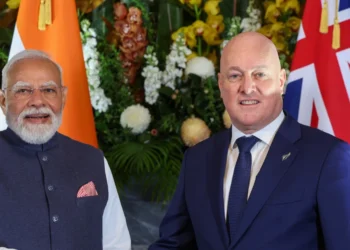
The deal was signed on 24 July 2025 in London, in the presence of Prime Minister Narendra Modi and his UK counterpart Keir Starmer. It took three years and fourteen rounds of negotiations. The entry-into-force date of 15 July 2026 was confirmed by both leaders on the sidelines of the G7 Summit in Évian on 17 June, with Foreign Secretary Vikram Misri describing it as one of the key outcomes of the summit.
The headline numbers, drawn directly from the UK Department for Business and Trade, are as follows. The agreement liberalises 99% of UK tariffs and 90% of Indian tariffs. Bilateral trade, already worth £48 billion in 2025, is forecast to grow by £25.5 billion a year in the long run. UK GDP is expected to rise by £4.8 billion annually; India’s by £5.1 billion.
For the Indian community in the UK, the most tangible gains fall into three areas: professional mobility, financial services, and everyday goods.
What Changes for Indian Professionals in Britain
The business mobility commitments in CETA are designed to make it easier for skilled professionals to move between the two countries. IT specialists, financial services professionals, yoga instructors, and a range of other categories are covered. The Annex on Professional Services also establishes a formal process for negotiating mutual recognition arrangements across professions, including accounting, auditing, and architecture, which could eventually allow qualifications earned in India to be recognised in the UK and vice versa.
The Double Contributions Convention is the most immediately practical change. Indian employees sent to the UK by Indian companies will be exempt from paying into both the UK’s National Insurance system and India’s social security system simultaneously, for postings lasting up to five years. The same applies in reverse for British nationals posted to India.
For Indian-owned businesses operating in the UK, the deal also grants equal treatment to UK firms operating in India, providing legal certainty on market access that did not previously exist.
Tariffs, Goods, and What Gets Cheaper
From 15 July, Indian exporters get duty-free access to the UK for 99% of their goods, effective immediately. That covers textiles, garments, leather goods, gems and jewellery, and pharmaceutical products, all sectors where Indian exporters have long faced barriers in the UK market.
For UK goods entering India, 64% of product lines become duty-free immediately, covering approximately £1.9 billion of current UK exports. The remaining cuts are phased over five to ten years, reaching 85% duty-free over time.
Some specific changes worth noting for the Indian community in Britain:
Indian-made clothing, shoes, and food products will become more competitively priced in UK supermarkets and retail. The tariff reductions on Indian textiles and apparel are immediate.
Scotch whisky, a symbolic sticking point in years of prior negotiations, finally gets a clear path into India. Tariffs fall from 150% to 75% on 15 July, then reduce gradually to 40% over ten years. British cars get tariff-rate quota access into India, with tariffs falling from over 100% to between 30% and 50% depending on the vehicle type.

The Social Security Agreement: Key Details
The Double Contributions Convention enters into force on the same date as CETA, 15 July 2026. Professionals covered are those on pre-existing visa routes, meaning the arrangement applies to workers arriving through the Skilled Worker visa and similar routes, not new categories created by CETA itself.
The exemption covers the full five-year period without requiring employees to reapply annually. UK nationals posted to India receive the same treatment, continuing to build entitlement to a UK State Pension during their time abroad without paying into India’s social security system.
The Indian government has confirmed that customs notifications and related processes are being put in place so that businesses on both sides can begin accessing the benefits from day one of implementation.
What It Does Not Cover
CETA does not change immigration rules or visa entitlements for Indian nationals. It does not create new visa categories or expand the number of Skilled Worker visas available. The mobility provisions apply to intra-company transfers and specific professional categories, not to general migration.
The deal also does not affect British Indians or Indian nationals who are already permanent residents or British citizens. The social security provisions apply to workers on temporary assignments, not to settled residents.
Background: How the Deal Got Here
Negotiations between India and the United Kingdom began in January 2022, shortly after Brexit created the space for the UK to pursue its own independent trade agreements. Talks stalled multiple times over sensitive areas, including Indian tariffs on Scotch whisky and UK concerns about student and professional visa access. The deal was finally concluded in May 2025 and signed formally at a ceremony in London on 24 July 2025.
Following the signing, Prime Minister Starmer led the largest-ever UK government trade mission to India in October 2025, bringing 125 CEOs, university vice-chancellors, and cultural leaders to Mumbai for two days of commercial engagement. The October mission produced a range of new trade and investment agreements between British and Indian organisations.
The entry-into-force announcement on 17 June at the G7 was the final milestone. Both governments have described it as the most economically significant bilateral free trade deal the UK has concluded since leaving the European Union, and one of the most comprehensive trade agreements India has ever signed.
For Indians in Britain, the immediate questions are practical: what professional exemptions apply to them, when their employers need to act, and how the customs registration process works. UK businesses exporting to India must register with HMRC through the Origin Registration portal to access preferential tariff rates from 15 July. Indian companies sending professionals to the UK should review whether their employees qualify for the social security exemption before that date.
The deal goes live in less than four weeks.