

Reetika Revathy Subramanian, University of East Anglia
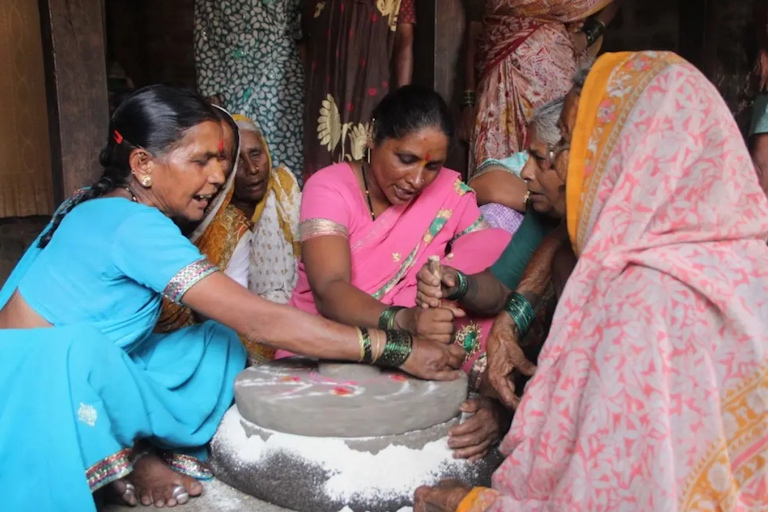
Anusuyabai Pandekar and her daughter-in-law Mandabai sit facing each other beside a stone grindmill. The mill is still. No grain rests between its stones. No flour gathers at the edges. Instead it sits between them like an object from another time.
One of the women begins to sing. The other joins. The melody carries the rhythm of a labour no longer being done, cyclical and without clear beginning or end:
It is raining heavily, let the soil become wet.
Women go to the fields, carrying baskets of bhakri (bread).
The pre-monsoon rain is beating down on the fields.
Under the jasmine tree, the ploughman is working with the drill-plough.
Scenes like the one this song describes, once common across rural western India, now belong increasingly to the archive. Hand-grinding has given way to electric mills. The work that once informed these songs has thinned out, leaving behind recordings, fragments and memory.
Accounts of drought and environmental change rarely include such voices. In official records and news reports, what is measured often overshadows what is lived. Climate change is typically explained through numbers, including emissions targets, temperature thresholds and rainfall variability. This data is necessary. But it cannot capture how change is inhabited: how it settles into bodies, reshapes routines and presses into everyday life.
Long before climate science named the crisis, women were registering these shifts in another language – song.
Climate, labour and everyday life
Across the world, women’s work songs function as informal archives of environmental change. Emerging from repetitive labour – including grinding, pounding, planting and carrying – they register shifts in seasons, resources and survival long before these enter formal records.
I began to understand this during my doctoral work in 2020 and 2021. I was researching labour arrangements within the sugar industry in drought-affected regions of western India. Policy reports described rainfall deficits, groundwater depletion and crop loss. But women spoke instead of work – walking further for water, delaying planting and stretching food across uncertain seasons.
Their voices extended beyond conversation into an unexpected archive – The Grindmill Songs Project. First documented in the 1990s and now hosted by the People’s Archive of Rural India, the project brings together around 100,000 songs organised by people, places and themes. I used this archive alongside ethnographic interviews to trace labour, marriage and drought in the sugarcane industry, where women’s voices were largely absent from official records.
Here, labour and environmental strain were articulated with a precision often absent from formal accounts. Climate was not abstract; it was embedded in the rhythms of work.
The climate crisis has a communications problem. How do we tell stories that move people – not just to fear the future, but to imagine and build a better one? This article is part of Climate Storytelling, a series exploring how arts and science can join forces to spark understanding, hope and action.
The water-guzzling sugarcane crop, around which the region’s economy turns, surfaced repeatedly in both speech and song. It appeared as a metaphor for happiness, for domestic violence, even for dowry; a substance moving between fields and households, binding labour, desire and coercion. Environmental stress did not stand apart from these concerns, but moved through them. As one song goes:
A daughter’s existence is like a sack of sugar
Father got his daughter married, he became a merchant
Another describes married life through the language of extraction:
Father says, daughter, how are you treated by your in-laws
Like a 12-year-old sugarcane crushed in the sugar-mill
A broader pattern emerges from this context. Across regions, environmental change is first encountered through its effects on labour, and only later abstracted into data. Comparable dynamics appear elsewhere. In west African farming communities, songs synchronise collective labour while expressing shared experience of seasonal uncertainty. In Malawi, during famine, women sang:
Koke kolole … pull, pull hard, pull the clouds –
why does the rain not come?
Our dead fathers, what have we done?
Forgive us … do you want us to die?
Send us rain.
Here, ecological crisis is framed as a breakdown within a moral and social order. Such songs interpret environmental failure through relationships between the living and the dead and between obligation and neglect.
On the Swahili coast, fishing songs similarly accompany sailing and net-making, embedding weather knowledge, labour discipline and social commentary within everyday maritime life. These songs accompany work, but they also organise it, giving rhythm to collective effort while encoding knowledge about seasons, risk and survival.
This relationship between labour and environment extends across very different histories. In the Caribbean, work songs bear the imprint of plantation economies shaped by extraction and environmental vulnerability. In Latin America, women’s traditions carry histories of colonial labour within their rhythms.
In Colombia’s San Basilio de Palenque, women still sing as they coax peanuts from rain-softened soil, gathering food, language and memory in the same gesture. Elsewhere, songs track movement itself: young men leaving with the dry-season wind, rivers in flood separating families.
Along cold North Sea coasts, herring workers, known as the “gutters”, sang Gaelic work songs in the 19th century while gutting fish at speed, their rhythms coordinating labour under harsh conditions. Beyond work, women also composed laments that dwelt on separation from men at sea.
Listening to climate differently
These songs describe hardship. But they also make it perceptible, situating environmental stress within labour, social relations and obligation. Climate change follows existing inequalities. In many contexts, its earliest effects are absorbed through women’s work, through longer hours, shifting responsibilities and increased strain.
Importantly, these songs were not intentionally composed as records of environmental change. They emerge from labour, relationships and survival. Yet because women’s work is so closely tied to land, water and season, environmental shifts are registered within them, often indirectly, as part of their lived experience.
Work songs therefore offer a distinct kind of record. Against archives that have historically privileged elite and male voices, they preserve forms of knowledge grounded in everyday labour.
But the conditions that sustained such singing are fading. Mechanisation and the decline of collective work have reduced the spaces in which these songs were produced and shared, with many now confined to ritual settings such as weddings and childbirth gatherings. As these practices decline, so too do the forms of knowledge embedded within them.
Listening to these songs does not replace data-driven, scientific knowledge about climate change. It complements it by making visible dimensions of change that are otherwise difficult to capture, including the reorganisation of labour, the strain on relationships and the uncertainty of survival.
Reetika Revathy Subramanian, Senior Research Associate, Global Development, University of East Anglia
This article is republished from The Conversation under a Creative Commons license. Read the original article.