


India has narrowly overtaken England to become Australia’s largest overseas country of birth for the first time, according to new data released by the Australian Bureau of Statistics (ABS), signalling a significant shift in the nation’s migration patterns.
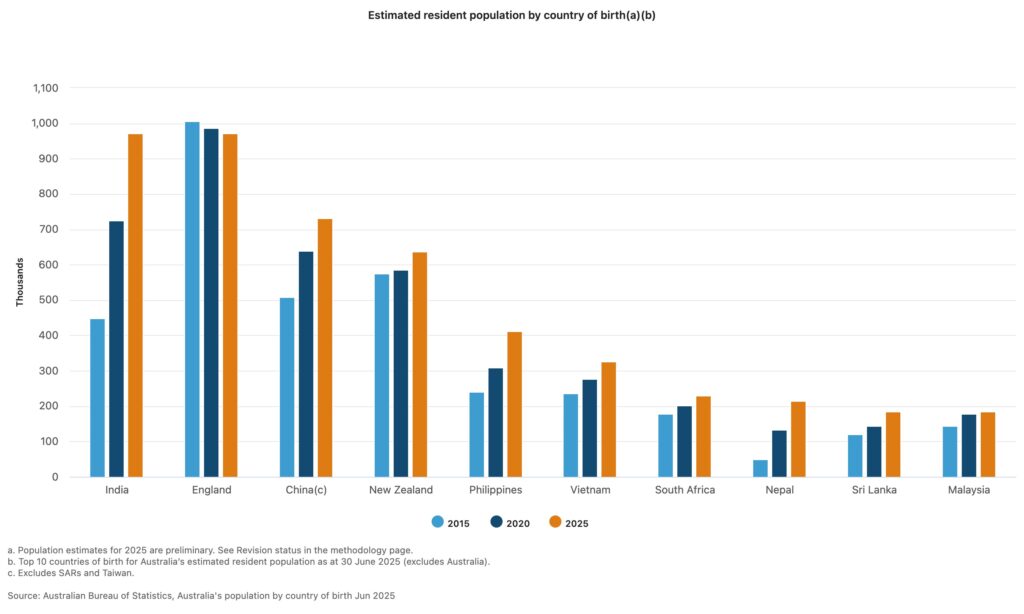
The ABS’s latest update on Australia’s population by country of birth shows that, as at June 2025, both Indian-born and England-born populations stood at roughly 971,000 people, with India just edging ahead.
This marks a historic milestone in Australia’s demographic evolution, with England having held the top position for decades.
A turning point in Australia’s migration story
The ABS said the change reflects long-term migration trends rather than a sudden shift. People born in India recorded the largest growth of any overseas-born group over the past decade, increasing by more than half a million since 2015.
By contrast, the population born in England has plateaued and gradually declined from earlier peaks, reflecting ageing migrant cohorts and reduced inflows compared to post-war migration patterns.
In 2024, England had still been the largest overseas-born group, followed by India, China, and New Zealand, underscoring how recent the crossover has been.
Overseas-born population reaches new highs
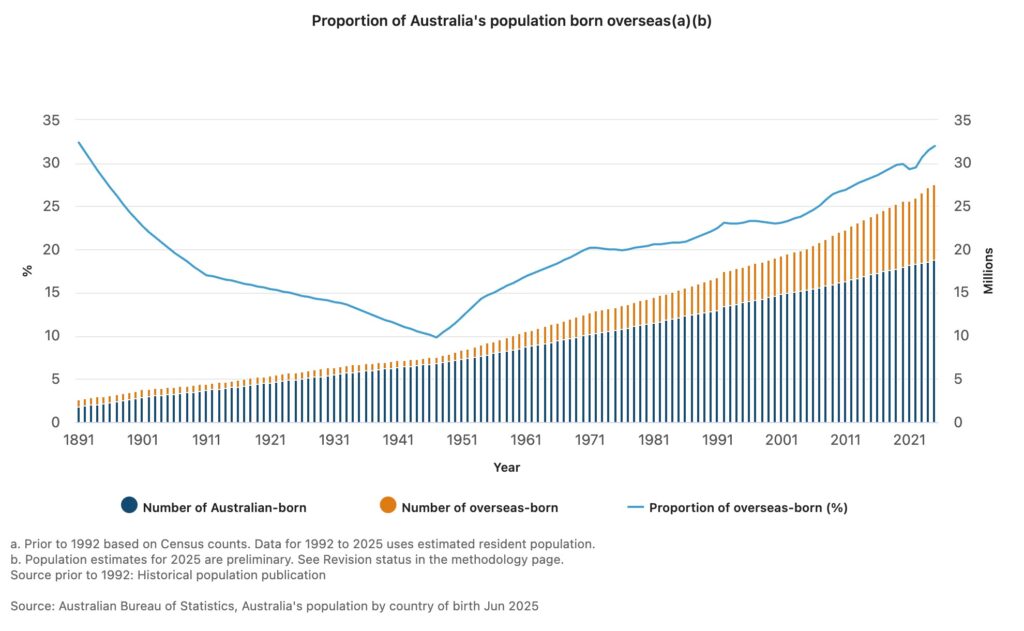
The broader data highlights the growing role of migration in shaping Australia’s population. In 2025, there were 8.8 million people born overseas, accounting for 32% of the total population of 27.6 million.
This proportion is approaching Australia’s historical peak of 32.4% recorded in 1891, according to the ABS.
The top five countries of birth for overseas-born residents in 2025 were India, England, China, New Zealand and the Philippines.
Long-term trends reshaping the migrant mix
The rise of India reflects broader structural changes in migration flows, particularly the growth in skilled migration, international education pathways and temporary-to-permanent visa transitions over the past decade.
ABS data shows the Indian-born population has more than doubled since 2015, reaching just over 971,000 in 2025.
At the same time, older migrant groups from Europe—especially the United Kingdom and Italy—are ageing, with median ages of 60 or over, contributing to slower growth or decline in those populations.
A more diverse and younger migrant population
The demographic shift is also reflected in age profiles. The median age of Australia’s overseas-born population is now 43, compared with 35 for Australian-born residents, indicating a relatively younger migrant intake in recent years.
Earlier ABS releases have highlighted that migration growth since the pandemic has been driven strongly by arrivals from Asia, particularly India, China, Nepal and the Philippines.
What it means for Australia
The milestone underscores Australia’s transition from a migration profile historically dominated by European countries to one increasingly shaped by Asia.
With India now the largest overseas country of birth, analysts say the shift reflects not just changing migration flows but also Australia’s evolving economic, educational and geopolitical ties with the region.
As migration continues to drive population growth, the ABS data suggests Australia’s cultural and demographic landscape will become even more diverse in the years ahead.